
TFSA withholding tax: US dividends in a TFSA vs RRSP
Foreign withholding tax is the small leak that many Canadian investors do not see until they compare account statements. You buy a US dividend stock, the company pays a dividend, and a slice is withheld before the cash reaches you. The stock did nothing wrong. The account did nothing wrong. The tax was collected at the source.
The key is that the same dividend can land differently in a TFSA, RRSP, FHSA, or taxable account. That does not mean one account is automatically better. It means the account changes what you can recover and what you need to verify.
What's in this guide
| Section | What it covers |
|---|---|
| What it is | Why tax can be withheld before a dividend reaches you |
| Account map | TFSA, RRSP, FHSA, and taxable account differences |
| ETF wrappers | Why VFV and VOO can produce different tax lessons |
| Foreign tax credit | When a taxable account may recover part of the drag |
| Sources | Official starting points |
What foreign withholding tax is
Withholding tax is collected by the country where the income arises. For Canadian investors, the common example is a US dividend. The default US withholding rate can be 30%, but a Canadian resident who has the right tax documentation on file, usually handled through Form W-8BEN, is commonly reduced to 15% under the Canada-US treaty.
That 15% is not charged by your broker as a fee. It is tax withheld before or as the payment is processed. On a $1,000 US dividend, a 15% withholding rate leaves $850 before any Canadian tax reporting.
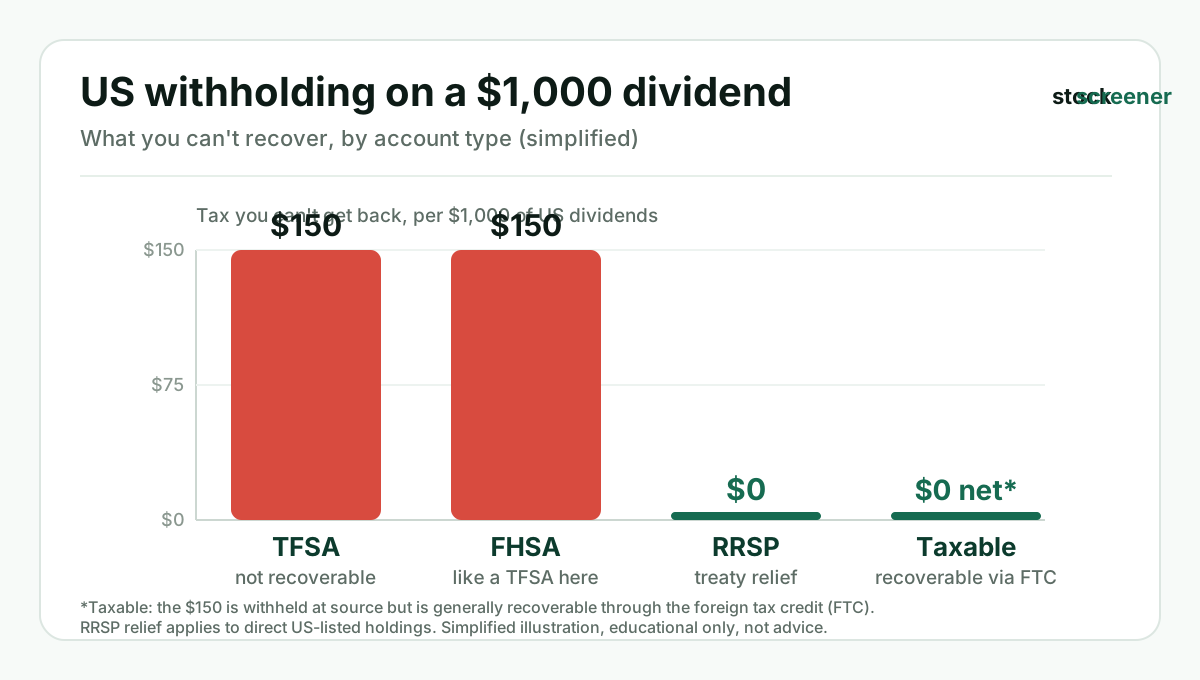
TFSA withholding tax compared with RRSP and taxable accounts
| Account | Common US dividend result | Practical lesson |
|---|---|---|
| TFSA | US withholding generally applies and is usually not recoverable inside the TFSA. | Great shelter for Canadian tax, but not a magic shield against foreign withholding. |
| RRSP | Direct US-listed stocks and US-listed ETFs may receive treaty relief from US withholding. | The cleanest account for many US dividend payers, but the wrapper and broker still matter. |
| FHSA | Foreign dividends paid to an FHSA can be subject to foreign withholding tax. | Treat it closer to a TFSA for this issue, not as a full RRSP substitute. |
| Taxable account | Withholding may apply, but a foreign tax credit may be available if the income is reported. | The drag may be partly recoverable, but you get more tax reporting and ACB work. |
The RRSP result is the one that gets repeated online, sometimes too casually. The Canada-US treaty includes special treatment for certain pension and retirement arrangements. In practice, Canadian brokers often apply that relief to direct US-listed securities in RRSPs and RRIFs. It does not mean every US exposure inside every registered account is exempt.
The TFSA is different. It is Canadian tax-sheltered, but it is not generally treated the same way as a pension or retirement plan for US dividend withholding. That is why a US dividend stock can still show a 15% drag in a TFSA even though the TFSA withdrawal is tax-free in Canada.
The ETF wrapper is often the whole story
Fund structure can matter more than the ticker. A US-listed ETF such as VOO is a US wrapper holding US stocks. A Canadian-listed ETF such as VFV gives similar S&P 500 exposure in Canadian dollars, but it is still a Canadian wrapper. If withholding happens inside the fund before distributions reach your RRSP or TFSA, you may not be able to recover it personally.
This is why the site treats ETFs carefully. A Canadian-listed ETF may be simpler to buy and hold, which is valuable. A US-listed ETF may be cleaner for US withholding inside an RRSP, but it adds currency conversion, USD settlement, and operational friction. The right educational signal depends on the wrapper, not just the index.
Where the foreign tax credit fits
In a taxable account, foreign withholding is not automatically gone forever. CRA says you may be able to claim a federal foreign tax credit if you paid foreign income or profit taxes on income earned outside Canada and reported that income on your Canadian return. The amount depends on the type and source of income, the eligible foreign tax paid, and Canadian tax otherwise payable on that foreign income.
That possible credit is why a taxable account sometimes compares better than people expect for foreign dividends. But it is also why the taxable account is more paperwork-heavy: slips, exchange rates, adjusted cost base, and foreign tax credit calculations all matter.
Check the account-location signal
Search a ticker or ETF name and see the educational TFSA, RRSP, and taxable-account notes before you assume the dividend lands the same way everywhere.
Open the free stock screenerRelated reading
- US dividend stocks in a TFSA vs RRSP for Canadians
- Canadian-listed vs US-listed ETFs in a TFSA and RRSP
- VFV vs VOO, XEQT, and QQQ account location
Frequently asked questions
How much US withholding tax applies in a TFSA?
For a Canadian resident with treaty documentation on file, US dividends paid into a TFSA are generally subject to 15% US withholding. There is usually no foreign tax credit inside the TFSA. Confirm the handling with your broker.
Does an RRSP avoid US withholding tax?
A direct US-listed stock or US-listed ETF held in an RRSP may receive treaty relief from US withholding on dividends. A Canadian-listed ETF holding US stocks may still have withholding at the fund level.
Can I claim a foreign tax credit in a taxable account?
You may be able to if you report the foreign income and paid eligible foreign tax. The CRA calculation depends on your facts, country, treaty, and return.