
XEQT vs VOO, QQQ vs VFV: which account suits each in Canada?
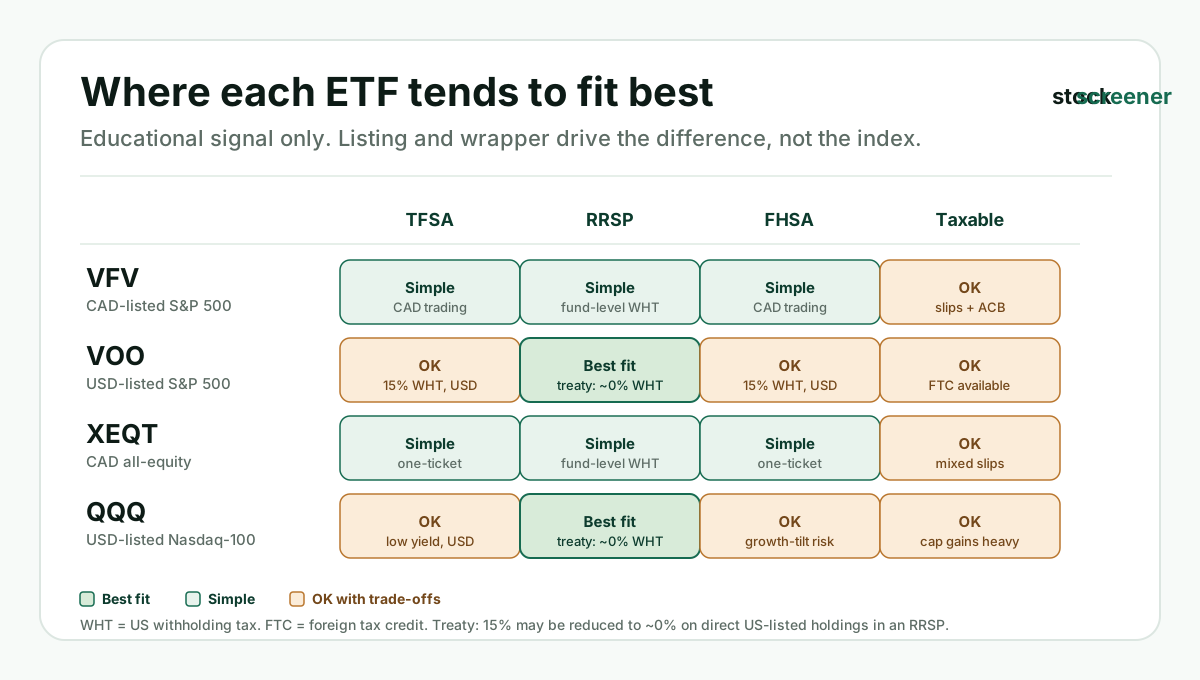
The account only changes the answer for the two US-listed funds. VOO or QQQ held directly in an RRSP or RRIF can generally receive the Canada-US treaty exemption on US dividends; VFV and XEQT are Canadian funds, so US withholding can occur inside them whatever the account. In a TFSA, FHSA or RESP, none of the four avoids that withholding.
That makes exposure the bigger decision. VFV and VOO are two routes to the same S&P 500. XEQT is a global all-equity portfolio, and QQQ is the narrower Nasdaq-100. Choose the exposure first, then weigh currency conversion and trading costs against any RRSP tax edge.
The four funds side by side
Information checked October 14, 2026. VFV figures use Vanguard Canada's August 31, 2026 factsheet, with an MER dated June 30, 2026; VOO's expense ratio is dated April 28, 2026; XEQT figures are current to September 30, 2026; and QQQ's 0.18% expense ratio took effect in December 2025. Fund providers can update fees and portfolios.
| Feature | VFV | VOO | XEQT | QQQ |
|---|---|---|---|---|
| Fund type | Canadian-listed S&P 500 index ETF | US-listed S&P 500 index ETF | Canadian-listed global all-equity ETF portfolio | US-listed Nasdaq-100 index ETF |
| Listing / trading currency | TSX / CAD | NYSE Arca / USD | TSX / CAD | Nasdaq / USD |
| Exposure | Large US companies in the S&P 500 | Large US companies in the S&P 500 | Canadian, US, developed international, and emerging-market equities | 100 of the largest non-financial companies listed on Nasdaq |
| Reported fund cost | 0.08% MER | 0.03% expense ratio | 0.19% MER; 0.17% management fee | 0.18% total expense ratio |
| Distributions | Quarterly, paid in CAD | Quarterly, paid in USD | Quarterly; tax character can include Canadian and foreign amounts | Quarterly, paid in USD |
| Currency hedging | Not CAD-hedged; CAD trading does not remove US-dollar exposure | No CAD hedge; USD security | No single CAD hedge across the global portfolio; foreign-currency exposure remains | No CAD hedge; USD security |
| US withholding by account | Can occur inside the Canadian wrapper in a TFSA or RRSP; taxable reporting may include foreign tax | RRSP treaty exemption may apply when held directly; TFSA withholding generally applies; taxable withholding may support a foreign tax credit | Can occur inside underlying fund layers; registered-account investors generally cannot recover it personally | Same direct US-listed framework as VOO for US-source distributions |
| Decision lens | CAD convenience plus S&P 500 exposure | Direct US listing, USD operations, and possible RRSP treaty treatment | One-ticket global diversification and automatic rebalancing | Nasdaq-100 exposure with greater sector and issuer concentration |
Official fund sources: VFV factsheet, VOO profile, XEQT profile, and QQQ profile. Withholding treatment is summarized from Vanguard Canada's official withholding-tax guide and the Canada-US treaty, both linked in Sources.
Jump to a pairing: XEQT vs VOO · QQQ vs VFV · QQQ vs XEQT · VFV vs VOO by account · Canadian equivalent of VOO
XEQT vs VOO: a whole portfolio or one market?
XEQT is meant to be the entire stock side of a portfolio. It holds underlying iShares ETFs, and BlackRock says it targets 100% equity, is continuously monitored and rebalanced, and is eligible for registered plans. Its September 30, 2026 factsheet shows roughly 25% Canada, 46% United States, 24% developed international markets, and 5% emerging markets.
VOO covers only large US companies in the S&P 500. Owning it in place of XEQT means dropping Canada, overseas developed markets and emerging markets, or buying them separately. The XEQT and VFV comparison looks at the same global-versus-S&P 500 choice with two Canadian-listed funds.
On cost, VOO looks cheaper: a 0.03% expense ratio as of April 28, 2026, against XEQT's 0.19% MER and 0.17% management fee. VOO's figure leaves out CAD-to-USD conversion, trading frictions, and the work of adding and rebalancing the other regions yourself. XEQT's covers a one-ticket structure that rebalances itself.
The listing matters for tax. XEQT trades in Canadian dollars on the TSX, but paying in CAD does not remove its foreign-currency exposure or the withholding inside its underlying funds. VOO trades in US dollars on NYSE Arca. Held directly in an RRSP, VOO's US dividends may receive treaty relief, which is a real edge but rarely large enough on its own to replace a global portfolio with a single-country fund.
QQQ vs VFV: Nasdaq-100 or S&P 500?
These two overlap heavily but track different indexes. VFV follows the S&P 500, a broad large-cap US benchmark. QQQ follows the Nasdaq-100, which Invesco describes as the 100 largest non-financial companies listed on Nasdaq. Leaving out financials tends to push the index further into technology and other growth businesses.
VFV trades in Canadian dollars on the TSX with a 0.08% MER. QQQ trades in US dollars on Nasdaq and has had a 0.18% total expense ratio since Invesco's December 2025 change. QQQ's narrower index means more weight in fewer companies and sectors; VFV spreads the money across the S&P 500. Neither is a diversified Canadian or global portfolio by itself.
The accounts treat them differently. QQQ follows the direct US-listed rules, so an RRSP can hold it with possible treaty relief on dividends. VFV is a Canadian wrapper that gets its S&P 500 exposure mainly through a US-domiciled Vanguard fund, so the withholding happens before the money reaches your account. Compare the expected distributions and your currency costs, not just the published fee.
QQQ vs XEQT: not substitutes
Swapping XEQT for QQQ changes far more than the account mechanics. QQQ is a single-country, single-exchange index fund. XEQT spans Canada, the United States, developed international markets and emerging markets in one ticket.
XEQT's Canadian listing suits regular CAD contributions, and BlackRock handles the target mix and rebalancing. QQQ needs US dollars and leaves every allocation decision beyond the Nasdaq-100 to you. Both pay quarterly, but XEQT can pass through Canadian-source and foreign-source amounts, while QQQ pays US-source distributions.
A TFSA shelters either holding from Canadian tax on income and gains inside the account, subject to the TFSA rules, but it does not create a US treaty exemption for dividends. An RRSP that holds QQQ directly may get different US withholding treatment. Settle whether you want a concentrated Nasdaq-100 position or a globally diversified one before those details come into play.
VFV vs VOO: which goes in a TFSA and which in an RRSP?
VFV and VOO hold effectively the same S&P 500 portfolio, so the account does most of the deciding. In an RRSP or RRIF, VOO held directly can generally receive the Canada-US treaty exemption on US dividends, while VFV, as a Canadian fund, bears US withholding internally. In a TFSA, FHSA or RESP, withholding is a net cost either way, and in a taxable account it is generally creditable for both. Any tax edge then has to be weighed against the cost of converting Canadian dollars to buy VOO.
The dedicated VFV vs VOO guide goes account by account and covers the fee gap, currency conversion, T1135 reporting and US estate exposure. For the rules underneath, see the foreign withholding tax guide and the Canadian-listed versus US-listed ETF guide.
What is the Canadian equivalent of VOO?
The closest Canadian-listed equivalents are VFV, XUS and ZSP: each tracks the S&P 500, trades in Canadian dollars, and leaves the US-dollar exposure unhedged like VOO. VSP, XSP and ZUE track the same index but hedge the currency, which makes them a different decision rather than a closer copy. XEQT is not an equivalent; it is a global all-equity portfolio.
The VOO Canadian equivalent guide compares all six funds by structure, fees, distributions, and withholding tax by account.
Related reading and ticker pages
- VFV account-location overview and VOO account-location overview
- XEQT account-location overview and QQQ account-location overview
- VEQT vs XEQT: fees, allocation, and account location
- Foreign withholding tax: TFSA vs RRSP vs taxable
- Canadian-listed vs US-listed ETFs in a TFSA and RRSP
- Norbert's Gambit and CAD-to-USD conversion
- XGRO vs XEQT: 80/20 or 100% equity in Canada?
- ZSP vs VFV: two Canadian S&P 500 ETFs compared
- VUN vs VFV: total US market or S&P 500?
- VDY vs VFV: Canadian dividends or US large caps?
- VFV vs VSP: unhedged or CAD-hedged S&P 500?
- QQQ vs QQC: same Nasdaq-100, Canadian or US wrapper?
Search the ETF before you place it
Look up VFV, VOO, XEQT, QQQ, or another ETF and read the educational account-location signal in context.
Open the free stock screenerFrequently asked questions
Is XEQT a Canadian equivalent of VOO?
No. XEQT is a Canadian-listed all-equity portfolio with Canadian, US, international developed, and emerging-market exposure. VOO is a US-listed ETF that tracks the S&P 500. VFV is the closer Canadian-listed S&P 500 comparison, although its wrapper and tax treatment differ from VOO.
Is XEQT or VOO better in a TFSA?
The TFSA does not pick a winner. Neither fund gets the US treaty exemption there: withholding generally applies to VOO held directly and occurs inside XEQT's underlying funds. The real choice is a global all-equity portfolio in Canadian dollars versus US large caps bought in US dollars.
Should QQQ or VFV go in a TFSA?
The account alone does not settle it. QQQ tracks the Nasdaq-100 and trades in US dollars; VFV tracks the S&P 500 through a Canadian-listed wrapper and trades in Canadian dollars. Compare the exposure, concentration, currency conversion, withholding, time horizon, and risk before considering account location.
Which of these four can avoid US withholding in an RRSP?
Only the US-listed funds, VOO and QQQ, and only when held directly in an RRSP or RRIF where the treaty exemption is applied. VFV and XEQT are Canadian funds, so withholding can occur inside them before distributions reach any account.
Sources
- Vanguard Canada, VFV factsheet, August 31, 2026, with MER as of June 30, 2026.
- Vanguard Canada, ETF prospectus, including VFV and CAD-hedged VSP.
- Vanguard US, VOO product profile, expense data as of April 28, 2026.
- BlackRock Canada, XEQT product page.
- BlackRock Canada, XEQT factsheet, portfolio and fee data as of September 30, 2026.
- Invesco, QQQ official overview.
- Invesco, QQQ structure and expense-ratio update, December 22, 2025.
- Vanguard Canada, Foreign Withholding Taxes guide, 2023.
- Department of Finance Canada, Canada-US Tax Convention, Article XXI.
- Canada Revenue Agency, qualified investments for registered plans.
- Canada Revenue Agency, federal foreign tax credit, updated for the 2025 tax year.