
Norbert's Gambit: convert CAD to USD cheaply
Norbert's Gambit is one of those Canadian investing tricks that sounds more mysterious than it is. The goal is simple: convert Canadian dollars to US dollars without paying a big retail foreign-exchange spread.
It is not magic, and it is not risk-free. It is an operational process. Done carefully, it can make sense for a large USD conversion. Done casually, it can create settlement mistakes, tax paperwork, and a few days of annoyance.
What's in this guide
| Section | What it covers |
|---|---|
| What it is | The basic idea behind the gambit |
| Steps | CAD to USD with DLR and DLR.U |
| Costs and risks | Spread, commissions, timing, and tax records |
| Account types | TFSA, RRSP, FHSA, and taxable account notes |
| Sources | Official and provider references |
What Norbert's Gambit is
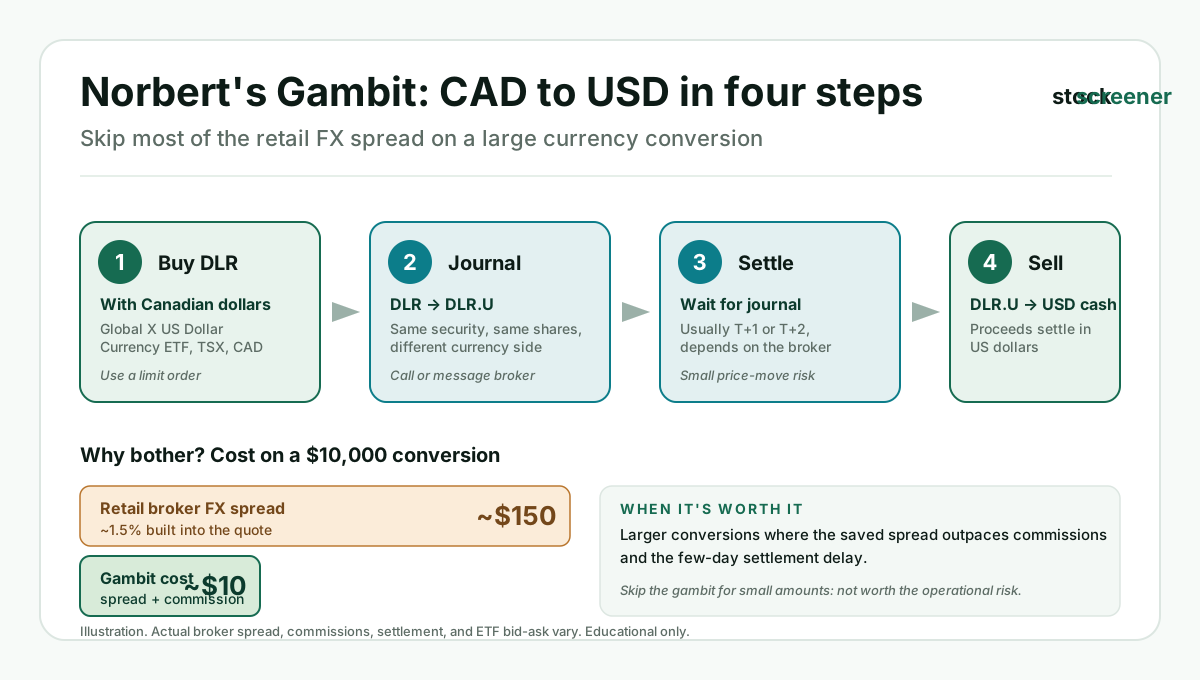
The gambit uses a security that can be bought on one currency side and sold on the other. Many Canadian investors use Global X US Dollar Currency ETF, which trades as DLR in Canadian dollars and DLR.U in US dollars. Global X describes DLR as a US dollar currency ETF that seeks to reflect the value of the US dollar, net of expenses, and notes that DLR units can be transferred into DLR.U.
The point is to replace a broker's retail FX spread with the trading costs of the security: bid-ask spread, commissions if any, and the time it takes to journal and settle. For small conversions, the effort may not be worth it. For larger conversions, the savings can be material.
The basic CAD to USD flow
- Buy the Canadian-dollar side, usually DLR, using CAD.
- Ask your broker to journal the position to the US-dollar side, DLR.U.
- Wait for the broker's settlement and journaling process to complete.
- Sell DLR.U to receive USD cash.
Going from USD back to CAD is the same idea in reverse: buy the USD side, journal to the CAD side, then sell for Canadian dollars.
The two words that matter are broker process. Some brokerages make journaling easy. Some require a call or secure message. Some require the trade to settle first. Some show both currency sides in the same account clearly, and some make it feel like paperwork from another century. Check first.
The costs and risks people forget
| Issue | Why it matters |
|---|---|
| Bid-ask spread | You buy at the ask and sell at the bid. That small spread is part of the cost. |
| Commissions | Some brokers charge trading commissions, and you may have two trades. |
| Settlement timing | You may be exposed to small price or FX movement while the process completes. |
| Operational mistakes | Selling too early, using the wrong side, or failing to journal can create a mess. |
| Taxable records | In a non-registered account, purchases and sales can create capital gains or losses and ACB tracking. |
That last point is important. Norbert's Gambit is not a tax loophole. It is a currency-conversion method. In a taxable account, you still need to track the trade, the currency amounts, and any gain or loss. If you use a volatile interlisted stock instead of a currency ETF, the equity-price risk can be much larger.
How account type changes the decision
TFSA: The gambit may help if you need USD for US-listed securities, but you still need enough TFSA contribution room for the Canadian-dollar value of contributions. CRA reminds investors that foreign funds are converted to Canadian dollars for reporting.
RRSP: The method is often discussed for RRSP investors who want to buy US-listed ETFs or stocks while avoiding a large FX spread. This is where it often connects to US dividend withholding, because direct US-listed holdings in an RRSP can have different treaty handling than the same exposure in a TFSA.
FHSA: The time horizon matters. If the home purchase is near, a low-risk, liquid approach may be more important than squeezing the last basis point out of FX conversion.
Taxable account: This is where recordkeeping matters most. Keep confirmations, dates, CAD and USD values, and adjusted cost base notes.
Converting USD to buy US-listed ETFs?
Once you have USD, check the account-location trade-off for VOO, QQQ, US dividend stocks, and other US-listed securities.
Read the ETF account guideRelated reading
- VFV vs VOO, XEQT and QQQ: which account?
- Foreign withholding tax: TFSA vs RRSP vs taxable
- US dividend stocks in a TFSA vs RRSP for Canadians
Frequently asked questions
What is Norbert's Gambit?
It is a Canadian currency-conversion method that buys a security on one currency side, journals it to the other side, then sells it for the target currency.
Is Norbert's Gambit free?
No. It can reduce FX spread costs, but there can still be bid-ask spread, commissions, fund fees, price movement, and recordkeeping costs.
Can I use it in a registered account?
Many investors use eligible securities such as DLR in registered accounts, but broker support differs. Confirm the exact journaling and settlement process first.