
ZSP vs VFV: the same S&P 500, held two different ways
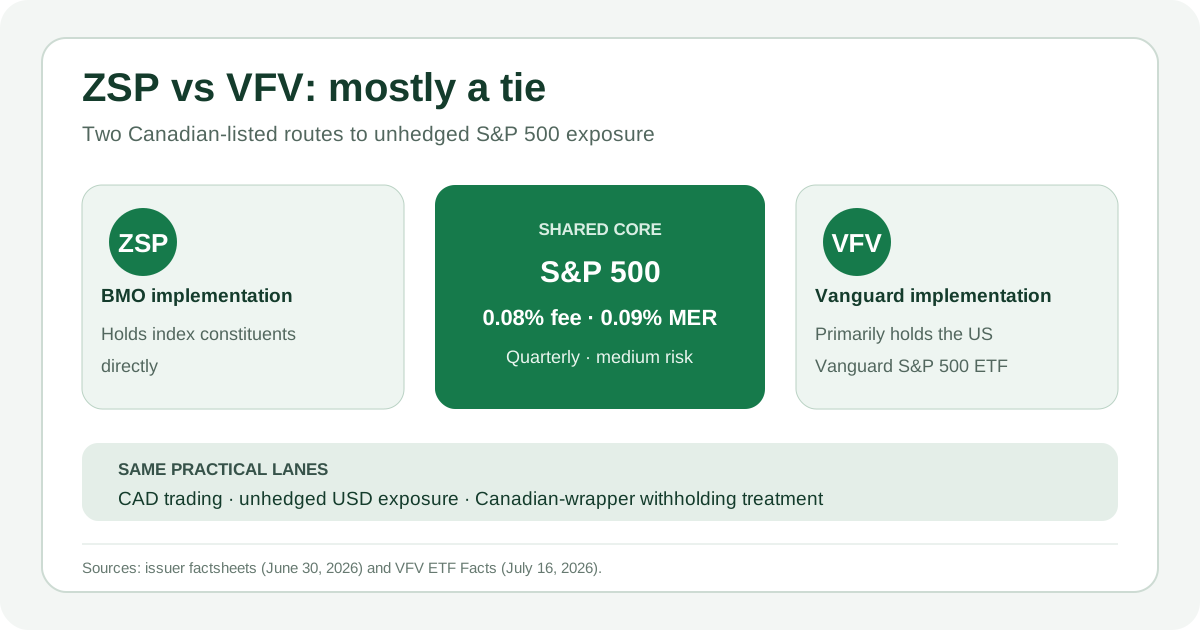
ZSP and VFV are close substitutes rather than competing strategies. Both are Canadian-listed, unhedged S&P 500 ETFs with a 0.08% management fee; ZSP reports a 0.09% management expense ratio (MER) and VFV 0.08%, a one-basis-point difference. Their holdings, currency exposure, distribution schedule, risk rating and treatment in every account are substantially the same.
The main difference is under the hood. BMO says ZSP holds the S&P 500 constituents directly, while Vanguard says VFV invests primarily through its US-domiciled S&P 500 ETF. That does not give either wrapper a withholding-tax advantage on US stocks. For someone who already owns one, changing tickers usually adds trading and tax considerations without materially changing the portfolio.
Does holding the stocks directly make ZSP different?
ZSP's factsheet says the fund invests in S&P 500 constituent securities in their index proportions. VFV's factsheet says its displayed portfolio information is for the US-domiciled Vanguard S&P 500 ETF in which VFV primarily invests. In practice, ZSP owns the shares directly while VFV mainly owns units of the underlying Vanguard fund.
A fund-of-funds structure can centralize trading and portfolio management; direct holdings remove the intermediate fund unit. Neither fact makes one product safer or more likely to outperform. The obvious worry with a fund that holds another fund is paying two management fees, and Vanguard explicitly states that there is no duplication of management fees charged through VFV's underlying Vanguard fund investment.
The structures also reach the same withholding result for US stocks. BlackRock's December 2025 reference guide says Canadian-listed funds seeking US equity exposure face the same level of US withholding whether they own US stocks directly or indirectly through a US or Canadian ETF. The structural difference between ZSP and VFV matters less here than the fact that both investor-facing securities are Canadian-listed funds.
ZSP and VFV side by side
Information checked October 14, 2026. ZSP figures use BMO's factsheet dated September 30, 2026. VFV figures use Vanguard's factsheet dated August 31, 2026, with its MER as of June 30, 2026. The two snapshots are a month apart. Risk and tax information comes from current issuer, regulator, and CRA documents.
| Feature | ZSP | VFV |
|---|---|---|
| Provider | BMO Asset Management | Vanguard Investments Canada |
| Investment objective | Replicate the S&P 500 Index, net of expenses | Track the S&P 500 Index before fees and expenses |
| Implementation | Holds index constituent securities directly | Invests primarily through Vanguard's US-domiciled S&P 500 ETF |
| Currency | Trades in CAD; US-dollar exposure is not hedged | Trades in CAD; US-dollar exposure is not hedged |
| Management fee / MER | 0.08% / 0.09% | 0.08% / 0.08% |
| Net assets | $25.593 billion (Sept. 30) | $35.156 billion (Aug. 31) |
| Securities | 505 (Sept. 30) | 505 in the underlying US fund display (Aug. 31) |
| Distributions | Quarterly | Quarterly |
| Inception | November 14, 2012 | November 2, 2012 |
| Risk rating | Medium | Medium |
| Registered plans | BMO lists it as RSP eligible | Vanguard lists RRSP, TFSA, RESP, RDSP, DPSP, RRIF, and FHSA eligibility |
Fund size and security count are not performance forecasts. Both products are large, established ETFs. The one-security difference can reflect cash and index implementation, and it does not create a meaningful diversification gap. Their common market-cap-weighted benchmark drives the result.
How closely the portfolios match
Both funds follow the S&P 500, a float-adjusted, market-capitalization-weighted index of large US companies. That means the largest companies receive the largest weights. Choosing ZSP instead of VFV does not add small-cap stocks, Canadian companies, developed markets outside the United States, or emerging markets.
The latest factsheets show how closely the portfolios line up, even a month apart. Information technology represented 39.71% of ZSP on September 30 and 37.9% of VFV's underlying fund display on August 31. Financials were 11.43% and 12.3%. ZSP's top holdings began with Nvidia at 8.38% and Apple at 7.37%; VFV reported 8.1% and 7.0%. The gaps mostly reflect a month of market movement between the two dates, not distinct investment theses. On June 30, when both factsheets shared a date, technology was 38.06% and 38.0%.
The shared index also creates the same concentration risk. About 38% in one sector is not the same as a balanced global portfolio. An S&P 500 ETF can be a useful US-equity component, but neither ticker supplies Canadian, international, or fixed-income diversification on its own. The sibling guide on XEQT vs VFV explains the difference between a global all-equity portfolio and concentrated US large-cap exposure.
One basis point of MER
BMO and Vanguard each report a 0.08% management fee. BMO reports a 0.09% MER for ZSP; Vanguard reports 0.08% for VFV as of June 30, 2026. The management fee pays the manager. MER is broader and includes the management fee plus applicable taxes and operating expenses, expressed as a percentage of average net assets. CIRO notes that trading costs such as commissions and bid-ask spreads sit outside the fund's ongoing management cost.
At those MERs, annual fund expenses come to approximately $9 for ZSP and $8 for VFV for each $10,000 invested, before compounding and changes in portfolio value. They are paid inside the fund and reduce its return rather than being withdrawn from your brokerage account, and a one-dollar difference is unlikely to decide anything.
Near-equal MERs do not guarantee perfectly equal returns. Cash balances, portfolio trades, withholding, valuation timing, and sampling can create small tracking differences. The issuers' June 30 figures show similar, but not identical, results. A short period of outperformance by either fund is weak evidence for a forward-looking choice because both are trying to deliver the same benchmark exposure.
Neither hedges the US dollar
Both trade on the TSX in Canadian dollars, which saves a Canadian-dollar account from converting cash to buy them. Neither hedges the portfolio's US-dollar exposure.
The Canadian-dollar value of either fund responds to two moving parts: the US-dollar value of the S&P 500 holdings and the CAD/USD exchange rate. If the Canadian dollar weakens against the US dollar, that currency move can lift the Canadian-dollar value of unchanged US assets. If the Canadian dollar strengthens, it can reduce the Canadian-dollar return. Both funds travel in the same currency lane.
Comparing a CAD unit price with a US-dollar index quote can therefore be misleading. The relevant benchmark is the S&P 500 measured in Canadian dollars, with dividends and fund costs treated consistently. For a true hedged-versus-unhedged decision, compare an unhedged fund with a product that explicitly uses currency hedging, not ZSP with VFV.
Every account treats them alike
CRA guidance says units of ETFs listed on a designated exchange are common qualified investments for RRSPs, TFSAs, FHSAs, RESPs, RRIFs, and RDSPs. Both providers identify their funds as eligible for registered plans. Eligibility does not make either fund suitable for a particular goal or time horizon.
TFSA. Canadian tax on income and gains is generally sheltered when TFSA rules are followed, but US withholding happens before underlying dividends reach either Canadian fund, and CRA says foreign taxes related to income earned in a TFSA are not counted for a foreign tax credit. ZSP's direct holdings and VFV's underlying US ETF lead to the same basic result.
RRSP. An RRSP generally defers Canadian tax until withdrawal. The treaty treatment that can exempt directly held US-listed stocks or ETFs from US dividend withholding in an RRSP does not pass through either Canadian-listed wrapper, and BlackRock's guide classifies both direct-holding and US-ETF-wrapping Canadian funds as bearing a net withholding cost there. That is why Canadian-listed vs US-listed ETFs is a separate decision, with its own currency-conversion and US-dollar trading questions.
FHSA. Both can be qualified investments, but the purchase date may matter more than the ticker: each has a medium risk rating and full equity exposure, and money needed soon may not recover from a large decline in time. The FHSA investments guide covers that timeline test.
Distributions from these Canadian mutual fund trusts are not automatically eligible Canadian dividends merely because the units trade in Canada. US-source income can be reported as foreign non-business income on a T3. CRA guidance says foreign tax reported on the slip may support a foreign tax credit, subject to the calculation and the investor's facts. Reinvested distributions remain taxable and can affect adjusted cost base.
Switching between them
For an existing position, inertia has value. Moving from VFV to ZSP, or back, does not change the benchmark and barely changes the MER. A taxable sale can create a gain or loss and new adjusted-cost-base records, and even in a registered account the trade can cost a spread or commission and some time out of the market.
A sale can realize a capital gain or loss. A different ticker is not automatically different property for the superficial loss rule. CRA's archived identical-property interpretation says the determination is fact-specific and turns on whether properties are the same in all material respects. Because these funds share a benchmark but differ in issuer and structure, an investor planning to sell one at a loss and acquire the other during the relevant period should get tax advice rather than assume either outcome.
For a new position
If the portfolio needs unhedged S&P 500 exposure, both do the job; if it needs global stocks, a Canadian tilt, small caps, bonds or currency hedging, neither solves that gap. Between the two, the practical differences sit with your broker: current commission, recurring-purchase support, fractional units, DRIP rules and the live bid-ask spread. The issuers report both funds as DRIP eligible, but the broker controls whether and how you can enrol, and a limit order can cap your purchase price or set a minimum sale price, although it may not fill.
- Confirm that US large-cap equity is the intended allocation.
- Check the live spread and total brokerage cost, not only the MER.
- Check whether the platform supports the desired automatic purchase or DRIP.
- Before switching, estimate the taxable gain or loss and record-keeping impact.
- Review the whole portfolio for missing Canadian, international, small-cap, or fixed-income exposure.
Related reading
- ETF account-location comparison hub: VFV, VOO, XEQT, and QQQ
- XEQT vs VFV: global equity or S&P 500?
- Canadian-listed vs US-listed ETFs in a TFSA and RRSP
- Foreign withholding tax by Canadian account type
- ZSP account-location overview and VFV account-location overview
Look up ZSP or VFV
The screener shows an educational account-location read for each fund. Confirm current documents and your brokerage costs.
Open ZSP in the screenerFrequently asked questions
Do ZSP and VFV hold the same stocks?
They seek to track the same S&P 500 Index, so their economic exposure is nearly identical. ZSP holds index constituents directly. VFV invests primarily through the US-domiciled Vanguard S&P 500 ETF. Small differences can result from cash, sampling, expenses, and implementation.
Does VFV charge two layers of management fees?
No. VFV invests primarily through the US-domiciled Vanguard S&P 500 ETF, and Vanguard states that there is no duplication of management fees charged through that underlying fund. VFV reports a 0.08% management fee and a 0.08% MER as of June 30, 2026.
Why do ZSP's and VFV's factsheet weights look different?
Mostly dates. ZSP's factsheet is dated September 30, 2026 and VFV's August 31, so a month of market movement separates them. On June 30, when both factsheets shared a date, information technology was 38.06% of ZSP and 38.0% of VFV.
Should I switch from VFV to ZSP, or from ZSP to VFV?
A switch rarely changes the portfolio's market exposure: both track the S&P 500, and their current MERs differ by one basis point (0.09% for ZSP, 0.08% for VFV). Before switching, compare any taxable capital gain or loss, commission, bid-ask spread, platform incentive, and the administrative cost of adding a second tax lot.
Sources
- BMO Global Asset Management, ZSP product page, fund description and current documents checked October 14, 2026.
- BMO Global Asset Management, ZSP factsheet, fees, assets, holdings, sector allocation, objective, and risk data as of September 30, 2026.
- BMO Global Asset Management, ZSP annual management report of fund performance, year ended December 31, 2025, including direct-holdings strategy and tracking discussion.
- Vanguard Canada, VFV product page, objective and current documents checked October 14, 2026.
- Vanguard Canada, VFV factsheet, fees, assets, underlying-fund structure, holdings, sector allocation, and eligibility as of August 31, 2026, with MER as of June 30, 2026.
- Vanguard Canada, VFV ETF Facts, July 16, 2026, including risk rating, distribution schedule, trading information, and tax note.
- BlackRock Canada, Understanding Foreign Withholding Tax, December 2025, including treatment of Canadian-listed funds holding US stocks directly or through a US ETF.
- Canada Revenue Agency, Income Tax Folio S3-F10-C1, qualified investments for registered plans.
- Canada Revenue Agency, Income Tax Folio S5-F2-C1, including foreign tax credit treatment for TFSA and RRSP holdings.
- Canada Revenue Agency, Tax treatment of mutual funds, T3 foreign income, foreign tax, reinvested distributions, and capital gains.
- Canada Revenue Agency, IT-387R2 Meaning of Identical Properties (archived), the CRA's interpretive test and question-of-fact warning.
- Canadian Investment Regulatory Organization, Fees and Costs, MER, commissions, and bid-ask spreads, checked October 14, 2026.