
XEQT vs VFV: a whole global portfolio or an S&P 500 slice?
XEQT is meant to be a complete global all-equity portfolio; VFV is a Canadian-listed route to the S&P 500, concentrated in large US companies. XEQT already holds substantial US equity, so swapping one for the other, or adding VFV to XEQT, changes your regional mix and concentration far more than it changes cost.
The account barely separates them. Both trade in Canadian dollars on the TSX and are eligible for registered plans, and both are Canadian fund wrappers, so foreign withholding can occur inside either fund in a TFSA, RRSP or taxable account. Trading in CAD also does not remove either fund's foreign-currency exposure.
What each fund is for
BlackRock describes XEQT as a portfolio of ETFs that targets a strategic allocation of 100% equity. The fund spans Canada, the United States, developed international markets, and emerging markets. BlackRock monitors the mix and rebalances it as needed. That makes XEQT a portfolio-level product rather than a fund for one country or one index.
VFV seeks to track the S&P 500, a market-capitalization-weighted index of large US companies. Vanguard's August 31, 2026 factsheet reports 505 stocks in the fund's underlying exposure. VFV does not contain a dedicated Canadian, developed-international, or emerging-market allocation. It can be one component of a broader portfolio, but the fund does not build that broader portfolio itself.
That is why "which is better?" misses the point. Replacing XEQT with VFV drops XEQT's deliberate Canadian and overseas allocations; replacing VFV with XEQT adds those regions and shrinks the dedicated US large-cap weight. Either change moves exposure much more than the gap in published MERs.
XEQT and VFV side by side
Information checked October 14, 2026. Portfolio and fee figures below come from BlackRock's XEQT factsheet dated September 30, 2026 and Vanguard's VFV factsheet dated August 31, 2026, with VFV's MER as of June 30, 2026. Allocations and holdings can change.
| Feature | XEQT | VFV |
|---|---|---|
| Portfolio job | Globally diversified all-equity portfolio | S&P 500 US large-cap exposure |
| Structure | Canadian ETF holding five underlying iShares ETFs plus small cash positions | Canadian ETF that primarily invests in the US-domiciled Vanguard S&P 500 ETF |
| Listing / currency | TSX / CAD | TSX / CAD |
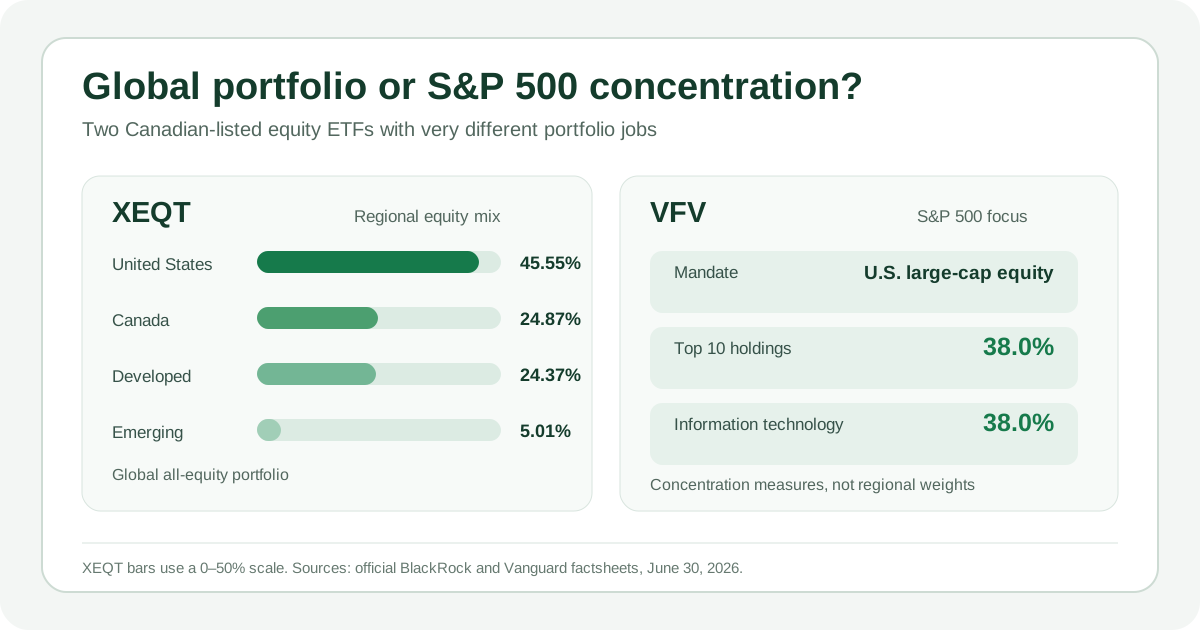
| US equity weight | 45.77%, calculated by combining two US underlying ETFs | S&P 500 mandate; no strategic Canada or international allocation |
| Canada weight | 24.89% | No strategic Canadian equity sleeve |
| Other regions | 24.26% developed international and 4.89% emerging markets | No strategic non-US equity sleeve |
| Concentration snapshot | Regional and company diversification through broad underlying ETFs | Top ten holdings were 39.2% and information technology was 37.9% |
| Management fee / MER | 0.17% / 0.19% | 0.08% / 0.08% |
| Distributions | Quarterly | Quarterly |
| Rebalancing | BlackRock monitors and rebalances the regional targets | Tracks the market-cap-weighted S&P 500 rather than a global regional mix |
| Currency exposure | CAD trading with Canadian, US, developed-market, and emerging-market underlying exposure | CAD trading with underlying US-dollar equity exposure; not the CAD-hedged VSP fund |
| Registered plans | Provider lists it as eligible | Provider lists RRSP, TFSA, FHSA, and other registered-plan eligibility |
Sources: BlackRock's XEQT factsheet and Vanguard's VFV factsheet, dated September 30 and August 31, 2026. XEQT's factsheet still contains a stale 0.18% management-fee sentence in its overview, but its fee table and BlackRock's current product page list 0.17%, effective December 18, 2025. This comparison uses the current fee table and effective-date notice.
What happens if you hold both
XEQT's US sleeve is broader than the S&P 500. Its September factsheet lists a 30.78% position in a Canadian-listed total US market ETF and a 14.99% position in a US-listed total-market ETF, for a calculated 45.77% US weight. Total-market exposure includes the large companies in the S&P 500 along with smaller US companies. Many of VFV's largest companies therefore already appear inside XEQT's US allocation.
A simple illustration shows the effect. A portfolio split equally between XEQT and VFV would have roughly 72.9% US equity exposure before small cash positions and rounding: half of VFV's US mandate plus half of XEQT's 45.77% US sleeve. Canada's effective weight would fall to about 12.4%, half of XEQT's 24.89%. These are calculations from the September 30 fund weights, not recommended targets.
Combining them is an allocation decision, not diversification in every direction: VFV adds weight to US large caps that XEQT already owns indirectly, and as VFV's share grows, Canada, developed international markets and emerging markets all shrink relative to the whole.
VFV is diversified across hundreds of S&P 500 companies, but market-cap weighting can still create concentration in the largest issuers and sectors. Vanguard reported that VFV's ten largest underlying holdings represented 39.2% of net asset value at August 31, 2026, and information technology represented 37.9% of the fund. Those are two separate measurements.
Canada, and the currencies underneath
XEQT's 24.89% Canadian allocation is a deliberate home-country tilt, though it still leaves about three quarters of the portfolio in foreign equity and cash. A home tilt can line part of a portfolio up with Canadian-dollar spending; it also ties more of the outcome to the make-up of Canada's equity market.
VFV has no strategic Canadian sleeve. Its companies are large US issuers, and while many earn revenue worldwide, global revenue is not the same as owning Canadian, European, Japanese or emerging-market stocks. XEQT holds those regions directly through underlying ETFs.
Both tickers trade in Canadian dollars, but the trading currency is only the settlement currency. VFV's underlying US equities remain exposed to changes between the Canadian and US dollars. XEQT has multiple foreign-currency exposures through its US, developed, and emerging-market sleeves. If the Canadian dollar strengthens, foreign holdings are generally worth less when translated into Canadian dollars, all else equal; a weaker Canadian dollar generally works in the other direction.
VFV is distinct from Vanguard's VSP, which is the explicitly CAD-hedged S&P 500 ETF in Vanguard's prospectus. XEQT is not presented as a fully CAD-hedged global portfolio. Currency movements can produce meaningful differences over shorter periods, but they do not change the underlying companies owned.
The fee gap: about $11 a year per $10,000
VFV reports a 0.08% management fee and a 0.08% MER. XEQT reports a 0.17% management fee and a 0.19% MER. MER includes more than the management fee and is reported from the fund's financial statements. It reduces fund returns rather than appearing as a separate charge on a brokerage statement.
Applied mechanically to an average $10,000 position for one year, a 0.08% MER is about $8 and a 0.19% MER is about $19. The difference is approximately $11 per $10,000. This illustration assumes the reported MERs remain unchanged and does not include trading costs, bid-ask spreads, taxes, tracking differences, or the cost of building and rebalancing a global allocation around VFV.
Both funds list quarterly distributions. Distribution frequency does not determine total return or tax efficiency. XEQT can receive Canadian dividends and multiple forms of foreign income from its underlying funds. VFV's distributions arise from its US equity exposure. The exact Canadian tax characteristics can change each year and should be checked in the provider's annual tax information and the investor's T3 slip.
Accounts: two Canadian wrappers, similar treatment
TFSA. BlackRock and Vanguard list both ETFs as eligible for registered plans. Inside a TFSA, Canadian tax generally does not apply to ordinary income and gains when the rules are followed, but that does not stop foreign withholding before distributions reach the Canadian ETF.
BlackRock's December 2025 withholding-tax guide says Canadian-listed ETFs seeking US equity exposure are subject to US withholding whether they hold US stocks directly or through another ETF. The withholding is generally a net cost in a TFSA. XEQT can also face foreign withholding on its developed and emerging-market holdings. Account eligibility therefore does not make the two exposures interchangeable.
RRSP. The Canada-US treaty can exempt qualifying US dividends when an RRSP directly holds US-listed securities and the intermediary applies the treatment. XEQT and VFV are both Canadian-listed wrappers, so that exemption does not remove withholding that occurs before dividends reach either fund. VFV's US-only mandate makes its withholding path simpler to describe, while XEQT has different layers across its US and international funds; the foreign withholding tax guide explains the account and wrapper distinction.
Taxable account. Both Canadian ETFs are generally reported on T3 slips. BlackRock says Canadian iShares ETF distributions can include Canadian dividends, foreign non-business income, capital gains, return of capital, and foreign tax paid, in a mix that depends on the fund and year; foreign tax designated to you may support a foreign tax credit, subject to the rules. XEQT's Canadian sleeve can produce Canadian dividend tax characteristics that VFV's US mandate does not, but simpler exposure is not a universal taxable-account advantage: province, income, realized gains, losses and the annual mix all change the result.
Purchases, sales, reinvested distributions, return of capital, and certain non-cash distributions can change adjusted cost base. The investor remains responsible for the complete ACB record even if a brokerage supplies figures. See the ETF distributions and adjusted cost base guide before relying on a single tax-slip number.
Questions to settle first
Name the job before the ticker. For global diversification with a Canadian tilt and automatic rebalancing, XEQT is built for that job. For a defined S&P 500 allocation inside a portfolio you build and rebalance yourself, VFV fills a different one. Then write down the regional mix that results across every account, and remember that VFV's lower MER excludes the other funds you would need to recreate Canada, developed-international and emerging-market exposure, while XEQT's higher MER covers the one-ticket structure. Neither prevents selling in a downturn, and both can fall sharply.
- Is the intended holding a complete equity portfolio or one regional component?
- How much US large-cap concentration results after all accounts are combined?
- Is XEQT's Canadian home bias intentional for this portfolio?
- Are the foreign-currency exposures understood despite CAD trading?
- Would a switch in a taxable account realize gains or losses?
Related reading
- XEQT account-location overview and VFV account-location overview
- VEQT vs XEQT: fees, allocation, and account location
- VFV vs VOO vs XEQT vs QQQ
- Canadian-listed vs US-listed ETFs
- Canadian stock and ETF account-location framework
- ZSP vs VFV: two Canadian S&P 500 ETFs compared
- VUN vs VFV: total US market or S&P 500?
- VFV vs VSP: unhedged or CAD-hedged S&P 500?
Look up XEQT or VFV
The screener shows an educational account-location read for each fund. Confirm current weights and fees with BlackRock and Vanguard.
Open XEQT in the screenerFrequently asked questions
Does XEQT already include the S&P 500?
XEQT does not hold VFV or target the S&P 500 specifically. Its US sleeve uses broad US total-market ETFs, which include many of the same large companies found in the S&P 500 plus smaller US companies. Adding VFV to XEQT therefore increases exposure to many companies already represented in XEQT.
What does a 50/50 mix of XEQT and VFV look like?
Using the September 30 weights, roughly 72.9% US equity before small cash positions and rounding: half of VFV's US mandate plus half of XEQT's 45.77% US sleeve. Canada's effective weight would fall to about 12.4%, half of XEQT's 24.89%. These are calculations, not recommended targets.
Why is XEQT's MER higher than VFV's?
XEQT reports a 0.19% MER and VFV 0.08%, about $19 against $8 a year on $10,000 if those rates held. XEQT's cost covers a global, self-rebalancing portfolio of underlying ETFs; VFV's covers only the S&P 500, so recreating XEQT's other regions around VFV would mean buying and rebalancing more funds.
Is VFV more tax-efficient than XEQT in an RRSP?
Not automatically. Both are Canadian-listed fund wrappers, so the treaty treatment available when an RRSP directly holds a US-listed ETF does not remove withholding inside either Canadian fund. XEQT also holds non-US foreign equities, so its withholding layers differ from VFV's US-only mandate.
Sources
- BlackRock Canada, XEQT product page, fee reduction effective December 18, 2025 and current product details checked October 14, 2026.
- BlackRock Canada, XEQT factsheet, portfolio, fees, distribution, and eligibility data as of September 30, 2026.
- BlackRock Canada, XEQT 2025 management report of fund performance, strategic allocation framework.
- Vanguard Canada, VFV product page.
- Vanguard Canada, VFV factsheet, portfolio, fees, distribution, and eligibility data as of August 31, 2026, with MER as of June 30, 2026.
- Vanguard Canada, VFV quarterly portfolio disclosure, March 31, 2026.
- Vanguard Canada ETF prospectus, June 20, 2025, including VFV, VSP, registered-plan eligibility, and fund structure.
- BlackRock Canada, Understanding Foreign Withholding Tax, December 2025.
- Vanguard Canada, The Impact of Withholding Taxes on Canadian ETF Investors, 2023.
- BlackRock Canada, distributions and tax FAQ.
- Department of Finance Canada, Canada-US Tax Convention, Articles X and XXI.
- Canada Revenue Agency, qualified investments for registered plans.