
ETF distributions and adjusted cost base in Canada
For a Canadian-listed ETF held in a non-registered account, keep two records: the income reported on the T3 slip and a running adjusted cost base, or ACB, for the units. They overlap, but they are not the same. A cash distribution can create taxable income without changing ACB. A fund-level reinvested distribution can create taxable income and increase ACB even though no cash arrives. Return of capital generally reduces ACB.
The short formula is: start with the cost of purchases, add reinvested distributions and units bought through a dividend reinvestment plan, then subtract return of capital. This guide focuses on Canadian-resident individuals who hold Canadian-listed ETF trust units as capital property in taxable accounts. Corporate accounts, traders reporting business income, mutual fund corporations, and US-listed funds can follow different reporting rules.
What's in this guide
| Section | What it answers |
|---|---|
| Distribution types | Which amounts affect income, cash, and ACB |
| Phantom distributions | Why taxable income can arrive without cash |
| DRIP versus reinvestment | Two similar-looking events with different mechanics |
| Worked ACB example | How additions and return of capital fit together |
| Record-keeping workflow | What to collect and reconcile each year |
| Screening implications | Why headline yield is not the whole distribution story |
| Related reading | Taxable accounts, distributions, and account location |
| FAQ | Four quick answers |
| Sources | CRA, TMX/CDS, and fund-provider documentation |
The same ETF payment can contain several tax types
An ETF distribution is not automatically a dividend. A Canadian ETF can allocate Canadian dividends, foreign income, interest or other income, capital gains, foreign tax paid, and return of capital. Vanguard Canada's tax centre says a T3 for a non-registered account shows these categories, while the brokerage, not the ETF manager, issues an ETF investor's slip.
| Event | Cash received? | Current tax reporting | Typical ACB effect |
|---|---|---|---|
| Cash income distribution | Yes | Report the final T3 classifications | None unless the cash buys more units |
| Brokerage DRIP purchase | Cash is used to buy units | The underlying distribution still keeps its T3 character | Add the cost of new units and acquisition costs |
| Fund-level reinvested distribution | No cash paid to the investor | Generally included in the year's taxable distribution reporting | Add the reinvested amount |
| Return of capital | Usually paid as part of cash distribution | Generally not immediate income unless ACB falls below zero | Subtract the final ROC amount |
| Sale of ETF units | Sale proceeds arrive | Calculate gain or loss on Schedule 3 when held on capital account | Use pooled ACB to calculate the result |
The T3 is therefore not a cash receipt. Its boxes describe the final tax character of distributions allocated to you. The CRA's T3 guide identifies box 21 for capital gains and box 42 for an amount that changes cost base. Canadian dividends and foreign income have their own boxes. Use the slip instructions rather than assuming that every dollar deposited by the ETF is taxed alike.
A phantom distribution is real for tax and ACB
“Phantom distribution” is an informal label for an amount the ETF allocates and reinvests instead of paying to the investor in cash. It often represents capital gains realized when the fund sold securities. You can owe tax on the allocated amount in a non-registered account even though your brokerage cash balance does not rise.
The matching ACB increase is essential. BlackRock Canada's distribution FAQ explains that iShares reinvested distributions increase ACB, reducing the gain that would otherwise be calculated on a later sale. For its ETFs, new units created by the reinvestment are immediately consolidated, so an investor may end with the same unit count. Missing the ACB addition can cause the same economic gain to be reflected once through the T3 allocation and again through an overstated gain when the units are sold.
Do not derive a phantom amount by comparing the ETF price before and after year-end. Use the manager's final tax information, the T3, and the tax breakdown reported through CDS. Estimates announced before year-end can change, and a reinvested distribution is different from the ordinary cash distribution shown in a transaction history.
A brokerage DRIP is not a phantom distribution
A brokerage dividend reinvestment plan takes a cash distribution and purchases more ETF units. The cash distribution remains taxable according to its final categories. The purchase is then a separate ACB event: add the amount paid for the new units, plus any acquisition cost, and include the units in the pooled average.
A fund-level reinvested distribution never reaches the account as spendable cash. It is allocated and reinvested inside the fund mechanics, and the ETF may consolidate units so the investor's count is unchanged. Both events can increase total ACB, but only the brokerage DRIP visibly adds units to the account. Calling both events a DRIP makes reconciliation harder.
Cash that remains as cash does not increase the ETF's ACB. Moving that cash to another investment does not change the first ETF's ACB either. The tax character of the distribution and the later use of the cash are separate questions.
A worked ETF ACB ledger
Assume an investor owns one Canadian-listed ETF only in taxable accounts. The example uses invented round numbers and ignores selling costs. It illustrates mechanics, not a tax estimate or the history of any real fund.
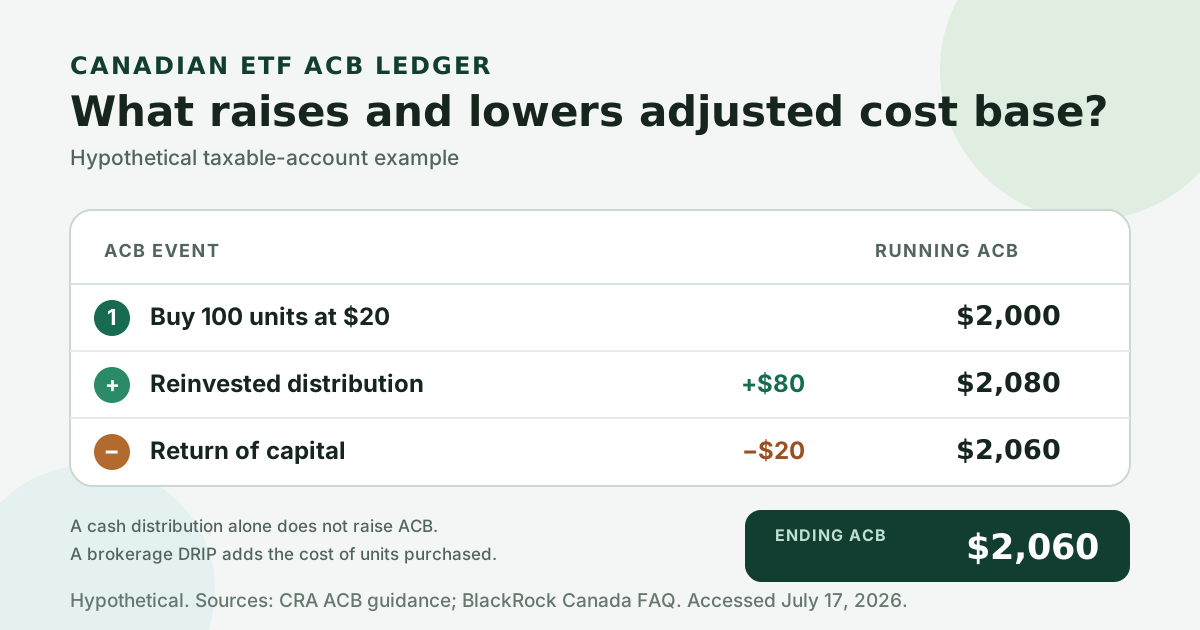
- Buy 100 units for $20 each. With no commission, total ACB starts at $2,000 and average ACB is $20 per unit.
- The ETF allocates an $80 reinvested distribution. No cash arrives and the unit count remains 100 after consolidation. Add $80. Total ACB becomes $2,080.
- Final tax reporting identifies $20 of return of capital. Subtract $20. Total ACB becomes $2,060, or $20.60 per unit.
- Later, all units are sold for $2,500. Ignoring selling costs, the capital gain is $2,500 minus $2,060, which equals $440. The T3 income allocated before the sale remains a separate part of the tax record.
The CRA's current ACB guidance says a positive box 42 amount is subtracted from the ACB of trust units. If the reduction would push ACB below zero, the negative amount is treated as a capital gain and ACB resets to zero. A high cash distribution is not automatically tax-free or a sign of strong performance just because part of it is classified as ROC.
A practical year-end record-keeping workflow
Canada pools identical units owned by the same taxpayer. The CRA's 2025 Capital Gains guide, current for returns filed in 2026, says the average cost is total cost divided by the number of identical properties owned. Section 47 of the Income Tax Act frames the calculation by taxpayer, not brokerage account. That means purchases at different prices are not separate tax lots in the US sense. Combine identical units across the same beneficial owner's taxable accounts, while keeping another taxpayer's property separate.
- Record each trade in Canadian dollars. Keep trade date, unit count, price, commission, and exchange rate where relevant.
- Record every DRIP as a purchase. Add the units and their acquisition cost to the pool.
- Wait for final tax classifications. A payment described as income during the year may be split into several categories after year-end.
- Reconcile the T3 by security. The slip may aggregate multiple ETFs, so use the brokerage supplement and manager records.
- Check the issuer or CDS breakdown. TMX/CDS says its Canadian Tax Breakdown Reporting Service lets issuers publish allocations and distributions used for T3 and other slips. Its public filing database can be searched by security and tax year.
- Add non-cash reinvested distributions and subtract ROC. Use final figures for the periods during which you held the units, especially if you sold partway through the year.
- Recalculate after every sale. A sale uses the average ACB per unit immediately before disposition. The ACB per remaining unit is normally unchanged by the sale itself.
A T5008 or brokerage gain report can be useful, but it does not replace the ledger. The CRA's T5008 instructions say box 20 may or may not reflect the ACB used to report a gain or loss and that the investor must make any required adjustments. Transfers between brokers, holdings at multiple firms, DRIPs, reinvested distributions, ROC, and superficial-loss adjustments are reasons to reconcile rather than accept one displayed book value without review.
What distribution history tells you when screening ETFs
Headline yield does not reveal how a distribution was produced or taxed. Two ETFs with the same cash yield can deliver different mixtures of Canadian dividends, foreign income, capital gains, interest, and ROC. Review the manager's multi-year tax-character history alongside mandate, holdings, fees, turnover, and total return. Do not treat ROC as extra return: it can simply return part of the capital already invested.
Account location changes the administrative burden. These ACB adjustments matter directly in a taxable account. A TFSA does not require capital-gain reporting on internal sales, while an RRSP has its own withdrawal rules. That does not make account choice automatic. Contribution room, time horizon, foreign withholding, income type, and flexibility still matter. The Canadian account-location framework shows how to weigh those factors without letting one tax feature drive the portfolio.
Related reading
- Eligible versus non-eligible dividends explains why a Canadian dividend allocation is not taxed like foreign or interest income.
- Foreign withholding tax by account separates fund-distribution reporting from tax withheld before income reaches the ETF investor.
- REITs in a TFSA, RRSP, or taxable account covers another investment whose cash distributions can contain several tax categories.
- Canadian-listed versus US-listed ETFs explains why the wrapper affects withholding and tax documents.
Screen the income before choosing the account
Use the free screener to review a stock or ETF's income type and compare its educational account-location read for TFSA, RRSP, FHSA, and taxable accounts.
Open the free stock screenerFrequently asked questions
Do ETF distributions increase ACB?
It depends. A fund-level reinvested distribution generally increases ACB. A brokerage DRIP adds the cost of the units purchased. ROC generally reduces ACB. An ordinary cash distribution that is not reinvested does not itself increase the ETF's ACB.
What is a phantom distribution?
It is an informal name for a distribution reinvested by the ETF rather than paid in cash. It is generally included in taxable reporting for a non-registered account and added to ACB, even if a unit consolidation leaves the investor with the same number of units.
Is return of capital tax-free?
ROC is generally not taxed immediately, but “tax-deferred” is a better description than “tax-free.” It reduces ACB, which can increase a later capital gain or reduce a later loss. If ACB falls below zero, the negative amount is treated as a capital gain and ACB resets to zero.
Can I rely on my broker's book value?
Use it as a cross-check, not the only record. Reconcile trade confirmations, transfers, T3 slips and supplements, DRIPs, issuer or CDS breakdowns, and prior ACB adjustments. The taxpayer is responsible for the ACB used when reporting a disposition.
Sources
- Canada Revenue Agency: T4037, Capital Gains 2025
- Canada Revenue Agency: Special rules and other transactions
- Canada Revenue Agency: T3 slip information for individuals
- Canada Revenue Agency: T5008 slip information for individuals
- Justice Laws Website: Income Tax Act, section 47
- BlackRock Canada: Distributions and tax FAQ
- Vanguard Canada: Tax Centre
- TMX CDS: Tax reporting and Canadian Tax Breakdown Reporting Service
- TMX CDS: Public Canadian Tax Breakdown Reporting Service filings
- TD Asset Management: ETF tax tips for year-end