
Canada's superficial loss rule: the 61-day test for investors
If you sell a stock or ETF at a loss, buying the same investment back too soon can stop you from claiming that loss now. Canada's superficial loss rule looks across an inclusive 61-day window, from 30 calendar days before the sale through 30 calendar days after it. It can also catch purchases by your spouse, your controlled corporation, a dividend reinvestment plan, or your TFSA, RRSP, or FHSA.
The result is not always the same. A loss may remain fully claimable, be deferred through the adjusted cost base of a taxable replacement, or become permanently unusable when the replacement is inside a TFSA, RRSP, or FHSA. The account and the buyer matter as much as the date.
What's in this guide
| Section | What it answers |
|---|---|
| The two-part test | When the rule applies and why the window is 61 days |
| Worked example | Claimed now, deferred, or permanently denied |
| Who else counts | Spouses, corporations, registered plans, and DRIPs |
| Identical property | How the test applies to stocks and ETFs |
| Partial losses | Why selling only part of a position can still trigger the rule |
| Decision checklist | What to verify before placing a loss trade |
| Tax records | ACB, Schedule 3, and carryback rules |
| Related reading | Account location and taxable-account mechanics |
| FAQ | Four quick answers |
| Sources | CRA, legislation, and specialist references |
The rule has two conditions, not one
Section 54 of the Income Tax Act and the CRA's capital-loss guidance set out two conditions. Both must be present:
- You or an affiliated person acquires, or obtains a right to acquire, the same or an identical property during the period beginning 30 calendar days before the disposition and ending 30 calendar days after it.
- You or an affiliated person still owns, or has a right to acquire, that substituted property at the end of the period.
The disposition date sits in the middle, so the inclusive window contains 61 calendar days. If July 14 is the disposition date for tax purposes, the window runs from June 14 through August 13, and August 14 is the first day outside it. Check the date used on the transaction's tax records, especially around settlement-cycle changes. Waiting only 30 days after a sale does not fix a purchase made before the sale, which is why checking both sides matters.
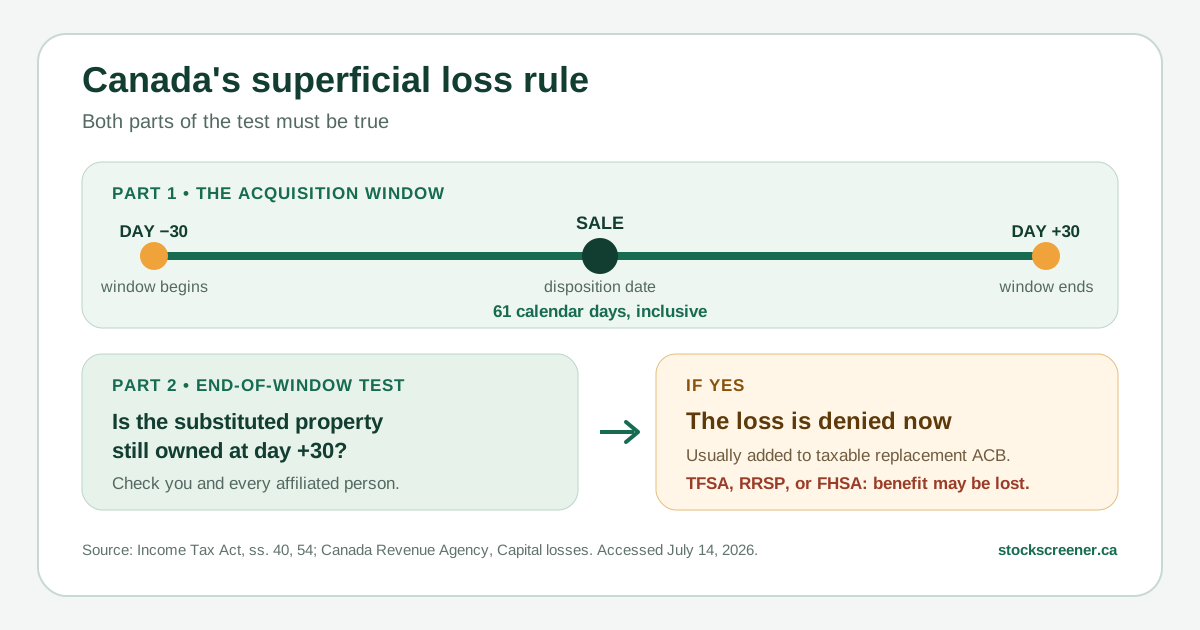
The second condition prevents a purchase inside the window from automatically tainting the loss forever. If the substituted property is no longer owned at the end of the window, the statutory test may not be met. That path can create another gain or loss and more transaction costs, so it is not a shortcut to use without reviewing the full sequence.
One sale, three possible tax outcomes
Assume an investor bought 100 shares for an aggregate adjusted cost base of $10,000, then sold all 100 for $7,000 on July 14. Ignoring selling costs, the economic loss is $3,000. The tax result depends on what happens around that sale.
| What happens | Likely treatment | Where the $3,000 goes |
|---|---|---|
| Neither the investor nor anyone affiliated with them acquires the same or identical property in the window | Not a superficial loss | Available under the normal capital-loss rules |
| The investor repurchases 100 identical shares in a taxable account on August 1 and still owns them on August 13 | Superficial loss | Usually added to the replacement shares' ACB, deferring recognition |
| The investor's spouse makes that taxable-account purchase and holds it through August 13 | Superficial loss | Generally added to the spouse's replacement-property ACB, creating cross-person tracking |
| The investor's TFSA, RRSP, or FHSA acquires the replacement and holds it through August 13 | Loss denied | The tax benefit can become permanently unusable |
The CRA says a superficial loss is not deductible in the sale year, but the person acquiring the substituted property can usually add it to that property's ACB. That higher ACB can reduce a later gain or increase a later loss. This is normally a deferral, not destruction of the loss. The registered-account outcome is harsher because ACB does not produce a deductible capital loss inside the plan. The current Income Tax Act, section 40 expressly includes FHSAs in its direct-transfer loss-denial rule, alongside TFSAs and several other registered trusts. CI Global Asset Management's tax guidance explains the same permanent-denial problem for RRSP and TFSA transfers or replacement purchases.
Your other accounts and automatic purchases count
The rule is wider than one brokerage account. The CRA lists a spouse or common-law partner, a corporation controlled by you or your spouse, certain partnerships, and certain trusts among affiliated persons. CI's technical summary notes that affiliation is narrower than ordinary family relationship: an individual is generally affiliated with a spouse or common-law partner, but not merely with a child, parent, or sibling.
A TFSA, RRSP, or FHSA trust can be within the affiliated-person net. This creates a common trap: a taxable account sells at a loss while one of those plans buys the same security. An in-kind contribution of a losing position from a taxable account to a TFSA, RRSP, or FHSA is also not a way to preserve the loss. The transfer is a disposition, and the loss can be specifically denied.
Automatic activity deserves the same review as a manual order. A DRIP that buys even a small number of identical shares during the window can create a partial superficial loss if those shares remain at the end. Recurring mutual-fund purchases, employee share plans, robo-adviser trades, and a spouse's standing orders can have the same effect. The CIBC tax and estate planning report illustrates how employee share purchases and partial holdings can trigger the rule.
A different ticker is not automatically different property
The CRA's archived interpretation bulletin IT-387R2, Meaning of Identical Properties, describes identical properties as the same in all material respects, such that a prospective buyer would not prefer one over the other. The CRA also says this is a question of fact based on the relevant details. The bulletin is archived and does not have the force of law, but it remains a useful statement of the CRA's interpretive approach.
For common shares of the same class in the same company, the answer is usually straightforward: one share is interchangeable with another. ETFs need more care. Two products can have different tickers and issuers yet follow the same benchmark. A PWL Capital research paper on Canadian-listed ETFs summarizes a CRA technical position that two index funds tracking the same benchmark may be identical property. It uses funds tracking different indexes as replacement examples, while warning that similar exposure still brings tracking difference, fees, bid-ask spreads, and market risk.
Do not rely on an old list of ticker pairs. Fund benchmarks, mandates, structures, and fees can change. Compare the current prospectus and fund facts for both products, and get tax advice when the distinction is material.
Selling part of a holding can deny part of the loss
The rule can apply even without a post-sale repurchase. Suppose shares were acquired inside the 30 days before a loss sale and some identical shares remain 30 days after the sale. The pre-sale acquisition satisfies the first condition, and continued ownership can satisfy the second.
For partial dispositions, the CRA has an administrative formula summarized by CIBC: the superficial portion is the total loss multiplied by the least of the number sold, acquired in the window, or still owned at the end, divided by the number sold. This is where DRIPs and payroll purchases can turn a seemingly clean sale into a partly denied loss. Multiple lots, owners, currencies, or corporate accounts make professional review more valuable.
A before-trade checklist
A loss should support the portfolio decision, not drive it. Selling and replacing an investment can change exposure, create spreads and commissions, or miss a rebound. TD Direct Investing's tax-loss harvesting overview frames harvesting as a non-registered-account strategy and stresses ACB, costs, and portfolio fit.
- Confirm there is a tax loss. Use aggregate Canadian-dollar ACB, not the price of one purchase lot or a brokerage's performance display.
- Map every owner and account. Check your taxable accounts, registered plans, controlled corporations, and your spouse or common-law partner's activity.
- Look back 30 calendar days. Include DRIPs, recurring buys, option rights, payroll plans, and transfers.
- Plan the next 30 calendar days. Decide whether to remain in cash or use an investment that is similar enough for the portfolio but not identical for tax purposes.
- Check the end-of-window holding. The second statutory condition is ownership or a right to acquire at the end of the period.
- Compare benefit with cost and risk. A tax deferral does not guarantee a better after-tax investment result.
- Document the conclusion. Keep trade confirmations, ACB calculations, fund documents, exchange rates, and the reason the replacement was considered non-identical.
How the loss reaches your tax return
The CRA's current 2025 Capital Gains guide, available for the 2026 filing season, says a capital loss is proceeds minus ACB and selling expenses when that result is negative. Publicly traded share and mutual-fund dispositions are reported on Schedule 3. A T5008 can help, but the CRA says supporting records are needed to calculate capital gains and losses. Book value shown by a broker may not capture positions at other institutions, transfers, reinvested distributions, return of capital, or superficial-loss adjustments.
Allowable capital losses first offset taxable capital gains for the year. A remaining net capital loss can generally be carried back three years or forward indefinitely against taxable capital gains, according to the CRA. Applying a prior-year loss involves inclusion-rate adjustments, so retain the assessed net-capital-loss balance rather than treating the raw economic loss as a permanent dollar-for-dollar amount.
Related reading
- Canadian stock account location: TFSA vs RRSP vs non-registered explains why the same holding can have a different tax result by account.
- FHSA investments and account location covers qualified investments and how this newer account differs from TFSA and RRSP thinking.
- Foreign withholding tax: TFSA vs RRSP vs taxable separates withholding tax from Canadian capital-gain treatment.
- Unused TFSA and RRSP contribution room explains why a transfer or recontribution can have consequences beyond the loss rule.
- TFSA transfer in kind: tax and contribution room covers the deemed-disposition and contribution-room consequences of moving investments between accounts.
Check the account before the ticker
Use the free screener to identify a stock or ETF's income type and compare its educational account-location read for TFSA, RRSP, FHSA, and taxable accounts.
Open the free stock screenerFrequently asked questions
How long must I wait to rebuy after selling at a loss?
The acquisition window runs from 30 calendar days before the disposition through 30 calendar days after it. If July 14 is the disposition date for tax purposes, August 14 is the first day outside the post-sale window. Check the date used on the transaction's tax records, pre-sale buys, and affiliated persons too.
Is a superficial loss gone forever?
Usually not. It is generally added to the ACB of the taxable replacement property, deferring recognition until a later disposition. A replacement inside a TFSA, RRSP, or FHSA is the major trap because the tax benefit can become permanently unusable.
Can my spouse trigger my superficial loss?
Yes. A spouse or common-law partner is affiliated for this rule. Their purchase can deny some or all of your loss if the same or identical property is still owned at the end of the window.
Does the rule apply inside a TFSA, RRSP, or FHSA?
A loss arising wholly inside one of these registered accounts is not deductible. The plan's replacement purchase can also deny a loss realized in your taxable account, which is why accounts must be reviewed together.
Sources
- Canada Revenue Agency: Capital losses
- Justice Laws Website: Income Tax Act, section 54
- Justice Laws Website: Income Tax Act, section 40
- Canada Revenue Agency: T4037, Capital Gains 2025
- Canada Revenue Agency: IT-387R2, Meaning of Identical Properties (archived)
- TD Direct Investing: Tax loss harvesting
- CIBC Private Wealth: Investors should be aware of this quirk in the superficial loss rule
- CI Global Asset Management: Superficial losses and how to plan around them
- PWL Capital: Tax-loss Selling Using Canadian-listed ETFs