
FHSA investments: what you can hold and how account location works
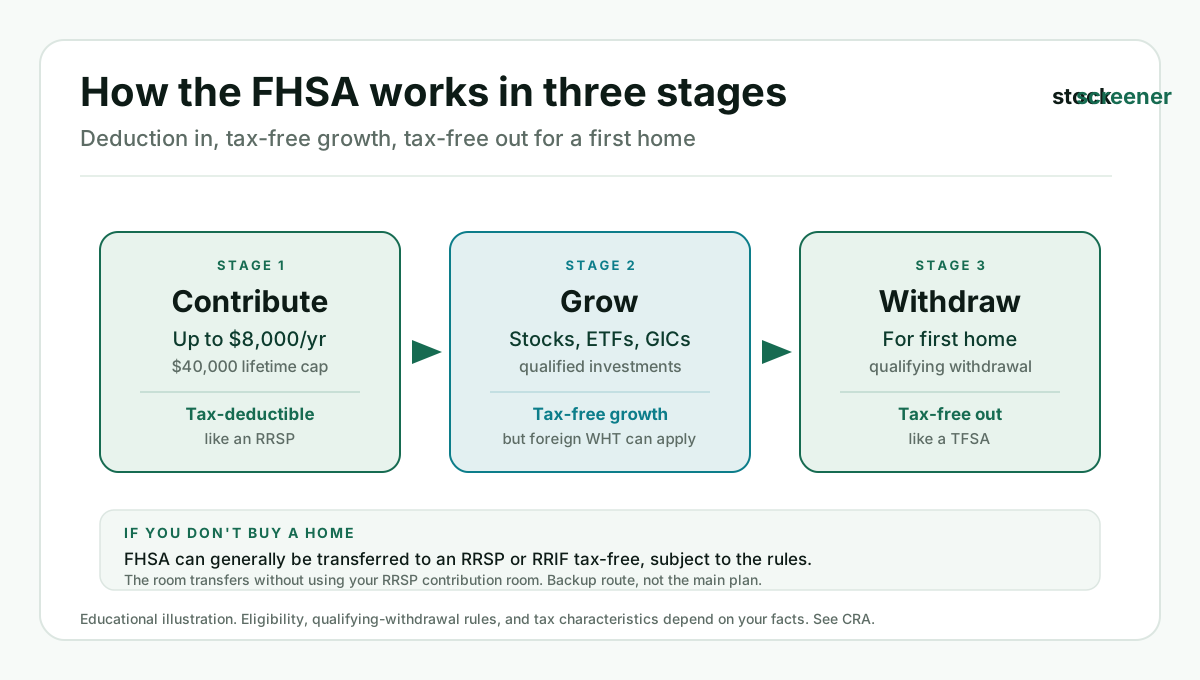
The FHSA is new enough that a lot of people still treat it like a mystery account. It is not quite a TFSA. It is not quite an RRSP. For first-time home buyers, it can be better than both in the right situation: contributions can be deductible, and qualifying withdrawals can be tax-free.
But once the account is open, the practical question shows up fast: what can you actually hold in it, and does account location still matter?
What's in this guide
| Section | What it covers |
|---|---|
| FHSA basics | Contribution room, deduction, and qualifying withdrawals |
| What you can hold | Qualified investments and issuer limits |
| Account location | How FHSA differs from TFSA, RRSP, and taxable accounts |
| Time horizon | Why home-buying timing matters more than cleverness |
| Sources | Official CRA references |
FHSA basics
CRA describes the FHSA as a registered plan that lets a qualifying first-time home buyer save to buy or build a qualifying first home tax-free, up to certain limits. Your participation room in the first year you open an FHSA is $8,000. Contributions are generally deductible, while direct transfers from RRSPs to FHSAs are not deductible.
The big lifetime number is $40,000, but do not confuse FHSA room with TFSA room. TFSA room has stacked every eligible year since 2009. FHSA room only starts once you open the account, and unused FHSA participation room has tighter carry-forward limits. If you might use an FHSA, opening timing matters.
What you can hold in an FHSA
CRA says FHSAs must limit investments to qualified investments, generally similar to RRSPs and TFSAs. Common qualified investments include:
- cash
- mutual funds
- most securities listed on a designated stock exchange
- guaranteed investment certificates
- Canada savings bonds and provincial savings bonds
- certain shares of small business corporations
That list is broad, but your issuer can still limit what its FHSA platform supports. A bank FHSA, brokerage FHSA, and robo-advisor FHSA can feel like three different products even though the tax account is the same.
Non-qualified and prohibited investments are a serious problem. CRA notes that a 50% tax can apply to non-qualified or prohibited investments, and income or gains on those investments can trigger additional tax. That is not a small footnote. It is a reason to avoid anything odd unless the issuer and a professional have confirmed it belongs.
How FHSA account location works
The FHSA combines two ideas investors already know. The contribution can feel RRSP-like because it is generally deductible. A qualifying withdrawal can feel TFSA-like because it comes out tax-free. But the investing layer has its own trade-offs.
| Holding type | FHSA account-location note |
|---|---|
| Cash and GICs | Simple, liquid, and easier to match to a near-term home purchase, but may have lower expected return. |
| Canadian stocks and ETFs | Can be qualified if listed properly, but short timelines make market risk important. |
| US stocks and US-listed ETFs | Can raise currency and foreign withholding questions. CRA notes foreign dividends paid to an FHSA could be subject to foreign withholding tax. |
| Global ETFs | Convenient diversification, but fund-wrapper withholding and distribution character can still matter. |
The important FHSA difference is purpose. A TFSA can be retirement money, emergency money, or long-term investing money. An FHSA is usually house money. If the home purchase is close, downside risk matters more than whether a dividend is taxed slightly more elegantly in one account than another.
The timeline should drive the investment
If you plan to buy in six months, the account-location signal is mostly liquidity and capital preservation. If the purchase is five years away, diversified market exposure might enter the conversation. The VFV, VOO, XEQT, and QQQ guide is one educational example of how exposure, currency, and wrappers differ. If the purchase never happens, the FHSA can generally be transferred to an RRSP or RRIF without immediate tax, subject to the rules, but that is a backup route rather than the main plan.
So the FHSA question is not "can I hold stocks?" Often, yes. The better question is "does this stock risk match a house down payment timeline?" That is a different kind of analysis than a retirement RRSP.
Check a ticker before it goes in the FHSA
Use the lookup to see whether a stock or ETF raises foreign withholding, dividend, or review flags before you place it in a registered account.
Open the free stock screenerRelated reading
- RESP investments and account location for Canadian parents
- Unused TFSA and RRSP contribution room
- Foreign withholding tax: TFSA vs RRSP vs taxable
- Canadian stock account location: TFSA vs RRSP vs taxable
Frequently asked questions
What can I hold in an FHSA?
CRA says common qualified investments include cash, mutual funds, most securities listed on a designated stock exchange, GICs, savings bonds, and certain small-business shares. Your issuer may limit the options it offers.
Does an FHSA have the same tax treatment as a TFSA?
No. An FHSA has deductible contributions and tax-free qualifying withdrawals, but foreign withholding, qualified-investment rules, and non-qualified investment taxes still matter.
Should I hold stocks in an FHSA?
It depends on your home-buying timeline, risk tolerance, and account room. A near-term purchase can make liquidity and downside risk more important than tax optimization.