
RESP investments and account location for Canadian parents
I get asked about RESPs more than any other registered account, and almost always in the wrong order. People want to know what to buy before they understand when they need it back. The Registered Education Savings Plan is the one Canadian shelter with a real deadline, which makes account location work differently here than in a TFSA, RRSP, or FHSA. Get the timeline right and you can ride the equity curve for fifteen years. Get it wrong and you can watch a market drop cut into the tuition cheque the year it actually has to be written.
This guide walks through how the RESP works, the grant math, what you can hold, and the part most articles skip: how the timeline should drive the allocation. Plus the foreign-withholding catch, the RESP vs FHSA question for the same kid, and what happens if your child doesn't end up going.
What's in this guide
| Section | What it covers |
|---|---|
| RESP basics | How the account works in 60 seconds |
| The numbers | Contribution limit, CESG, CLB, QESI |
| What you can hold | Qualified investments and how the menu compares |
| The timeline trap | Why a glidepath beats "set and forget" |
| Foreign withholding in an RESP | Why the RRSP treaty exemption does not apply |
| RESP vs FHSA for the same kid | Two different problems, two different tools |
| Withdrawals and the AIP risk | EAP, PSE, and what happens if school doesn't happen |
| Quebec angle | QESI and the extra match |
| Common mistakes | What I'd tell a friend opening one tomorrow |
| FAQ | Quick answers |
| Sources | CRA, ESDC, Revenu Québec |
How an RESP works in 60 seconds
An RESP is a registered account with a specific purpose: paying for a child's post-secondary education. You (the subscriber) contribute money for a beneficiary. The federal government adds the Canada Education Savings Grant on top. The money grows tax-free inside the plan. When the beneficiary enrols in qualifying school, you withdraw to pay for it, and the taxation is split: your original contributions come back to you tax-free, while the growth and grants are taxed in the student's hands, usually at a very low rate.
Three things make the RESP different from a TFSA or RRSP. First, it's purpose-built for one event. Second, the government chips in real money you can't get anywhere else. Third, there's a deadline. By design, the account is meant to be drained over a four-to-six-year window starting when the child turns 17 or 18, not held for life.
The numbers
This is the math worth memorizing.
- Lifetime contribution limit: $50,000 per beneficiary. No annual contribution cap, but contributions over the lifetime limit trigger a 1% per month penalty until removed.
- CESG (basic): a 20% match on contributions, up to $500 per beneficiary per year, with a lifetime maximum of $7,200.
- CESG carry-forward: unused grant room carries forward, but the maximum CESG payable in any single year is $1,000 (which requires a $5,000 contribution).
- Additional CESG: an extra 10% or 20% on the first $500 contributed each year, for lower- and middle-income families.
- Canada Learning Bond: up to $2,000 over time for kids in low-income families, with no contribution required to receive it.
- Beneficiary age for CESG: generally 17 or younger, with extra rules for ages 16 and 17 to discourage last-minute opening.
- Account lifespan: RESPs can stay open up to 35 years (longer for a Specified Plan).
The practical sweet spot for getting the full $7,200 CESG is contributing $2,500 per year for 14 years, plus one final $1,000 contribution to mop up. Front-loading more than that in early years still gets you the lifetime cap on contributions, but the CESG only matches the annual amount, so you leave grant money on the table.
What you can hold
The qualified-investment menu in an RESP is essentially the same as in an RRSP or TFSA: cash, GICs, government and corporate bonds, mutual funds, ETFs, and stocks listed on designated exchanges. Same building blocks. What changes is what makes sense, because of the timeline.
If you're looking up specific tickers and trying to decide where they fit, that's what the free Canadian stock screener is for. The account-location framework for picking the right wrapper is laid out in Canadian stock account location: TFSA vs RRSP vs non-registered, and the ETF angle in VFV vs VOO, XEQT and QQQ. The RESP twist is that all of that needs to be filtered through one question: how many years until tuition?
The timeline trap
This is the part I wish more people understood before they bought their first share. A TFSA can hold the same ETF for forty years. An RRSP becomes a RRIF and drips out for thirty more. An RESP, by design, needs to be largely in cash and short bonds by the time the kid is 17, because tuition starts hitting at 18. That fundamentally changes the allocation question.
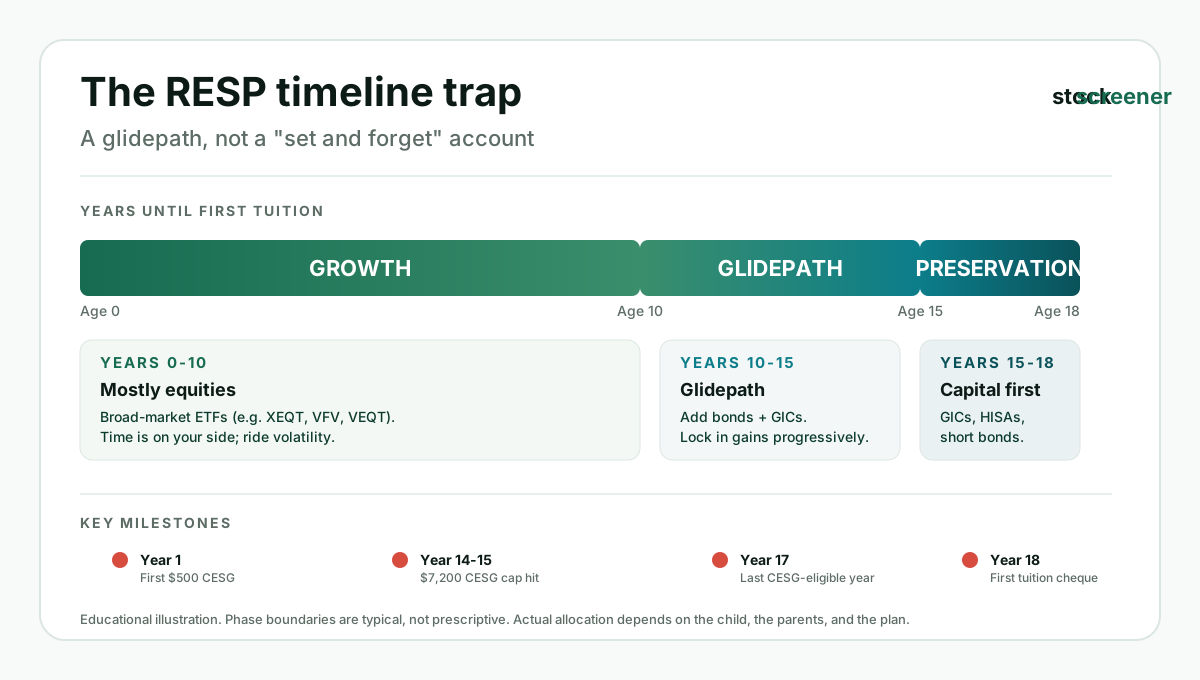
Years 0-10 (growth). The kid is little, you have a decade-plus runway, and the account should look a lot like an aggressive TFSA: broad-market equity ETFs, including XEQT and VFV, or VEQT, high stock weight, you wear the volatility. A 30% drawdown in year three is uncomfortable but recoverable.
Years 10-15 (glidepath). Start trimming. Add bonds and GICs each year, lock in some of the gains. Think of this like landing a plane: you want to be at a much lower altitude by the time you reach the runway. A 30% drawdown in year fourteen is genuinely bad, because the time to recover before the first tuition cheque has run out.
Years 15-18 (preservation). Capital comes first now. Short bonds, GICs laddered to match the years of school, high-interest savings. The grant has been paid, the growth has happened, and your job is to make sure the money is there when the registration office sends the invoice. Sequence-of-returns risk in an RESP is real, and the consequences land on the kid's first semester.
The mistake I see most often is treating the RESP like a TFSA and leaving it 100% in equities the whole way through. It feels fine right up until the year it doesn't.
Foreign withholding in an RESP
People assume that "registered" means "treaty-protected." It doesn't. The Canada-US tax treaty exempts US-source dividends from US withholding tax inside an RRSP, because the treaty specifically recognizes the RRSP as a retirement plan. The RESP is not on that list. So if you hold a US-listed dividend payer (think VOO, JNJ, KO) directly inside an RESP, expect 15% withholding on the dividend, and that 15% is not recoverable inside the plan.
For the early growth years this often doesn't matter much: broad US equity ETFs yield maybe 1.3%, so the drag is something like 20 basis points. For a high-yield US dividend strategy, it's much more. The full mechanics, including what changes for Canadian-listed wrappers like VFV (which holds VOO underneath and still pays withholding at the fund level), are in Foreign withholding tax: TFSA vs RRSP vs taxable.
RESP vs FHSA for the same kid
People conflate these because both have "first" in the elevator pitch. They're for different things.
| RESP | FHSA | |
|---|---|---|
| Purpose | Post-secondary education | First home purchase |
| Subscriber | You contribute for the child | The eventual buyer contributes for themselves (age 18+) |
| Contribution tax | No deduction | Deductible (like an RRSP) |
| Government top-up | CESG up to $7,200 + CLB | None |
| Withdrawal tax | Growth/grants taxed in student's hands | Tax-free for qualifying first-home purchase |
The practical answer: if the child is little and might go to school, an RESP is the no-brainer because the CESG is free money. The FHSA only makes sense once the child is 18 and ready to open one themselves (it has to be in their name, not yours). For the home-purchase question specifically, see FHSA investments: what you can hold and how account location works.
Withdrawals and the AIP risk
When the kid enrols in qualifying post-secondary, withdrawals split into two streams.
- Post-Secondary Education (PSE) payments are your original contributions coming back. Tax-free to you, the subscriber, because you already paid tax on them.
- Educational Assistance Payments (EAPs) are the grants plus the investment growth. These are taxable in the student's hands, which usually means almost no tax: students have basic personal amounts, tuition credits, often little other income. This is the magic of the RESP. Dollars that grew tax-free come out at the lowest rate in the family.
The strategy is to draw EAPs first, while there are still tuition credits to absorb them, and use PSEs later. There's a $5,000 EAP cap in the first 13 weeks of enrolment, after which it loosens.
If the child doesn't go to school, you have options, but watch the tax. The contributions come back to you tax-free. The grants go back to the government. The investment growth becomes an Accumulated Income Payment, taxed at your marginal rate plus an additional 20% under Part X.5 of the Income Tax Act (12% if you're in Quebec). You can avoid that if you have RRSP contribution room: a subscriber can transfer up to $50,000 of AIP directly into their own RRSP (or a spouse's), provided each beneficiary is at least 21 and not enrolled. That's a planning win worth knowing about long before the question becomes urgent.
Quebec angle
If you're a Quebec resident, the federal CESG is only part of the stack. The Quebec Education Savings Incentive (QESI) adds 10% on annual contributions, up to $250 per year, with a lifetime maximum of $3,600 per child. Lower-income families get an extra 5% or 10% on the first $500 each year. Combined with the federal CESG, a Quebec family contributing $2,500 per year can land roughly $750 in annual government top-ups in the early years. The QESI is paid annually, typically in May of the year after the contribution, so don't panic when it doesn't show up immediately.
Common mistakes
- Front-loading the contribution. Putting $25,000 in year one feels efficient, but it caps you at $500 of CESG that year and loses you years of grant matching. The point of $2,500 per year is to harvest the full $500 grant every year.
- Leaving it 100% equities at age 16. The whole point of the timeline trap section above. By that point you're holding a defined obligation, not a long-term investment.
- Buying US-listed dividend stocks for the income. The 15% withholding isn't recoverable in an RESP. If you want US dividend exposure, do it more deliberately, and read the foreign-withholding piece first.
- Forgetting the CESG age rules at 16-17. To receive CESG at 16 or 17, there are extra hoops: either at least $2,000 must have been contributed before the calendar year the child turned 16, or at least $100 per year in any four years before that year. Don't open the account in year 16 and expect grants.
- Treating PSE and EAP withdrawals interchangeably. Pull EAPs first, while the tuition credits exist to absorb them.
See where a specific stock or ETF would fit
Search any ticker and see the educational read for TFSA, RRSP, FHSA, and taxable. RESP follows the same income-type logic, but with the timeline overlay above.
Open the free stock screenerFrequently asked questions
What is the RESP contribution limit?
$50,000 lifetime per beneficiary, regardless of how many RESPs or contributors. No annual cap, but the CESG is matched only on the first $2,500 per year ($5,000 if you have carry-forward room), so most families contribute at that rhythm to harvest the grant.
How much CESG can I get?
The basic CESG matches 20% of contributions up to $500 per year, with a lifetime cap of $7,200. Lower-income families can receive an additional 10% or 20% on the first $500 each year. Carry-forward of unused grant room is allowed, but no more than $1,000 of CESG can be paid in a single year.
What can I hold in an RESP?
The same qualified investments allowed in an RRSP or TFSA: cash, GICs, bonds, mutual funds, ETFs, and stocks listed on designated exchanges. The constraint isn't the menu, it's the timeline.
Are US dividends exempt from withholding tax inside an RESP?
No. The Canada-US treaty exempts US dividends in an RRSP, but not in an RESP. Expect 15% to be withheld and unrecoverable inside the plan.
What if my child doesn't go to school?
Your contributions return to you tax-free. The grants go back to the government. The investment growth becomes an Accumulated Income Payment, taxed at your marginal rate plus 20% (12% in Quebec), unless you can transfer up to $50,000 into your RRSP via the AIP-to-RRSP rules.