
TFSA transfer in kind: tax and contribution room in Canada
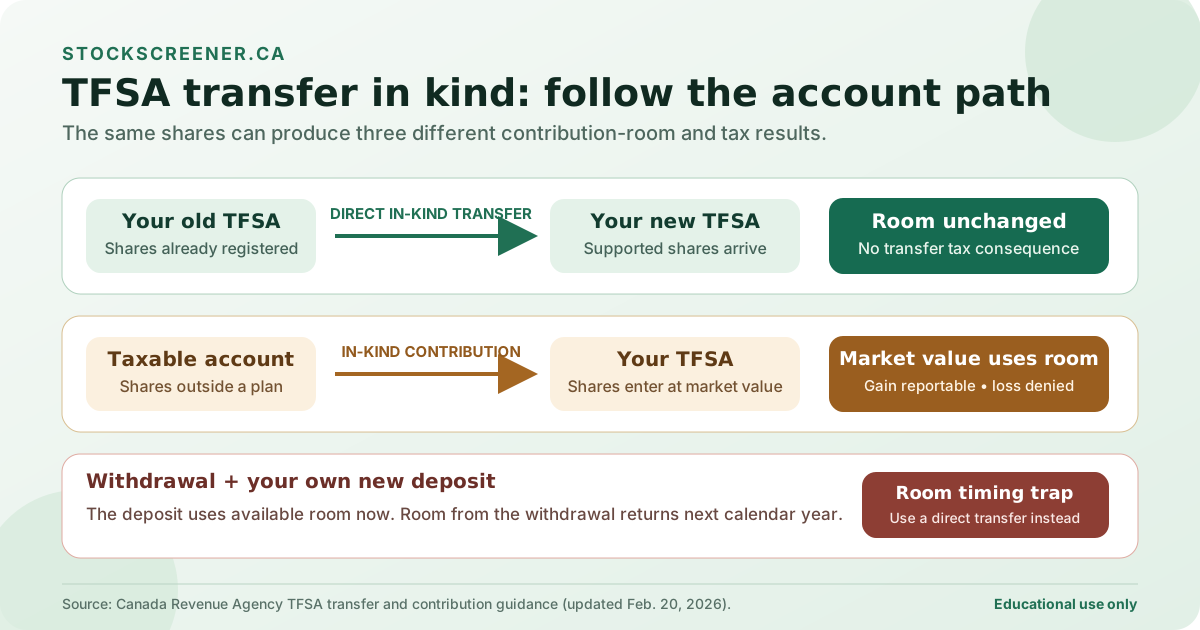
Answer first: A direct in-kind transfer from one of your TFSAs to another keeps the investments intact and does not affect your TFSA contribution room. Ask the receiving institution to initiate it. Moving shares from a non-registered account into a TFSA is different: it is a new contribution at fair market value and a deemed disposition for tax purposes. A gain must be reported, while a loss cannot be claimed.
Withdrawing an investment or cash yourself and depositing it into another TFSA is also not a direct transfer. The deposit uses current contribution room. The withdrawal is added back only on January 1 of the next calendar year, which can create an accidental over-contribution.
The phrase “transfer in kind” describes how the asset moves, not its tax result. The account it leaves, the account it enters, and whether the institutions process it as a direct registered transfer determine the result.
TFSA transfer routes compared
Rules checked August 11, 2026. CRA's current TFSA pages distinguish a direct TFSA transfer from a withdrawal and recontribution, and distinguish both from an in-kind contribution out of a regular non-registered portfolio.
| Route | What happens to holdings | Contribution-room result | Immediate tax result |
|---|---|---|---|
| TFSA to TFSA, direct in kind | Supported investments move without being sold | No effect | No tax consequence from the transfer |
| TFSA to TFSA, direct in cash | Investments are sold inside the old TFSA; cash moves directly | No effect | No tax consequence from the transfer |
| Withdraw, then recontribute yourself | You remove cash or investments, then make a separate deposit | Deposit uses room now; withdrawal returns as room next calendar year | Over-contribution tax can apply if current room is insufficient |
| Non-registered account to TFSA, in kind | Investment moves without a market sale | Fair market value uses room immediately | Deemed disposition: gain reportable; loss not claimable |
| RRSP to TFSA | RRSP property is withdrawn before entering the TFSA | Fair market value uses TFSA room | RRSP withdrawal is income and withholding can apply |
What's in this guide
| What “in kind” means | Transfer method versus account path |
| Direct TFSA-to-TFSA transfers | Room, tax, timing, and asset support |
| Taxable investments moved into a TFSA | Fair market value, gains, and denied losses |
| The withdrawal and recontribution trap | Why a do-it-yourself move can cost room |
| Transfer checklist | Questions to settle before submitting |
“In kind” tells you what moves, not which tax rule applies
An in-kind transfer moves a security as a security. If you own 100 whole shares of an ETF, the transfer request asks the delivering institution to send those shares rather than sell them and send cash. An in-cash transfer sells the investment and sends the cash balance. A partial transfer moves only the positions or amount specified.
Those labels do not identify the tax route. A direct in-kind transfer between two TFSAs is a registered-plan transfer. An in-kind move from a taxable account to a TFSA is a contribution. An in-kind move out of a TFSA to a taxable account is a withdrawal. The security may look unchanged in all three cases, but the contribution-room and tax records are different.
The comparison also should not be reduced to avoiding a sale. Selling an investment inside a TFSA does not by itself create a taxable capital gain or loss. A direct in-cash transfer can therefore be sensible when the receiving institution cannot hold a proprietary mutual fund, a particular GIC, or another position. The trade-off is time out of the market between liquidation and reinvestment, plus any transaction, redemption, spread, or conversion costs.
A direct TFSA-to-TFSA transfer preserves contribution room
CRA says to ask the receiving financial institution to arrange the direct transfer. When it is processed that way, the amount moved is neither a withdrawal that creates future room nor a contribution that consumes current room. This applies whether the transfer is in kind, in cash, full, or partial, assuming the institutions support the chosen method.
Start the request at the destination because it needs the new TFSA registration and the authority to obtain the old account. Do not withdraw first unless you deliberately want a withdrawal and have checked the room consequences. Keep the submitted form, recent statements, and completion notice so the account path is clear if transaction records need to be reconciled later.
“In kind” is not a promise that every position can move. The destination must support the investment. TD, for example, says a D-series mutual fund can transfer in kind to another self-directed brokerage only if that brokerage accepts it. Fractional shares, institution-specific funds, GICs with transfer restrictions, and unsupported securities may need separate handling. Ask for a position-by-position answer before authorizing liquidation.
Timing also depends on the assets. The Financial Consumer Agency of Canada says Canadian Bankers Association member banks target seven business days for deposit-type registered plans, or 12 during the February 15 to April 8 peak, when documents are complete. It explicitly notes that plans containing mutual funds or other investments can take a different amount of time. As one brokerage example, Questrade says a recent stock or ETF purchase must settle one business day after the trade before an internal transfer can process. These are reference points, not a universal transfer deadline.
A delivering institution may charge a transfer-out fee. A receiving broker may reimburse it, but thresholds and conditions change. Compare the current fee schedules and reimbursement terms before moving. A reimbursement policy should not determine whether the account or investments fit the plan.
Moving taxable investments into a TFSA uses fair market value
CRA treats a qualified investment contributed in kind from a non-registered account as disposed of at its fair market value at the time of contribution. That same fair market value is the TFSA contribution amount. If the shares are worth $8,000 when moved, the contribution uses $8,000 of room, regardless of what they originally cost.
If those shares had an adjusted cost base of $6,000, the move produces a $2,000 capital gain before any relevant outlays. The gain must be reported for the year. This does not mean the entire $8,000 is income, and this guide deliberately does not calculate the taxable portion because capital-gain rules and individual circumstances need to be applied for the transaction year.
The loss treatment is less forgiving. If the same shares had an $8,000 adjusted cost base but a $6,000 fair market value, the $2,000 capital loss cannot be claimed, while the transfer still uses $6,000 of TFSA room. Moving a losing position directly into the TFSA does not preserve the loss for later.
Selling at a loss in the taxable account and immediately repurchasing the same investment inside the TFSA is not an automatic workaround. CRA's superficial-loss test can apply when you or an affiliated person acquires the same or identical property during the period beginning 30 calendar days before the sale and ending 30 days after it, and still owns it 30 days after the sale. A denied loss attached to a TFSA replacement can be unusable. The superficial loss guide explains the full 61-day test and registered-account trap.
Before an in-kind contribution, verify the adjusted cost base across all non-registered accounts holding identical property, confirm the security is a qualified investment, obtain the institution's fair market value convention, and leave room for market movement. A rising price between the request and the booked contribution can make the final contribution larger than expected.
Withdrawing and recontributing is the common room trap
CRA says a TFSA withdrawal does not create new room immediately. The amount withdrawn is added back on January 1 of the next calendar year. If you withdraw $20,000 from one TFSA in August and deposit $20,000 into another TFSA in September, that September deposit needs $20,000 of contribution room already available for the current year.
If no room is available, the deposit can become a $20,000 excess even though the money came from another TFSA. CRA generally taxes the highest excess amount in each month at 1% for as long as the excess remains. In this example, that is $200 for each affected month. Removing the excess quickly can limit further tax, but CRA says a TFSA return is still required for an excess amount.
This is why a direct institutional transfer is usually the clean mechanism when the goal is simply to change providers. The separate TFSA contribution-room guide shows how annual room, carried-forward room, and withdrawals fit together. CRA also warns that its account data can lag because issuers report the prior calendar year's activity after year-end, so reconcile your own records rather than treating an online estimate as real-time.
A practical TFSA transfer checklist
- Name the source and destination accounts. TFSA-to-TFSA, taxable-to-TFSA, TFSA-to-taxable, and RRSP-to-TFSA are different transactions.
- Choose in kind or in cash. Compare asset support, market exposure during the move, trading costs, redemption charges, and currency handling.
- Confirm every position with the receiving institution. Ask what will transfer intact, what must be sold, and how residual cash or later distributions will follow.
- Check room from your own ledger. For a taxable-to-TFSA contribution, allow for the investment's fair market value to change before booking.
- Check tax records before moving taxable property. Calculate adjusted cost base in Canadian dollars and identify a reportable gain or denied loss.
- Pause unsettled activity. Ask whether recent trades, open orders, a dividend reinvestment plan, or pending distributions could delay or fragment the transfer.
- Save the evidence. Keep the request, statements from both sides, fees, dates, quantities, and the booked fair market value.
The best transfer method is the one that matches the account path. A direct TFSA-to-TFSA request protects the registered status and contribution-room record. A non-registered-to-TFSA move is a contribution decision that requires room and tax math, even when no sell order appears on screen. For the broader account-location framework, start with TFSA versus RRSP versus non-registered accounts.
Related reading
- Unused TFSA and RRSP contribution room by year
- Canada's superficial loss rule and the 61-day test
- Canadian stock account location: TFSA vs RRSP vs non-registered
- Canadian-listed vs US-listed ETFs in a TFSA and RRSP
Review the investment before moving it
Use the free screener to check a stock or ETF's sector, dividend, and account-location context before transferring the position.
Open the free stock screenerFrequently asked questions
Does a TFSA transfer in kind use contribution room?
A direct TFSA-to-TFSA transfer does not. An in-kind move from a non-registered account into a TFSA is a new contribution at fair market value and uses that amount of room.
Can I transfer stocks from one TFSA to another without selling?
Usually, if the receiving institution supports each security. Ask the receiving institution to arrange a direct in-kind transfer and confirm any positions that cannot move intact before submitting the request.
What happens to a capital loss when shares are transferred into a TFSA?
The non-registered property is deemed disposed of at fair market value. If that value is below its adjusted cost base, CRA says the resulting capital loss cannot be claimed.
Can I withdraw from one TFSA and deposit into another?
Yes, but that is not a direct transfer. The new deposit uses current room, while room from the withdrawal returns only on January 1 of the next calendar year. Without enough unused room, the deposit can create an excess amount.
Sources
- Canada Revenue Agency, Requesting a TFSA transfer, updated February 20, 2026; direct, in-kind, in-cash, partial, and do-it-yourself transfers.
- Canada Revenue Agency, Before you contribute to a TFSA, updated February 20, 2026; 2026 limit, fair market value, qualified investments, in-kind gains and losses, RRSP-to-TFSA treatment, and foreign-currency contributions.
- Canada Revenue Agency, If you over-contribute to a TFSA, updated January 6, 2026; monthly excess tax, issuer reporting, removal, and TFSA return requirements.
- Canada Revenue Agency, If you owe tax on excess TFSA amounts, updated October 14, 2025; highest monthly excess calculation and same-year recontribution example.
- Canada Revenue Agency, Capital losses, updated February 5, 2026; superficial-loss acquisition window and continuing-ownership test.
- Financial Consumer Agency of Canada, Registered products: know your rights, updated October 15, 2025; bank transfer timelines and investment-type caveat.
- TD Direct Investing, D-Series Funds, checked August 11, 2026; receiving-broker acceptance and transfer-out fee caveat for in-kind transfers.
- Questrade, Moving funds and investments overview, checked August 11, 2026; settlement and internal-transfer processing considerations.