
VFV vs VSP: unhedged or CAD-hedged S&P 500?
Answer first: VFV and VSP provide almost the same S&P 500 portfolio at the same published management fee and MER. VFV leaves its US-dollar exposure unhedged. VSP uses currency forwards to seek to hedge that exposure back to Canadian dollars. Choose between the currency policies, not the stock holdings.
Vanguard's June 30, 2026 factsheets reported 506 stocks, a 38.0% top-10 weight, a 1.1% portfolio equity yield, a 0.08% management fee, and a 0.09% management expense ratio (MER) for both funds. The holdings do not settle this comparison because they are effectively the same. The return paths differ when the Canadian dollar moves and because hedging is imperfect.
VFV fits an allocation that intentionally keeps USD exposure. VSP fits an allocation that seeks to isolate the US equity result from CAD/USD movement. Neither choice predicts the currency. A written hedge policy that survives good and bad years is more useful than switching after one fund outperforms.
VFV vs VSP comparison
Information checked August 4, 2026. Portfolio figures and net assets use Vanguard factsheets dated June 30, 2026. MERs are as of December 31, 2025. Trading statistics cover the 12 months ended May 31, 2026. These are dated snapshots, not forecasts.
| Feature | VFV | VSP |
|---|---|---|
| Portfolio role | Unhedged S&P 500 exposure | CAD-hedged S&P 500 exposure |
| Benchmark | S&P 500 Index | S&P 500 Index (CAD-hedged) |
| Holdings | Primarily the same US-domiciled Vanguard S&P 500 ETF | |
| June 30 stocks | 506 | 506 |
| June 30 top-10 weight | 38.0% | 38.0% |
| Management fee / MER | 0.08% / 0.09% | 0.08% / 0.09% |
| Currency policy | USD exposure retained | Uses derivatives to seek a CAD hedge |
| Trading currency | Canadian dollars on the TSX | |
| June 30 net assets | $34.093 billion | $6.113 billion |
| May 31 average spread | 0.018% | 0.028% |
| Distribution schedule | Quarterly | |
| Risk rating | Medium | |
| Plan eligibility | Vanguard lists RRSP, RRIF, RESP, TFSA, DPSP, RDSP, non-registered, and FHSA | |
What's in this guide
| The same stocks underneath | What is identical and what is not |
| What VSP's hedge does | Forwards, resets, and imperfect tracking |
| Why recent returns can mislead | The currency winner changed repeatedly |
| Fees, spreads, and switching costs | The costs beyond the MER |
| TFSA, RRSP, FHSA, RESP, and taxable | Why the account is not the hedge decision |
| A practical decision framework | Set a policy instead of forecasting CAD |
VFV and VSP own the same stocks underneath
Both funds began on November 2, 2012 and primarily invest in the US-domiciled Vanguard S&P 500 ETF. Vanguard's latest factsheets show identical stock counts, sector weights, valuation measures, equity yields, and top holdings. Nvidia, Apple, Alphabet, Microsoft, and Amazon led both lists on June 30, 2026.
That common portfolio matters. VSP is not a more conservative stock fund. It still holds US large-cap equities, and it carries the same market, company, sector, and single-country risks. Vanguard rated both funds “medium” under the prescribed ETF Facts volatility scale, but either can lose money. Hedging one currency exposure does not turn equities into cash or bonds.
The ticker also does not determine the currency exposure. Both ETFs trade in Canadian dollars on the Toronto Stock Exchange. An investor can buy either without converting cash to US dollars. VFV's unit value still reflects the Canadian-dollar value of its US assets. CAD trading is a brokerage convenience; a currency hedge is an investment strategy.
VSP seeks to offset USD/CAD movement with forwards
VFV leaves the exchange-rate effect in the Canadian investor's return. If the US stocks are unchanged in US-dollar terms and the Canadian dollar weakens against the US dollar, those assets become more valuable when translated to Canadian dollars. If the Canadian dollar strengthens, the translation works in the other direction.
VSP uses derivative instruments to seek to hedge the US-dollar exposure back to Canadian dollars. Vanguard's prospectus says certain hedged ETFs enter currency-forward transactions with financial institutions. A forward locks in an exchange rate for a future currency transaction, allowing the fund to offset much of a currency move without selling the underlying shares.
The S&P Dow Jones Indices methodology uses a 100% hedge ratio for its standard currency-hedged indexes and rolls the forwards monthly. It also explains why the result is not perfect: the portfolio moves between resets, the forward rate differs from the spot rate, and the currency weights can change. VSP's objective is to track the CAD-hedged index, not to promise an exact removal of every currency effect.
Vanguard identifies more sources of slippage. Hedge effectiveness can fall when the equity index or exchange rate is volatile, and differences between Canadian and foreign interest rates affect forward pricing. Counterparty exposure, transaction timing, fund cash flows, fees, and ordinary tracking error also matter. “CAD-hedged” means a systematic attempt to reduce currency movement, not a guarantee.
The recent winner changed every year
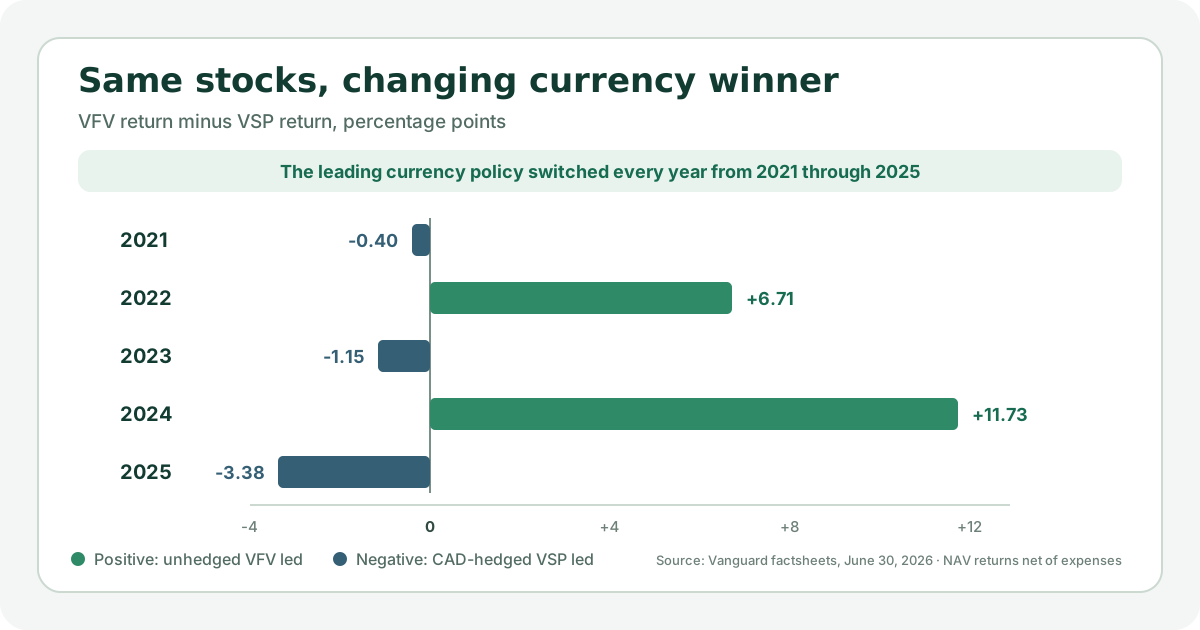
The funds' calendar returns show why choosing the latest winner is a poor currency policy. In 2022, VFV returned -12.69% while VSP returned -19.40%, so the unhedged fund led by 6.71 percentage points. In 2024, VFV led by 11.73 points. The direction reversed in 2023 and again in 2025, when VSP returned 15.61% against VFV's 12.23%.
Across 2021 through 2025, the fund with the higher return switched every year. That is not evidence of a reliable alternating pattern. It is evidence that currency can overwhelm the small differences visible in the fee table, and that a one-year comparison says little about the next year.
Past returns also should not be used to infer the exact CAD/USD move. Fund returns include expenses, distributions, cash flows, hedge implementation, and tracking. The useful lesson is directional: unhedged and hedged versions of the same stock portfolio can report materially different Canadian-dollar results.
The MER is tied, but implementation costs are not identical
Both funds reported a 0.08% management fee and a 0.09% MER as of December 31, 2025. That makes this cleaner than comparisons where the hedged version charges a visibly higher published fee. It does not make hedging free. Forward pricing and hedge implementation show up in the fund's return relative to the unhedged portfolio and its hedged benchmark, rather than as a separate line an investor pays.
VFV was much larger at June 30, with $34.093 billion in net assets compared with VSP's $6.113 billion. ETF Facts reported average daily volume of 793,279 VFV units and 180,733 VSP units for the 12 months ended May 31. The average bid-ask spreads were 0.018% and 0.028%, respectively. Both spreads were small historical averages, not promised trading costs. Live spreads and order execution matter at the time of a trade.
Switching can cost more than the spread. A sale in a taxable account may realize a capital gain or loss. A commission may apply, and time out of the market can change the outcome. Any comparison of a wholesale switch should include the tax, trading, and behavioural costs of acting on a currency view.
Account type does not decide VFV versus VSP
Vanguard lists both ETFs as eligible for the main Canadian registered accounts. Since the funds use the same Canadian wrapper and underlying US equity exposure, the TFSA, RRSP, FHSA, RESP, or taxable label does not make one hedge policy inherently superior. Start with whether the portfolio should retain or reduce USD exposure.
TFSA, FHSA, and RESP
Inside these accounts, Canadian tax sheltering does not eliminate the funds' internal US dividend-withholding layer. BlackRock's December 2025 reference guide says US withholding applies to Canadian-listed funds with US stock exposure in both taxable and non-taxable accounts. CRA says foreign taxes on TFSA and RRSP holdings are excluded from an individual's foreign tax credit calculation, and notes that the same approach may apply to other registered plans.
VSP's hedge does not alter the source of the dividends or make the US companies Canadian. VFV and VSP therefore have the same broad withholding framework. The choice remains currency exposure, risk capacity, time horizon, and the role of US equities in the whole portfolio.
RRSP and RRIF
The Canada-US treaty can exempt qualifying US dividends paid to certain retirement arrangements. That benefit is most relevant when eligible US-listed stocks or ETFs are held directly and the intermediary applies it. VFV and VSP are Canadian-listed wrappers that primarily hold a US-domiciled fund, so US withholding can occur before the distribution reaches the investor's RRSP or RRIF. Hedging does not change that structure.
Investors comparing a Canadian-listed fund with a US-listed fund face a separate wrapper decision involving currency conversion, trading, withholding, simplicity, and position size. The Canadian-listed versus US-listed ETF guide covers that issue. It should not be mixed up with VFV versus VSP, where both listings are Canadian.
Taxable account
CRA says Canadian mutual-fund distributions can include foreign income, capital gains, other income, or return of capital, and that investors must report reinvested distributions shown on their slips. Foreign income and foreign tax paid can appear on the T3, with the credit subject to CRA's limits. The annual tax character can differ between VFV and VSP because their hedge activity and fund results differ, so use each fund's tax information and the actual T3 rather than assuming identical distributions.
Track adjusted cost base for either ETF. If changing hedge policy requires selling, calculate the taxable gain or loss using the Canadian-dollar proceeds, adjusted cost base, and selling costs. The site's ETF distribution and adjusted cost base guide explains the recordkeeping.
Use a hedge policy, not a currency forecast
A practical comparison starts with four questions:
- What exposure is intended? Both funds are US large-cap sleeves, not complete global portfolios. If the real decision is S&P 500 versus broader diversification, compare the holdings before debating the hedge. The VUN versus VFV comparison covers total-market versus large-cap US exposure.
- Is USD exposure useful in the whole portfolio? VFV preserves a foreign-currency component that can diversify Canadian-dollar assets and liabilities, but it also adds exchange-rate movement. VSP seeks to reduce the CAD/USD translation effect, though the equity risk remains.
- Can the policy survive underperformance? VFV will lag a hedged peer in some periods; VSP will lag in others. A policy that changes after every disappointing year turns currency movement into a performance-chasing trigger.
- What would a switch cost? Consider the spread, commissions, taxes, time out of market, and the risk that the currency moves before or after the trade.
An unhedged policy points toward VFV. A policy designed to reduce USD/CAD movement points toward VSP. Holding both creates a partial hedge but adds no new stocks. If a 50/50 split is intentional, it needs rebalancing because the two positions will not grow at the same rate.
The broader portfolio still matters more than the ticker. Either fund can deepen an existing US mega-cap concentration. The ETF account-location comparison hub puts S&P 500 exposure beside global equity and US-listed alternatives, while the XEQT versus VFV guide isolates the global-versus-US decision.
Related reading
- ETF account-location comparison hub: VFV, VOO, XEQT, and QQQ
- VUN vs VFV: total US market or S&P 500?
- XEQT vs VFV: global equity or US large caps?
- Foreign withholding tax by Canadian account type
- Canadian-listed vs US-listed ETFs in a TFSA and RRSP
Check the holding in account context
Use the free screener for an educational account-location overview, then confirm the current issuer documents, tax information, and brokerage costs.
Search VFV in the screenerFrequently asked questions
Is VFV or VSP better for Canadians?
Neither is universally better. They provide nearly the same S&P 500 portfolio at the same current MER. VFV leaves the US-dollar exposure unhedged, while VSP uses derivatives to seek to hedge that exposure to Canadian dollars. The useful choice is the currency policy an investor can maintain, not which fund won recently.
Does VSP remove all currency risk?
No. VSP seeks to hedge its US-dollar exposure, but Vanguard says a currency hedge may not be fully effective. Forward-contract costs, interest-rate differences, market movement between hedge resets, cash flows, and tracking can create differences from the CAD-hedged benchmark.
Are VFV and VSP both traded in Canadian dollars?
Yes. Both trade in Canadian dollars on the Toronto Stock Exchange. That trading currency does not make VFV currency hedged. VFV retains US-dollar economic exposure, while VSP uses derivatives to seek to offset it.
Is VSP better than VFV in an RRSP?
The RRSP does not decide the hedge question. Both are Canadian-listed funds that primarily invest in a US-domiciled underlying Vanguard fund, so US dividend withholding can remain an internal fund cost. Choose between their currency policies first, then assess account location.
Can I hold both VFV and VSP?
Yes, but the combination does not add new stocks because the funds track the same US large-cap portfolio. It creates a partially hedged S&P 500 allocation. The hedge ratio will drift unless the holdings are rebalanced to a written target.
Sources
- Vanguard Canada, VFV product page, current product information and documents checked August 4, 2026.
- Vanguard Canada, VFV factsheet, objective, benchmark, fee, MER, assets, eligibility, holdings, sectors, equity yield, distribution schedule, and returns as of June 30, 2026.
- Vanguard Canada, VFV ETF Facts, July 16, 2026, including May 31 fund size, volume, spread, holdings, risk, and cost data.
- Vanguard Canada, VSP product page, current product information and documents checked August 4, 2026.
- Vanguard Canada, VSP factsheet, objective, benchmark, hedge, fee, MER, assets, eligibility, holdings, sectors, equity yield, distribution schedule, and returns as of June 30, 2026.
- Vanguard Canada, VSP ETF Facts, July 16, 2026, including May 31 fund size, volume, spread, holdings, risk, and cost data.
- Vanguard Canada, ETF prospectus, June 20, 2025, including VFV and VSP strategy, underlying-fund structure, forward transactions, currency-hedging risk, and distribution policy.
- S&P Dow Jones Indices, Index Mathematics Methodology, May 2026, standard hedge ratio, monthly currency-hedged calculation, forward rolls, and sources of residual currency effects.
- BlackRock Canada, Understanding Foreign Withholding Tax, December 2025, Canadian-listed US equity fund treatment in RRSP, RRIF, TFSA, RESP, and taxable accounts.
- Department of Finance Canada, Canada-US Tax Convention, consolidated convention, including Article XXI treatment of dividend and interest income derived by qualifying retirement arrangements.
- Canada Revenue Agency, Income Tax Folio S5-F2-C1, effective March 31, 2026, including foreign tax credit treatment for TFSAs, RRSPs, and other registered plans.
- Canada Revenue Agency, Federal foreign tax credit, updated July 10, 2026, eligibility and calculation framework.
- Canada Revenue Agency, Tax treatment of mutual funds, updated February 5, 2026, distribution types, T3 reporting, reinvested distributions, sales, and adjusted cost base.