
VUN vs VFV: total US market or S&P 500 in Canada?
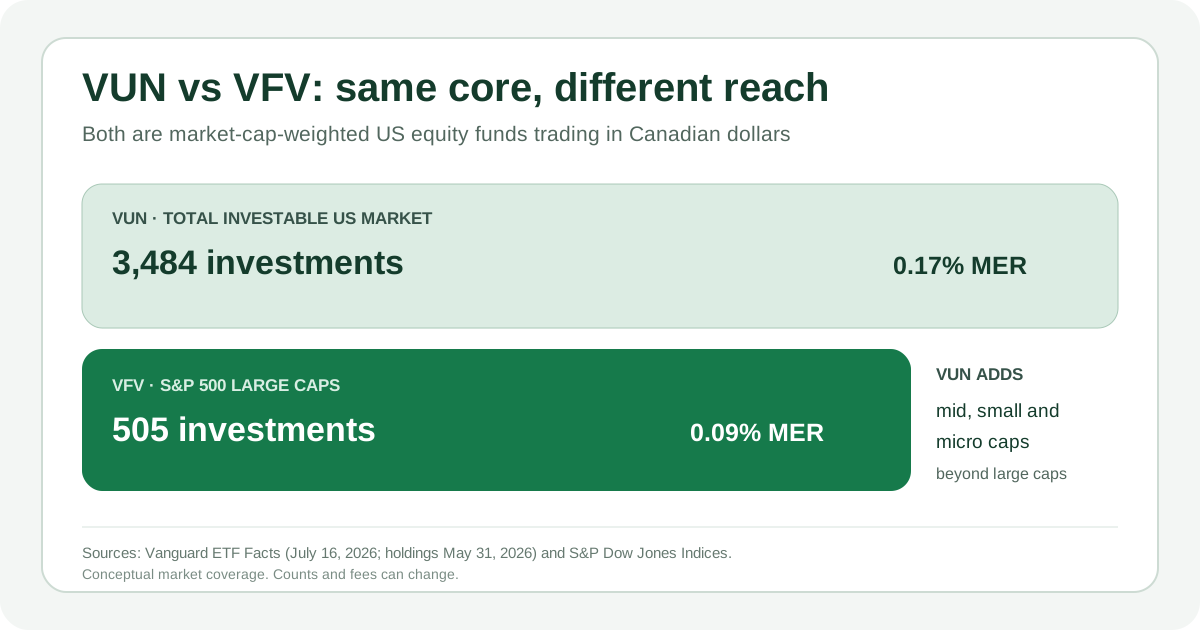
Answer first: VUN is the broader fund; VFV is the cheaper fund. VUN covers large-, mid-, small-, and micro-cap US companies. VFV covers the S&P 500's large-cap companies. Vanguard's July 2026 documents report a 0.17% management expense ratio (MER) for VUN and 0.09% for VFV.
The choice is less dramatic than the stock counts suggest. VUN reported 3,484 investments and VFV 505 as of May 31, 2026, yet market-cap weighting gives the largest companies most of both portfolios. VUN's top 10 represented 35.87% of the fund compared with 40.52% for VFV. VUN adds meaningful small- and mid-cap coverage, but both remain concentrated in the United States, exposed to the US dollar, and driven heavily by the same mega-cap stocks.
For a new allocation, VUN is the more complete one-ticket US market sleeve. VFV offers a lower-cost large-cap sleeve. For an existing holding, switching solely because one recently outperformed can create trading costs and, in a taxable account, a realized gain or loss without fixing a broader portfolio gap.
VUN vs VFV comparison
Information checked July 28, 2026. Management fees and assets use Vanguard factsheets dated June 30, 2026. MERs are as of December 31, 2025 and appear in ETF Facts dated July 16, 2026. Holdings and spread figures in ETF Facts are as of May 31, 2026.
| Feature | VUN | VFV |
|---|---|---|
| Market exposure | Total investable US equity market | US large caps in the S&P 500 |
| Benchmark | CRSP US Total Market Index, or a successor | S&P 500 Index, or a successor |
| May 31 investments | 3,484 | 505 |
| May 31 top-10 weight | 35.87% | 40.52% |
| Management fee / MER | 0.15% / 0.17% | 0.08% / 0.09% |
| June 30 net assets | $18.986 billion | $34.093 billion |
| Implementation | Primarily holds the US-listed Vanguard Total Stock Market ETF | Primarily holds the US-listed Vanguard S&P 500 ETF |
| Trading currency / hedge | CAD / not currency hedged | CAD / not currency hedged |
| Distributions / risk rating | Quarterly / medium | Quarterly / medium |
| Registered-plan eligibility | Vanguard lists RRSP, RRIF, RESP, TFSA, DPSP, RDSP, and FHSA | Vanguard lists the same plans |
What's in this guide
| How much broader is VUN? | Market coverage and overlap |
| What the extra stocks change | Diversification, concentration, and risk |
| Fees and fund structure | The cost gap in dollars |
| Currency and sector pitfalls | Two common comparison errors |
| TFSA, RRSP, FHSA, and taxable | Why account treatment is the same |
| A practical decision rule | Choose the role before the ticker |
VUN is broader, but the portfolios overlap heavily
The benchmark makes the core difference. Vanguard describes VUN's benchmark as a market-cap-weighted index of large-, mid-, small-, and micro-cap US stocks. The index provider describes the total-market benchmark as representing 100% of the investable US equity market. S&P Dow Jones Indices says the S&P 500 covers approximately 80% of available US market capitalization.
That remaining slice is VUN's differentiator. It gives an investor exposure to companies below the S&P 500's large-cap segment without needing a separate completion-market or small-cap fund. VFV omits that slice by design.
VUN does not divide money equally among thousands of companies. Both benchmarks weight companies by float-adjusted market capitalization, so a trillion-dollar company matters far more than a small public company. Nvidia, Apple, Alphabet, Microsoft, Amazon, Broadcom, Meta, Tesla, Micron, and Eli Lilly were the same 10 names at the top of both July ETF Facts documents, in that order. Their individual weights were lower in VUN because smaller companies absorbed part of the portfolio.
This is why “3,484 versus 505” should not be read as nearly seven times the diversification. VUN spreads the last part of the portfolio across far more companies, but the first part still looks much like VFV.
What VUN's extra stocks actually change
Broader market coverage reduces dependence on the S&P committee's inclusion decisions and captures companies before they become large enough for the S&P 500. It also adds the different return patterns of mid-, small-, and micro-cap stocks. Those segments can lead or lag large caps for long periods.
The trade-off is not a promise of higher returns. Smaller companies can have less stable earnings, less access to financing, lower trading liquidity, and larger price swings. VUN's own ETF Facts still rates the whole fund “medium” risk, the same category as VFV. A shared rating does not mean identical behaviour, and it does not mean either all-equity fund is low risk.
Neither fund solves diversification outside the United States. A Canadian investor holding VUN instead of VFV does not gain Canadian stocks, developed markets outside North America, emerging markets, or bonds. The XEQT vs VFV comparison shows how a globally diversified all-equity portfolio differs from a single-country US sleeve.
VFV costs 0.08 percentage points less per year
Vanguard's June 30, 2026 factsheets report a 0.15% management fee for VUN and 0.08% for VFV. Their ETF Facts report MERs of 0.17% and 0.09%, respectively, as of December 31, 2025. MER includes the management fee and fund operating expenses. It is paid inside the fund and reduces returns rather than appearing as a separate brokerage charge.
The 0.08-percentage-point MER gap is about $8 a year per $10,000 invested, before compounding and changes in portfolio value. At $100,000, the same simple illustration is about $80 a year. The dollar difference can grow with the position, but fee alone does not decide whether total-market or large-cap exposure is the intended allocation.
Both Canadian funds primarily invest through a US-domiciled Vanguard ETF. VUN uses Vanguard Total Stock Market ETF; VFV uses Vanguard S&P 500 ETF. Vanguard says there is no duplication of management fees charged through the underlying Vanguard funds. The structure also means the Canadian fund's investment count and portfolio display largely describe that underlying US fund.
ETF Facts reported an average bid-ask spread of 0.027% for VUN and 0.018% for VFV for the 12 months ended May 31, 2026. Those are historical averages, not guaranteed trading costs. Live spreads, commissions, recurring-purchase support, and fractional-unit availability depend on the market and brokerage.
CAD trading does not mean CAD-hedged
VUN and VFV trade in Canadian dollars on the TSX. Neither hedges its US-dollar exposure. Canadian-dollar returns therefore reflect both the US stock portfolio and movement in the CAD/USD exchange rate. Buying with Canadian cash avoids a direct currency conversion for the trade, but it does not remove currency risk.
Vanguard offers separate hedged counterparts: VUS for the US total market and VSP for the S&P 500. The ETF account-location comparison hub covers how listing currency, economic exposure, and account type interact.
Do not compare the sector tables at face value
Vanguard's June factsheets classify VUN with the Industry Classification Benchmark and VFV with the Global Industry Classification Standard. Those systems group some companies differently. For example, VUN's factsheet showed 41.0% “Technology” while VFV showed 38.0% “Information Technology.” That does not prove the broader fund had a larger economic technology bet. A clean concentration comparison uses common holdings and weights, not differently labelled sector buckets.
VUN vs VFV in a TFSA, RRSP, FHSA, or taxable account
CRA guidance says units of ETFs listed on a designated exchange are common qualified investments for registered plans. Vanguard lists both funds as eligible for RRSPs, TFSAs, FHSAs, RESPs, RRIFs, RDSPs, and DPSPs. Eligibility does not establish suitability.
TFSA
Canadian tax on income and gains is generally sheltered when TFSA rules are followed. US tax is different. BlackRock's December 2025 reference guide says Canadian-listed funds seeking US stock exposure face US dividend withholding whether they hold US stocks directly or through a US ETF. CRA says foreign taxes related to TFSA income do not count for a foreign tax credit. VUN and VFV therefore have the same basic withholding lane.
RRSP
An RRSP generally defers Canadian tax until withdrawal. Directly held US-listed stocks or ETFs can receive treaty relief from US dividend withholding in an RRSP, but that relief does not pass through a Canadian-listed wrapper. Both VUN and VFV primarily hold a US ETF inside a Canadian fund, so neither gets an RRSP withholding advantage over the other. The separate guide to Canadian-listed vs US-listed ETFs explains the wrapper decision and its currency-conversion trade-offs.
FHSA
Both can be qualified investments in an FHSA, but a home-purchase timeline can matter more than the benchmark. These are all-equity US funds with medium risk ratings. Money needed for a near-term purchase may not have time to recover from a major decline. An FHSA's deduction and tax-free qualifying withdrawal do not make equity volatility disappear.
Taxable account
Distributions from either Canadian mutual fund trust can include foreign income and foreign tax paid. CRA says a foreign tax credit may be available when the investor reports the foreign income, subject to the calculation and personal facts. Reinvested distributions remain taxable and can change adjusted cost base.
Selling one fund to buy the other can realize a capital gain or loss. The new holding also starts its own cost-base records. Tax consequences, commissions, and time out of market can outweigh an eight-basis-point fee difference for an existing position. The site's ETF distribution and adjusted cost base guide explains the record-keeping mechanics.
A practical VUN vs VFV decision rule
Choose the portfolio role before the ticker. If the role is the broadest practical US equity sleeve in one Canadian-listed fund, VUN fits that description. If the role is specifically US large caps at the lower current fee, VFV fits that description. Neither answer is a complete portfolio by itself.
- Map existing US exposure, including US holdings inside asset-allocation ETFs.
- Decide whether small- and mid-cap exposure is intentional or merely incidental.
- Compare the 0.08-percentage-point MER gap with the value of broader coverage.
- Check live spread, commission, automatic-purchase support, and DRIP rules.
- Before switching in a taxable account, estimate the realized gain or loss and record-keeping impact.
Owning both is not automatically more diversified. VFV mostly adds more weight to large US companies already inside VUN. A blend can be intentional, but it should have a target rather than emerge from ticker indecision.
Related reading
- ETF account-location comparison hub: VFV, VOO, XEQT, and QQQ
- ZSP vs VFV: two Canadian S&P 500 ETFs
- XEQT vs VFV: global equity or US large caps?
- Canadian-listed vs US-listed ETFs in a TFSA and RRSP
- Foreign withholding tax by Canadian account type
Check the US sleeve in context
Use the free screener for an educational account-location overview, then confirm the latest issuer documents and brokerage costs.
Search VUN in the screenerFrequently asked questions
Is VUN or VFV better?
Neither is universally better. VUN covers large-, mid-, small-, and micro-cap US stocks, while VFV focuses on S&P 500 large caps. VFV has the lower current fee. The useful choice is broader market coverage versus a cheaper large-cap portfolio, considered alongside the rest of the investor's holdings.
Does VUN include the S&P 500?
VUN does not track the S&P 500 as a separate sleeve, but its total-market benchmark includes the large US companies that dominate the S&P 500. Market-cap weighting makes the two funds overlap heavily even though VUN also owns mid-, small-, and micro-cap stocks.
Are VUN and VFV currency hedged?
No. Both trade in Canadian dollars on the TSX, but both retain exposure to movements between the Canadian and US dollars. Vanguard offers separate CAD-hedged counterparts, VUS for total-market exposure and VSP for S&P 500 exposure.
Is VUN or VFV better in an RRSP than a TFSA?
The account does not create a tax advantage for VUN over VFV, or VFV over VUN. Both are Canadian-listed funds that primarily use a US-domiciled underlying ETF, so US dividend withholding generally remains a fund cost in either an RRSP or TFSA.
Should I own both VUN and VFV?
Holding both is possible, but it mostly increases the weight of the same US large-cap companies already held by VUN. It does not add Canada, international markets, or bonds. Before combining them, define the intended allocation and check whether the overlap serves it.
Sources
- Vanguard Canada, VUN product page, current documents and product information checked July 28, 2026.
- Vanguard Canada, VUN factsheet, objective, fee, MER, assets, benchmark, structure, sector classification, distributions, and eligibility as of June 30, 2026.
- Vanguard Canada, VUN ETF Facts, July 16, 2026, including May 31 holdings, concentration, trading data, cost, and risk rating.
- Vanguard Canada, VFV product page, current documents and product information checked July 28, 2026.
- Vanguard Canada, VFV factsheet, objective, fee, MER, assets, benchmark, structure, sector classification, distributions, and eligibility as of June 30, 2026.
- Vanguard Canada, VFV ETF Facts, July 16, 2026, including May 31 holdings, concentration, trading data, cost, and risk rating.
- Vanguard Canada ETFs prospectus, June 20, 2025, including fund strategies, underlying-fund structure, currency risk, and the separate VUS and VSP hedged funds.
- S&P Dow Jones Indices, S&P 500, large-cap description and approximate 80% coverage of available US market capitalization, checked July 28, 2026.
- Morningstar Indexes, Expanding How Investors Access the Market, June 11, 2026, including the 100% investable-US-equity-market description and July 2026 rebranding of the CRSP Market Indexes.
- BlackRock Canada, Understanding Foreign Withholding Tax, December 2025, including Canadian-listed US equity fund treatment in RRSP, TFSA, and taxable accounts.
- Canada Revenue Agency, Income Tax Folio S3-F10-C1, qualified investments for registered plans.
- Canada Revenue Agency, What is a TFSA, updated February 20, 2026, including Canadian tax treatment of income and gains in a TFSA.
- Canada Revenue Agency, First Home Savings Account, updated February 2, 2026, including the general deduction and qualifying-home framework.
- Canada Revenue Agency, Income Tax Folio S5-F2-C1, effective March 31, 2026, including foreign tax credit treatment for TFSA and RRSP holdings.
- Canada Revenue Agency, Federal foreign tax credit, updated July 10, 2026, including the basic credit calculation and reporting requirements.
- Canada Revenue Agency, Tax treatment of mutual funds, updated February 5, 2026, including foreign income, reinvested distributions, sales, and adjusted cost base.