
QQQ vs QQC in Canada: same index, different wrapper
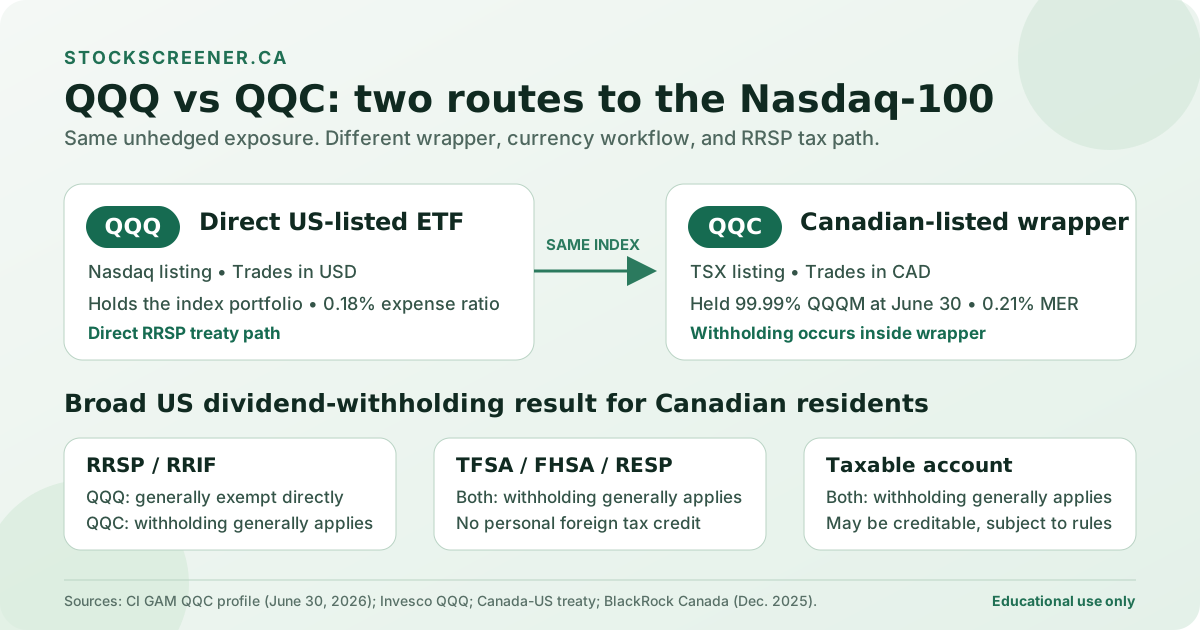
Answer first: QQQ and QQC both provide unhedged Nasdaq-100 exposure. QQQ trades in US dollars on Nasdaq and holds the index portfolio directly. QQC trades in Canadian dollars on the TSX and, according to its June 30, 2026 profile, held 99.99% in the lower-fee US-listed QQQM. For a Canadian investor, the meaningful differences are wrapper, fee, trading currency, liquidity, withholding-tax mechanics, and tax reporting, not the underlying index.
QQQ currently publishes a 0.18% total expense ratio. QQC reported a 0.21% MER as of December 31, 2025, and CI says that MER includes its proportionate share of any underlying-fund expenses. That is a three-basis-point gap, equal to about $3 a year per $10,000 before tracking, withholding, brokerage, and currency-conversion costs.
QQC avoids a personal currency conversion for recurring Canadian-dollar contributions. QQQ trades in US dollars and can receive favourable US dividend-withholding treatment when held directly in an RRSP or RRIF and the intermediary applies the treaty. The dollar value of that tax advantage changes with cash distributions, so it should be weighed against foreign-exchange and trading costs rather than treated as an automatic reason to convert.
QQQ vs QQC comparison
Information checked August 7, 2026. QQC portfolio data are from its June 30, 2026 monthly profile; its MER is dated December 31, 2025. QQQ's current prospectus reports a 0.18% expense ratio following its reclassification, which took effect after market close on December 19, 2025. These are dated facts, not return forecasts.
| Feature | QQQ | QQC |
|---|---|---|
| Current fund name | Invesco QQQ ETF | CI Invesco NASDAQ 100 Index ETF |
| Target exposure | Unhedged Nasdaq-100 Index | |
| Structure | US-listed ETF holding index securities | Canadian-listed fund of funds; 99.99% QQQM on June 30 |
| Listing / trading currency | Nasdaq / USD | TSX / CAD |
| Currency hedge | None | |
| Expense ratio / MER | 0.18% | 0.21% |
| Fee difference per $10,000 | About $3 a year, if the published rates remain unchanged | |
| Inception | March 10, 1999 | May 27, 2021 for CAD units |
| RRSP US dividend withholding | Generally exempt when held directly and treaty relief is applied | Generally applies inside the Canadian wrapper |
| TFSA / FHSA / RESP withholding | Generally applies and is not creditable to the plan holder | |
| Taxable-account T1135 | Can count as specified foreign property | Canadian mutual fund trust units are generally excluded |
What's in this guide
| The same Nasdaq-100 exposure | What the index does and does not diversify |
| QQC's 2026 manager and name changes | Current QQQM holding and wrapper structure |
| CAD trading is not a currency hedge | Trading currency versus economic exposure |
| Fees, spreads, and conversion costs | Why the MER is only one cost |
| TFSA, RRSP, FHSA, RESP, and taxable | Where the wrappers differ most |
| A practical decision framework | Choose the route that fits the workflow |
Both funds target the Nasdaq-100, not the whole US market
Nasdaq's 2026 methodology defines the Nasdaq-100 as 100 of the largest Nasdaq-listed non-financial companies, using a modified market-capitalization weighting scheme. It excludes companies classified in the financial industry, and it is tied to the listing venue. A large company listed elsewhere does not enter merely because it is large.
The methodology now rebalances quarterly and reconstitutes annually. It also caps large weights under specified rules. Those controls limit, but do not eliminate, concentration. QQC's June profile classified 70.64% of the look-through portfolio as technology and gave the Canadian units a medium-to-high risk rating. Invesco describes QQQ as non-diversified and warns that sector-focused investments can be more volatile.
This means “100 companies” should not be read as a complete US equity allocation. Both funds can overlap heavily with an S&P 500 or global all-equity ETF already in a portfolio. The ETF account-location comparison hub puts QQQ beside VFV, VOO, and XEQT, while the XEQT versus VFV comparison shows how a diversified global portfolio differs from a single-country sleeve.
QQC has a new manager and name, but remains a wrapper
CI Global Asset Management became manager of the former Invesco Canada funds on June 1, 2026. CI announced that QQC would be renamed CI Invesco NASDAQ 100 Index ETF on or about July 31, with no ticker change and no material change to the objective or strategy. Investors may still see the old name in a broker's interface, statement, or cached document while systems catch up.
The more important implementation detail is underneath. QQC's June profile says it may invest in QQQ, QQQM, or US companies to replicate the index. The actual top-holdings table showed 99.99% in QQQM at month-end. QQQM tracks the same index as QQQ, but QQC investors own units of the Canadian fund, not QQQM shares directly.
That distinction explains the account-location result. An RRSP holding QQQ directly can be recognized as the retirement arrangement receiving the US-listed fund distribution. With QQC, the dividend first crosses from a US-listed underlying ETF to a Canadian fund. The investor's RRSP sits one level above that payment, so the retirement-account exemption does not remove the fund-level withholding.
QQC trades in CAD but remains exposed to USD
Trading currency and currency exposure are different. QQC lets an investor place an order and receive distributions in Canadian dollars. It does not hedge the underlying US-dollar exposure. If the Canadian dollar weakens against the US dollar, the Canadian-dollar value of the US assets rises, all else equal. If the Canadian dollar strengthens, translation works in the other direction.
QQQ has the same unhedged economic exposure, but a Canadian investor must have US dollars to buy it. A brokerage may convert currency automatically and charge a spread, or the investor may fund a US-dollar side of the account. For larger conversions, Norbert's Gambit is one possible process, but it adds trades, settlement steps, bid-ask spreads, and execution risk.
QQC.F is a separate CAD-hedged series. It is not the ticker in this comparison. An investor choosing between unhedged QQQ and unhedged QQC should not base the decision on a forecast for the Canadian dollar because the intended currency exposure is substantially the same.
The three-basis-point fee gap may not be the largest cost
QQQ's current 0.18% total expense ratio is lower than QQC's 0.21% MER. CI defines the QQC MER as a trailing 12-month measure that includes operating costs, applicable sales taxes, and the fund's proportionate share of underlying-fund expenses. Do not add QQQM's expense ratio to the published 0.21% again.
At unchanged rates, the explicit fee difference is about $3 annually for each $10,000 invested. Actual return differences will also reflect tracking, cash, taxes, portfolio transactions, and the timing of index changes. A fee calculation is useful, but it is not a forecast of the precise performance gap.
Trading conditions can differ meaningfully because QQQ trades on Nasdaq while QQC trades on the TSX. QQC avoids a visible personal currency conversion for CAD purchases, though currency conversion still occurs within the market and fund mechanism. Compare live depth and bid-ask spreads, commissions, brokerage foreign-exchange rates, and how often contributions arrive. Paying a large conversion spread repeatedly can outweigh a few basis points of annual fund fee.
Account type changes the withholding result
CRA says most securities listed on a designated exchange, including ETF units, are common qualified investments for RRSPs, RRIFs, TFSAs, FHSAs, RESPs, and RDSPs. A plan administrator can impose narrower platform rules, so eligibility and trading support should still be confirmed with the broker.
RRSP and RRIF
Article XXI of the Canada-US treaty exempts qualifying dividend and interest income derived by an arrangement operated exclusively to provide pension or retirement benefits. BlackRock's Canadian withholding guide summarizes the practical result: US-listed ETFs held directly in RRSPs and RRIFs are generally exempt from US dividend withholding, while Canadian-listed ETFs with US stock exposure bear withholding inside the fund.
This gives QQQ a recurring tax-mechanism advantage over QQC in an RRSP or RRIF. It is not 15% of the investment balance. It is generally 15% of the US-source cash dividend. Nasdaq-100 yields are not fixed, and the value of the saving changes with distributions. The broker must also apply the treaty treatment correctly.
TFSA, FHSA, RESP, and RDSP
These accounts do not receive the same US retirement-arrangement exemption. A direct holding of QQQ generally has 15% withheld from US distributions, and QQC receives its underlying US ETF distribution after withholding. CRA's foreign-tax-credit folio says foreign tax and income inside a TFSA or RRSP are excluded from the credit calculation and that the same approach may apply to other registered plans.
Because withholding is broadly tied in these accounts, implementation moves to the front. QQC avoids personal currency conversion for recurring CAD contributions, while that hurdle is smaller for QQQ when an account is already funded in USD. Neither wrapper makes the Nasdaq-100 less concentrated, and an FHSA or RESP with a near-term withdrawal may need a very different risk level regardless of ticker.
Taxable account
US dividend withholding generally applies to both structures in a taxable account and may be creditable, subject to the foreign-tax-credit rules and the amounts reported on the tax slip. Capital gains and losses must be calculated in Canadian dollars. QQC can distribute foreign income, capital gains, or return of capital, so the tax slip and adjusted-cost-base records matter.
There is also a reporting difference. CRA says shares of a non-resident corporation or an interest in a non-resident fund are specified foreign property. QQQ can therefore count toward the aggregate C$100,000 cost threshold for Form T1135, even at a Canadian broker. CRA also says an investment in a Canadian mutual fund trust is not specified foreign property. QQC's prospectus says it qualifies as a Canadian mutual fund trust. Registered accounts are excluded from T1135 reporting.
For a deeper explanation of these tax layers, read the foreign withholding tax guide and the Canadian-listed versus US-listed ETF guide.
A practical QQQ versus QQC decision framework
- Confirm the desired exposure. Decide whether a concentrated Nasdaq-100 sleeve is intentional after looking through the rest of the portfolio.
- Choose the currency workflow. If contributions and withdrawals are in CAD, estimate the actual cost and effort of converting. If USD is already available, QQQ's trading-currency hurdle is smaller.
- Apply the account rule. The direct US-listed route has a withholding advantage in an RRSP or RRIF. The broad withholding result is tied in a TFSA, FHSA, RESP, RDSP, or taxable account.
- Compare total implementation cost. Include the fee, live spread, commission, foreign exchange, tax slips, T1135 work, and the cost of changing course later.
- Keep the choice proportionate. A small fee or withholding difference should not override diversification, time horizon, or the ability to tolerate a large equity decline.
The cleanest summary is operational. QQQ is the direct, USD-traded route with the stronger RRSP withholding mechanism and a slightly lower published expense ratio. QQC is the CAD-traded Canadian wrapper with simpler cash handling and no direct foreign-property reporting for the units. Both remain unhedged, concentrated Nasdaq-100 exposure.
Related reading
- ETF account-location comparison hub: VFV, VOO, XEQT, and QQQ
- XEQT vs VFV: global equity or S&P 500?
- Canadian-listed vs US-listed ETFs in a TFSA and RRSP
- Foreign withholding tax by Canadian account
- QQQ account-location overview
Check the ticker in the whole portfolio
Use the free screener to review QQQ's sector, dividend, and account-location context before treating a wrapper difference as the main decision.
Open the QQQ overviewFrequently asked questions
Is QQC the Canadian version of QQQ?
Broadly, yes. Both target the unhedged Nasdaq-100. QQQ holds the index portfolio as a US-listed ETF. QQC is a Canadian-listed wrapper whose June profile showed 99.99% in QQQM. Fees, tracking, cash, and currency translation can still produce different returns.
Does buying QQC in Canadian dollars remove currency risk?
No. QQC's CAD units are unhedged. Buying in Canadian dollars changes the trading workflow, not the underlying US-dollar exposure. QQC.F is the separate hedged series.
Is QQQ or QQC better in an RRSP?
QQQ has the stronger withholding mechanism because direct US-listed holdings in an RRSP or RRIF can generally receive treaty exemption on US dividends. QQC cannot pass the account-level exemption through its Canadian wrapper. The dollar benefit depends on distributions and must be balanced against currency and trading costs.
Is QQQ or QQC better in a TFSA?
Neither receives the RRSP treaty advantage. US dividend withholding generally applies to both and cannot be claimed as a foreign tax credit. The operational comparison is QQQ's lower published fee and direct USD trading versus QQC's CAD trading and simpler contribution workflow.
Did QQC change its name or manager in 2026?
Yes. CI Global Asset Management became manager on June 1, and the fund was renamed CI Invesco NASDAQ 100 Index ETF on or about July 31. CI said the ticker stayed QQC and the objective and strategy did not materially change.
Sources
- CI Global Asset Management, CI Invesco NASDAQ 100 Index ETF product page, manager, current name, ticker, fee, MER, assets, eligibility, and documents checked August 7, 2026.
- CI Global Asset Management, QQC monthly profile, holdings, allocations, risk, fee, MER, distributions, and returns as of June 30, 2026.
- CI Global Asset Management, fund-name-change announcement, June 2, 2026, including QQC's new name and unchanged ticker.
- CI Global Asset Management, amended and restated ETF prospectus, June 9, 2026, including QQC's investment objective, QQQM strategy, currency series, withholding risk, and mutual fund trust status.
- Invesco, QQQ official overview, index, holdings process, risk, and fund structure checked August 7, 2026.
- Invesco, QQQ structure and expense-ratio update, December 22, 2025, including the 0.18% expense ratio.
- US Securities and Exchange Commission, Invesco QQQ prospectus filing, December 19, 2025, including the 0.18% annual operating expenses and reclassification effective after market close that day.
- Nasdaq, Nasdaq-100 Index Methodology, 2026 index objective, eligibility, weighting, quarterly rebalancing, and annual reconstitution.
- BlackRock Canada, Understanding Foreign Withholding Tax, December 2025, US-stock treatment by ETF structure and Canadian account.
- Department of Finance Canada, Canada-US Tax Convention, Article X 15% treaty rate and Article XXI retirement-arrangement exemption.
- Canada Revenue Agency, Income Tax Folio S5-F2-C1, effective March 31, 2026, including foreign-tax-credit treatment for registered plans.
- Canada Revenue Agency, Income Tax Folio S3-F10-C1, qualified investments for RRSPs, RRIFs, RESPs, RDSPs, FHSAs, and TFSAs.
- Canada Revenue Agency, Form T1135 questions and answers, updated 2026, specified foreign property, Canadian mutual fund trusts, and registered-plan exclusions.
- Canada Revenue Agency, calculating and reporting capital gains and losses, Canadian-dollar conversion of proceeds, adjusted cost base, and selling costs for foreign-currency transactions, checked August 7, 2026.