
XGRO vs XEQT: same stocks, one 20% bond decision
XGRO and XEQT differ on one thing that matters: whether about 20% of the portfolio sits in fixed income. XGRO targets roughly 80% equities and 20% fixed income; XEQT targets roughly 100% equities. Their fees and regional stock mix are nearly identical, and no account type settles the choice for you.
BlackRock rates XGRO “low to medium” risk and XEQT “medium,” with XEQT accepting full equity exposure in pursuit of long-term capital growth. Neither label predicts the next loss. The right mix depends on the goal, the time horizon, how much loss your finances can absorb, and whether you would stay invested through a large decline.
The stock side is nearly the same
Information checked October 14, 2026. Portfolio weights and MERs come from BlackRock factsheets with data as of September 30, 2026. Risk ratings come from ETF Facts dated June 19, 2026. Holdings change over time.
| Feature | XGRO | XEQT |
|---|---|---|
| Portfolio job | Global growth portfolio with fixed income | Global all-equity portfolio |
| Strategic target | Approximately 80% equity / 20% fixed income | Approximately 100% equity |
| September 30 equity mix | 36.88% US, 19.55% Canada, 19.94% developed international, 4.36% emerging markets | 45.77% US, 24.89% Canada, 24.26% developed international, 4.89% emerging markets |
| September 30 fixed income | 19.07% across Canadian universe and short corporate bonds, US Treasuries, and US investment-grade corporate bonds | No strategic fixed-income allocation |
| Currency approach | Foreign equity remains exposed to foreign currencies; non-Canadian fixed income uses a currency-hedging strategy | Foreign equity remains exposed to foreign currencies |
| Management fee / MER | 0.17% / 0.19% | 0.17% / 0.19% |
| Distributions | Quarterly | Quarterly |
| Current risk rating | Low to medium | Medium |
| Registered plans | BlackRock lists it as eligible | BlackRock lists it as eligible |
| Rebalancing | BlackRock monitors and rebalances the asset-class targets | BlackRock monitors and rebalances the regional equity targets |
The regional percentages are underlying ETF positions, not guarantees. XGRO's four fixed-income positions total 19.07% and its four equity positions 80.73%; XEQT's equity positions total 99.81%, with small cash positions and rounding making up the rest. Both factsheets still carry a stale 0.18% sentence in the overview, but their fee tables and current product pages report a 0.17% management fee, effective December 18, 2025, which is the figure used here.
XGRO's stocks come from broad US, Canadian, developed-international and emerging-market iShares ETFs. XEQT uses the same four regional building blocks, although it splits its US exposure across two underlying funds. Strip bonds and cash out of XGRO's September 30 positions and its stock sleeve is approximately 45.7% US, 24.2% Canada, 24.7% developed international, and 5.4% emerging markets. XEQT's corresponding total-portfolio weights were 45.77%, 24.89%, 24.26%, and 4.89%.
So XEQT adds no missing country, and XGRO has no different Canadian home bias. Choosing XGRO mainly swaps about one fifth of the all-equity mix for a diversified fixed-income sleeve. Both keep substantial foreign equity and currency exposure despite trading in Canadian dollars on the TSX.
What the 20% in bonds does, and what it cannot do
Bond returns are driven by interest rates, credit conditions and repayment terms rather than corporate profits alone, which is why they can diversify a stock-heavy portfolio. CIRO describes stock prices as capable of frequent, large fluctuations, explains how bond prices respond to interest rates, and calls GICs lower risk. XGRO's fixed income can soften some stock-market swings and gives BlackRock something to rebalance from after equities fall.
Twenty per cent is still a minority position. In a sharp equity decline XGRO can also lose substantially. Bonds carry their own risks: prices generally fall when market yields rise, corporate bonds suffer when credit deteriorates, and longer maturities are more sensitive to rate changes. Stocks and bonds can fall together, so the sleeve is no floor under the unit price.
BlackRock's June 2026 ETF Facts ratings rest on historical volatility. The documents warn that ratings can change and do not show how volatile a fund will be in future. Read them as evidence of relative risk, not a promise that XGRO will always lose less.
Which fits your time horizon and tolerance for losses?
Two separate questions hide inside "risk tolerance." Willingness is how you are likely to react to losses. Capacity is whether your finances can withstand them. CIRO's investor questionnaire treats income stability, assets, debt, the share of total savings invested, objectives and time horizon as relevant inputs. Someone happy to take equity risk may still lack the capacity if the money has a near-term job.
Start with the withdrawal date. CIRO says a very short horizon may call for more conservative holdings such as GICs or money-market funds. XGRO's bonds do not turn an equity-dominated portfolio into short-term savings, and XEQT demands even more room for sustained losses. Both BlackRock ETF Facts describe the funds as medium- to long-term holdings.
Then picture the bad year. If a full-equity decline would push you to sell, XEQT's theoretical long-run return is irrelevant, because the plan may not survive the downturn. XGRO's bond position may help, but only if its own potential losses stay tolerable. Ask which allocation can stay intact through a bad market while the goal remains funded, not which fund returned more recently.
Holding both: 85/15, 90/10 and 95/5 blends
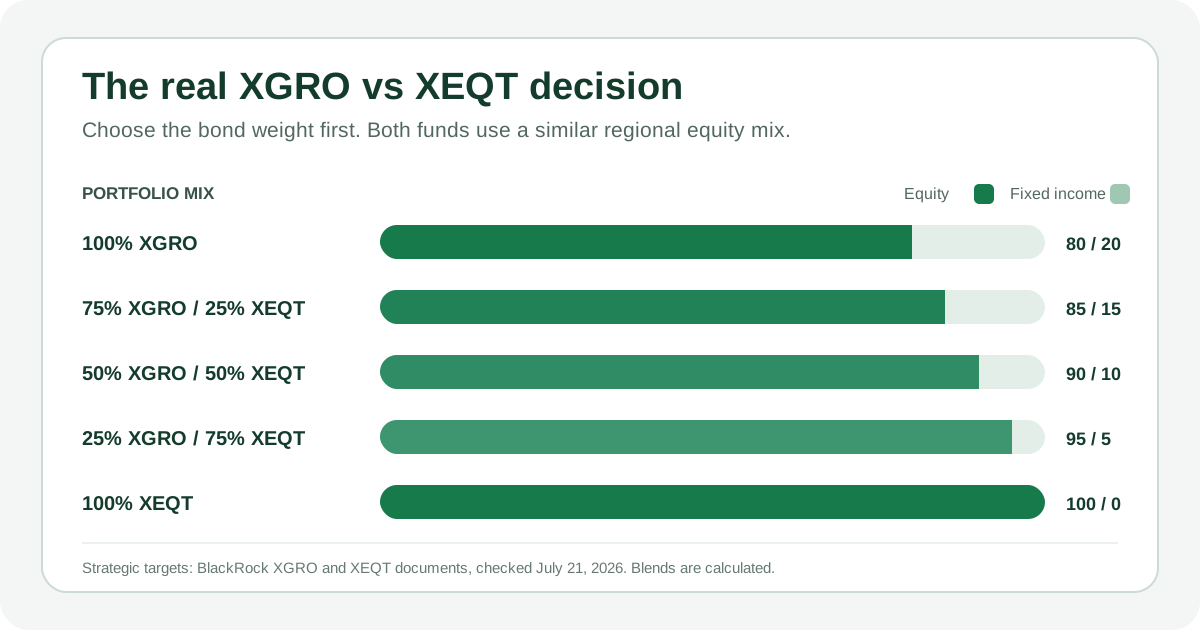
Because the regional stock mixes match so closely, combining the two is a simple way to land between them. A 50/50 split between XGRO and XEQT is approximately 90% equity and 10% fixed income. A 75/25 XGRO-to-XEQT split is about 85/15; reversing it gives about 95/5. These figures use strategic targets, not daily holdings.
The price is maintenance. Market moves and contributions shift the two-fund weights, so you need a rebalancing rule. A blend can smooth a gradual move from one fund to the other, but holding it permanently gives up part of the one-ticket simplicity each fund is built for, and adjusting the mix in response to headlines turns a risk plan into market timing.
Does the account change the answer?
Not much. Both funds are Canadian-listed, BlackRock lists both as eligible for registered plans, and CRA guidance says units of ETFs listed on a designated stock exchange are generally qualified investments.
TFSA
A TFSA shelters Canadian tax on income and gains when its rules are followed, but it does not make 100% equity right for every goal. Both funds hold foreign stocks through Canadian ETF wrappers, and BlackRock's December 2025 withholding guide says US withholding applies inside Canadian-listed funds seeking US stock exposure regardless of whether the investor's account is taxable or non-taxable. Other countries can withhold too. The amount varies with each fund's foreign equity weight, but the mechanism is shared.
RRSP
Both defer Canadian tax until withdrawal. Holding a Canadian-listed fund in an RRSP does not earn the treaty exemption that US-listed securities held directly can receive. The foreign withholding tax guide explains why the wrapper matters.
Putting XGRO in the RRSP and XEQT in the TFSA is not automatically tax-optimal. The combined stock/bond mix drifts as the accounts grow at different rates, and equal balances are not equally spendable when RRSP withdrawals are taxable and TFSA withdrawals are generally tax-free. Measure risk across the household portfolio, not ticker by ticker.
FHSA
An FHSA can hold listed ETFs, but the purchase date dominates. A home purchase expected soon may leave too little time to recover from an equity loss, XGRO included. The FHSA investments guide covers qualified investments and the timeline problem; the account's tax benefits do not make a volatile asset suitable for a near-term down payment.
Taxable account
Both ETFs can distribute Canadian dividends, foreign income, capital gains and return of capital, and XGRO can also pass through interest from its bond funds. BlackRock says interest and foreign non-business income are generally taxed at ordinary marginal rates, while eligible Canadian dividends and capital gains receive different treatment. The actual mix changes by fund and year and is reported on a T3 slip.
That can make XGRO's bonds less tax-efficient than equity growth in some cases, but tax should not set the risk level: choosing XEQT only to avoid taxable interest means taking on more equity risk. Reinvested and return-of-capital distributions can also change adjusted cost base; see the ETF distribution and ACB guide.
Before switching between them
Write down the target allocation and the reason for changing it. A recent rally, a forecast or a disappointing year is not evidence that your risk capacity changed; a new withdrawal date, a pension, a debt obligation, an income change or a clearer sense of how you handle losses may be. Look at the whole portfolio after the proposed trade, including funds held in other accounts.
A sale in a taxable account can realize a capital gain or loss. Registered accounts do not create a taxable capital gain on the trade, but commissions, bid-ask spreads and time out of the market can still matter. New contributions can sometimes shift the allocation gradually without selling, and for a modest shift the blend arithmetic above shows the resulting stock/bond mix.
- Is this money genuinely available for a medium- to long-term goal?
- How large a dollar loss could the plan withstand without changing course?
- What stock/bond mix results across every account after the trade?
- Would a taxable sale realize a material gain or loss?
- Who will rebalance, and under what written rule?
Other all-in-one and global ETF comparisons
- XGRO account-location overview and XEQT account-location overview
- ETF account-location comparison hub: VFV, VOO, XEQT, and QQQ
- VEQT vs XEQT: fees, allocation, and account location
- XEQT vs VFV: global equity or S&P 500?
- Canadian stock and ETF account-location framework
Look up XGRO or XEQT
The screener shows each fund's educational account-location read; BlackRock's documents have the current allocation and risk rating.
Open XGRO in the screenerFrequently asked questions
Is XGRO safer than XEQT?
XGRO has a lower current risk rating and about 20% fixed income, but it is not safe or guaranteed. Its roughly 80% equity allocation can still produce substantial losses, and its bonds carry interest-rate, credit and currency risks of their own. Stocks and bonds can fall at the same time, so the 20% sleeve moderates risk rather than protecting principal.
Do XGRO and XEQT charge the same fees?
Yes, on current figures. Both list a 0.17% management fee, effective December 18, 2025, and both factsheets reported a 0.19% MER as of September 30, 2026. A stale 0.18% sentence remains in each factsheet's overview, but the fee tables use 0.17%.
Can I hold XGRO and XEQT together?
Yes. Because their regional equity mixes are similar, combining them mainly adjusts the bond weight. A 50/50 blend is approximately 90% equity and 10% fixed income based on their strategic targets. The trade-off is having to monitor and rebalance two funds.
Should XGRO go in an RRSP and XEQT in a TFSA?
Not automatically. That split changes the combined household allocation as account balances move, and RRSP dollars are taxable when withdrawn while TFSA withdrawals are generally tax-free. The allocation across all accounts, withdrawal plans, contribution room, and tax circumstances need to be considered together.
Sources
- BlackRock Canada, XGRO product page, current fees, registered-plan eligibility, distribution frequency, and product details checked October 14, 2026.
- BlackRock Canada, XEQT product page, current fees, registered-plan eligibility, distribution frequency, and product details checked October 14, 2026.
- BlackRock Canada, XGRO factsheet, portfolio and fee data as of September 30, 2026.
- BlackRock Canada, XEQT factsheet, portfolio and fee data as of September 30, 2026.
- BlackRock Canada, XGRO ETF Facts, June 19, 2026, including objective, risk rating, tax note, and April 30 holdings.
- BlackRock Canada, XEQT ETF Facts, June 19, 2026, including objective, risk rating, tax note, and April 30 holdings.
- Canadian Investment Regulatory Organization, Investor Questionnaire, time horizon, objectives, risk capacity, and risk tolerance, checked October 14, 2026.
- Canadian Investment Regulatory Organization, Types of Investments and Types of Accounts, equity and bond characteristics, checked October 14, 2026.
- Canada Revenue Agency, Income Tax Folio S3-F10-C1, qualified investments for RRSPs, RESPs, RRIFs, RDSPs, FHSAs, and TFSAs.
- BlackRock Canada, Distributions and Tax, distribution types, taxable-account treatment, T3 reporting, and adjusted cost base.
- BlackRock Canada, Understanding Foreign Withholding Tax, December 2025.