
Questrade vs Wealthsimple Canada: fees, USD and account types
Answer first: Questrade is the more direct fit when free dual-currency accounts, a wider menu of account structures and investments, or advanced trading tools are priorities. Wealthsimple is the more direct fit when recurring purchases, an integrated money-and-investing app, and no outgoing account-transfer fee matter more. Neither has the old headline advantage on basic trading: both published $0 commissions for online trades of listed Canadian and U.S. stocks and ETFs when checked August 25, 2026.
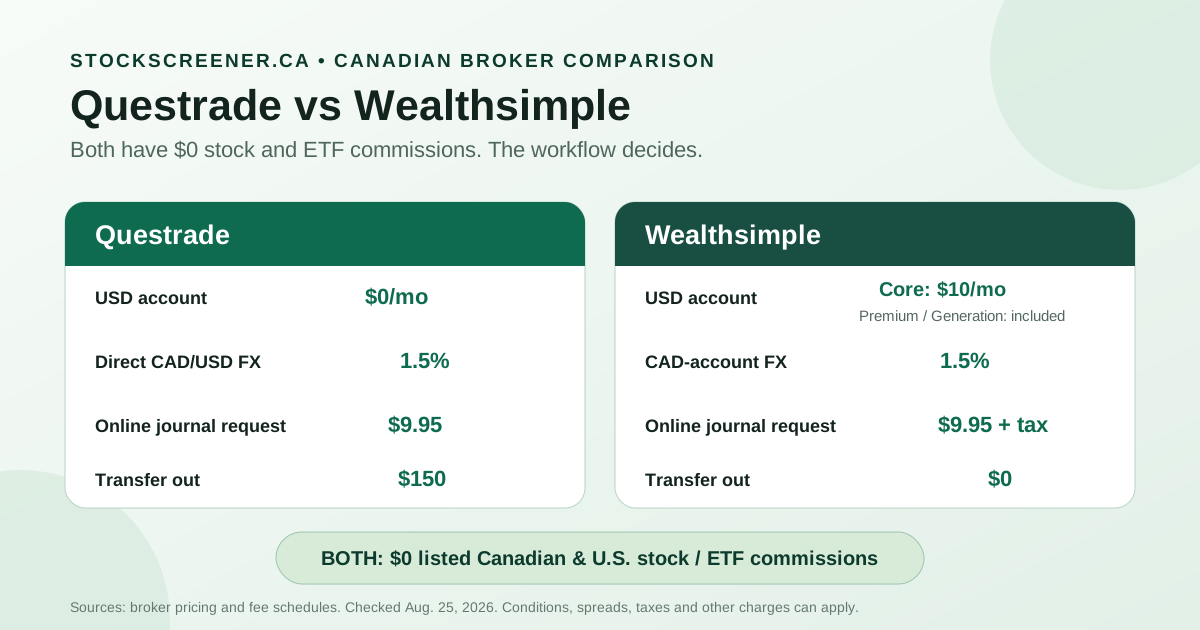
The largest cost difference for many buy-and-hold investors is now the US-dollar workflow. Questrade includes dual-currency capability at $0 per month. Wealthsimple includes USD accounts for Premium and Generation clients, but lists them at $10 per month for Core clients after a trial. Both publish a 1.5% standard currency-conversion fee, and both now support a $9.95 online Norbert's Gambit journal request.
This is a comparison of self-directed investing, not Questrade's Questwealth portfolios or Wealthsimple's managed portfolios. The right broker does not determine the right account or investment. Use the Canadian account-location framework separately.
Questrade versus Wealthsimple at a glance
Terms checked August 25, 2026. Dollar amounts are in Canadian dollars unless marked USD. Taxes and third-party charges can apply. A $0 commission does not remove bid-ask spreads, ETF expenses, currency costs, or market risk.
| Factor | Questrade | Wealthsimple | Why it matters |
|---|---|---|---|
| Listed Canadian and U.S. stocks and ETFs | $0 online commission | $0 commission | A tie on the basic headline fee. Security eligibility still differs. |
| USD account | Dual currency included at $0 per month | $10 per month for Core after a trial; included for Premium and Generation | Frequent U.S. trading can turn a subscription or repeated FX into the main cost. |
| Standard CAD/USD conversion | 1.5% | 1.5% from a CAD account; USD-account cash conversions range from 1.5% to 0% by amount | The fee scales with the amount converted. |
| Online journaling | $9.95 per request; included with Questrade Plus | $9.95 plus tax per request; an active USD account is required | Norbert's Gambit replaces a percentage FX fee with a mostly fixed workflow cost, plus spreads and time. |
| Outgoing institutional transfer | $150 for a full or partial account transfer | $0 | Exit cost matters if needs or platform features change later. |
| Account and product breadth | Common registered accounts plus joint, trust, estate and entity choices; bonds, GICs and mutual funds are listed | Common registered accounts, non-registered, margin and business trading; broad stocks, ETFs and options focus | The required account or security must exist before app design matters. |
Sources for the changing figures are the brokers' current Questrade pricing page, Questrade administrative schedule, Wealthsimple plan table, and Wealthsimple trade fee schedule, all checked August 25, 2026.
What's in this guide
| Trading costs | What $0 covers and what remains |
| U.S. dollars | Subscriptions, FX, and journaling |
| Accounts and securities | Where the product menus diverge |
| Automation and platforms | Fractional shares, recurring orders, and tools |
| Transfers and protection | Exit fees, portability, CIRO, and CIPF |
| Decision checklist | A practical fit test |
Stock and ETF commissions are no longer the deciding factor
Questrade and Wealthsimple each list $0 commissions for online trades of listed Canadian and U.S. stocks and ETFs. Neither lists an account-opening or inactivity fee for the basic self-directed account, and Questrade also lists no annual account fee. That makes an old comparison, free ETF purchases at one broker versus paid stock sales at the other, obsolete.
Zero commission is narrower than zero cost. A marketable order can cross the bid-ask spread. An ETF still deducts its management expense ratio and trading expenses within the fund. Foreign currency can create a conversion fee. Optional subscriptions, margin interest, wire transfers, paper documents, special registrations, and security-specific charges can also apply.
Options fees are not one number. Equity, index, exercise, early-exercise, and instruction charges can differ. If options matter, compare the current official schedules and the order preview rather than relying on the words “$0 options.” Those details are unlikely to decide the better platform for a long-term ETF investor.
The U.S.-dollar workflow can outweigh commission savings
Questrade: the standard plan includes free dual-currency accounts, so settled U.S. dollars can remain as USD in registered accounts. Its transaction schedule lists a 1.5% direct currency-conversion fee. The pricing page also lists online journaling at $9.95 per request, or no added journal charge with the $19.99 monthly Questrade Plus plan. Its journaling guide says a request may take up to five business days, with one business day of settlement time added for a recent purchase. Online journaling is not available for an RESP, although the guide directs RESP clients to contact support.
Wealthsimple: a CAD account applies a 1.5% conversion fee when a U.S.-listed trade causes a currency conversion. A USD account avoids conversion on every U.S. trade. The August 25, 2026 plan table lists the USD feature at $10 per month for Core clients after a trial and includes it for Premium clients at $100,000 in assets and Generation clients at $500,000. Its trade fee schedule tiers cash conversions within a USD account: 1.5% below $10,000, 1.0% from $10,000 to $24,999.99, 0.5% from $25,000 to $99,999.99, and 0% at $100,000 or more per transaction. The firm's corporate exchange rate can still contain a variable spread.
Wealthsimple added a web-based DLR/DLR.U journaling workflow in 2026. Its official instructions list a $9.95 fee plus tax and approximately two business days, and require an active USD account. Questrade and Wealthsimple therefore both support Norbert's Gambit, but the account subscription, processing estimate, interface, and conditions differ.
Do not compare only 1.5% with $9.95. Journaling also involves two trades, bid-ask spreads, settlement, exchange-rate movement, and possible tax records in a non-registered account. The Questrade Norbert's Gambit walkthrough covers those mechanics and account-setting traps.
Start with the account and security you actually need
Both brokers offer self-directed TFSA, RRSP, spousal RRSP, FHSA, RESP, LIRA and non-registered choices. Wealthsimple's account table, updated August 23, 2026, also lists RRIF, margin and business trading. Questrade publishes a longer list of specialized structures, including joint margin, corporate cash and margin, partnership, sole proprietorship, formal and informal trust, and estate accounts.
Questrade also publishes trading routes for mutual funds, bonds and GICs, alongside stocks, ETFs and options. Wealthsimple's trading eligibility page says its trading accounts do not support mutual funds, GICs, forwards, rights and warrants, bonds, investment savings accounts, money-market securities, or stocks and ETFs on non-North-American exchanges. Products offered elsewhere in a brokerage's ecosystem are not necessarily available inside every self-directed account.
This distinction is easy to miss during a transfer. A brokerage can support the account type but reject a particular holding. Wealthsimple's transfer guide, updated August 25, 2026, says fractional shares cannot transfer into a trading account and FHSAs can transfer in only as cash. Confirm each ticker, currency side, account registration, and in-kind eligibility before submitting transfer forms.
Both automate investing, with different boundaries
Both brokers support fractional shares and recurring investments for eligible securities. Wealthsimple's recurring-investment guide lists daily, weekly, biweekly, and monthly stock and ETF purchases, funded from account cash, an external bank, or Wealthsimple chequing for non-margin accounts. Its public plan table summarizes the frequencies as weekly, biweekly, and monthly, so confirm whether daily scheduling appears for the account and security being used.
Questrade supports fractional trading in selected Canadian and U.S. stocks and ETFs. Its recurring-investment guide is narrower: scheduled purchases apply to eligible fractional U.S.-listed stocks and ETFs, use market orders during regular hours, and are unavailable in margin accounts. A recurring U.S. purchase funded only with CAD triggers the published 1.5% conversion fee.
For a simple Canadian-listed ETF contribution, verify that the exact symbol is eligible for the automation desired. For manual limit orders, compare the web and mobile order tickets, statements, alerts, research, and data views. Questrade's pricing page lists free Level 1 streaming data and paid expanded or Level 2 packages. Wealthsimple's plan table lists real-time streaming quotes. Interface preferences are important, but they are separate from account, security, and total-cost requirements.
Exit fees and investor protection deserve separate checks
Questrade's administrative schedule lists $150 for either a full or partial institutional transfer out. Wealthsimple's trade fee schedule lists outgoing account transfers at $0. The receiving institution may reimburse an outgoing fee, but promotions have thresholds and holding periods. A reimbursement is not guaranteed unless its written conditions are met.
For a TFSA or RRSP, ask the receiving institution to arrange a direct transfer when the goal is to preserve registration. CRA says a direct TFSA transfer does not affect contribution room, while withdrawing and recontributing yourself can create an excess amount. CRA also says a direct RRSP-to-RRSP transfer is not a withdrawal, while RRSP withdrawals are generally taxable. The TFSA transfer-in-kind guide explains the operational difference.
Questrade, Inc. and Wealthsimple Investments Inc. both appear in the Canadian Investor Protection Fund's current investment-dealer member directory. CIPF provides limited protection for eligible client property missing after a member firm's insolvency, within its rules and limits. It does not insure a falling stock or ETF price, bad advice, an unsuitable investment, or an issuer failure. Brokerage protection and investment risk are different questions.
A practical way to choose between the two
Questrade's structure may fit the requirement better when:
- USD cash needs to remain inside a self-directed account without a monthly USD subscription.
- The plan uses a specialized joint, trust, estate, or entity account.
- Bonds, GICs, or mutual funds must sit beside listed stocks and ETFs.
- Advanced order entry or a deeper paid market-data option matters.
Wealthsimple's structure may fit the requirement better when:
- The portfolio uses supported stocks and ETFs and prioritizes recurring purchases and fractional investing.
- Banking, tax, managed investing, and self-directed investing are intentionally kept in one ecosystem.
- The household already meets Premium or Generation thresholds, making the USD feature included.
- A $0 outgoing institutional transfer is valuable flexibility.
A split setup can also be reasonable, such as Canadian-dollar automated purchases at one broker and USD holdings at another. The cost is more statements, tax slips, beneficiaries, cash balances, and security settings to monitor. Simplicity has value, especially when two platforms do not solve a real portfolio problem.
Choose the account before the broker
Compare TFSA, RRSP, FHSA, RESP, and taxable treatment for the security first. Then use the broker comparison to implement that account choice.
Open the account-location frameworkRelated reading
- Norbert's Gambit at Questrade: current step-by-step workflow
- Norbert's Gambit in Canada: broker-neutral mechanics
- TFSA transfer in kind: tax and contribution-room traps
- Canadian-listed versus U.S.-listed ETFs in a TFSA and RRSP
Frequently asked questions
Is Questrade or Wealthsimple cheaper for stocks and ETFs?
Both published $0 commissions for online trades of listed Canadian and U.S. stocks and ETFs when checked August 25, 2026. Total cost can still differ because of currency conversion, USD-account subscriptions, journaling, transfer-out fees, spreads, fund expenses, and optional data or service plans.
Which is better for holding U.S. dollars, Questrade or Wealthsimple?
Questrade included dual-currency capability at $0 per month. Wealthsimple included USD accounts for Premium and Generation clients, while Core clients were shown a $10 monthly price after a free trial. Both allowed U.S. securities to trade from a USD balance without converting every trade.
Can you do Norbert's Gambit at both Questrade and Wealthsimple?
Yes. Both brokers published online journaling at $9.95 per request when checked August 25, 2026. Wealthsimple specifically documents a DLR and DLR.U workflow, adds tax, and requires an active USD account. Processing time, spreads, settlement, and tax records still matter.
Can I transfer a TFSA or RRSP between Questrade and Wealthsimple?
An institutional transfer can move an eligible registered account without treating the move itself as a withdrawal and new contribution. Confirm whether it will be in kind or in cash, whether every holding is supported, and what fees apply. Questrade listed a $150 full or partial transfer-out fee, while Wealthsimple listed outgoing institutional transfers at $0 as of August 25, 2026.
Sources
- Questrade, Trading fees and commissions, checked August 25, 2026; stock and ETF commissions, plan prices, USD capability, journaling, and market data.
- Questrade, Self-directed transaction fees, checked August 25, 2026; currency conversion and product-specific transaction fees.
- Questrade, Administrative fees, checked August 25, 2026; account transfers, deregistration, wires, and document charges.
- Questrade, Account types, checked August 25, 2026; registered, non-registered, entity, trust, and estate account menus.
- Questrade, Journaling shares, checked August 25, 2026; online workflow, fee, processing estimate, settlement delay, and RESP limitation.
- Questrade, Fractional Shares Terms and Conditions, checked August 25, 2026; eligible Canadian- and U.S.-listed shares and transfer limitations.
- Questrade, Recurring Investments Guide, updated December 12, 2025 and checked August 25, 2026; eligible U.S. fractional securities, account limitations, frequencies, market orders, and currency conversion.
- Wealthsimple, Compare plans and fees, checked August 25, 2026; Core, Premium and Generation thresholds, commissions, USD-account price, automation, and market data.
- Wealthsimple Investments Inc., Fee Schedule for Trade Accounts, checked August 25, 2026; commissions, CAD- and USD-account currency conversion, journaling, transfer-out, inactivity, and options fees.
- Wealthsimple, Choose an account to open, updated August 23, 2026 and checked August 25, 2026; account types, trading availability, and USD eligibility.
- Wealthsimple, Eligibility criteria for stocks, ETFs, and futures, updated August 25, 2026; supported exchanges and unsupported trading-account securities.
- Wealthsimple, Transfer an account to Wealthsimple, updated August 25, 2026; supported transfer types, unsupported assets, and registered-account transfer handling.
- Wealthsimple, Set up a recurring investment, updated August 11, 2026 and checked August 25, 2026; frequencies, funding sources, and account limitations.
- Wealthsimple, Convert currency with Norbert's Gambit, updated August 21, 2026 and checked August 25, 2026; eligibility, web workflow, $9.95 fee plus tax, and processing estimate.
- Canada Revenue Agency, Requesting a TFSA transfer, updated February 20, 2026 and checked August 25, 2026; direct transfers, contribution room, and excess-amount risk.
- Canada Revenue Agency, Making withdrawals, updated January 29, 2026 and checked August 25, 2026; direct RRSP transfers and taxation of withdrawals.
- Canadian Investor Protection Fund, Investment Dealer Member Firms, checked August 25, 2026; Questrade, Inc. and Wealthsimple Investments Inc. membership.
- Canadian Investor Protection Fund, FAQs, checked August 25, 2026; eligible property and losses that CIPF does not cover.