
TFSA successor holder vs beneficiary: what happens after death
Answer first: A TFSA successor holder receives the account itself; a beneficiary receives money or property from the account. Only a spouse or common-law partner can be a successor holder. If properly designated, that person becomes the holder immediately, the TFSA keeps its tax-exempt status, and post-death growth remains sheltered without using the survivor's own contribution room.
A child, other relative, friend or organization can be a beneficiary, but not a successor holder. The TFSA's fair market value immediately before death can generally reach the beneficiary tax-free. Growth after death may be taxable. A surviving spouse named only as beneficiary has an extra route: an eligible survivor payment can be contributed to their own TFSA as an exempt contribution without using room, subject to timing, paperwork and other conditions.
Quebec is different. Successor-holder and beneficiary designations are not recognized for non-insurance TFSAs, so the will and exempt-contribution rules become especially important.
What's in this guide
| Successor holder vs beneficiary | Eligibility, ownership, tax, contribution room and paperwork |
| How a successor holder works | Why the TFSA continues and what the survivor receives |
| How a beneficiary works | Date-of-death value, post-death growth and TFSA type |
| The 2026 exempt-contribution change | Rollover timing, Form RC240 and conflicting CRA wording |
| Three worked examples | Spouse successor, spouse beneficiary and adult child |
| Designation checklist | Practical steps for holders and survivors |
| Frequently asked questions | Short answers to common TFSA estate questions |
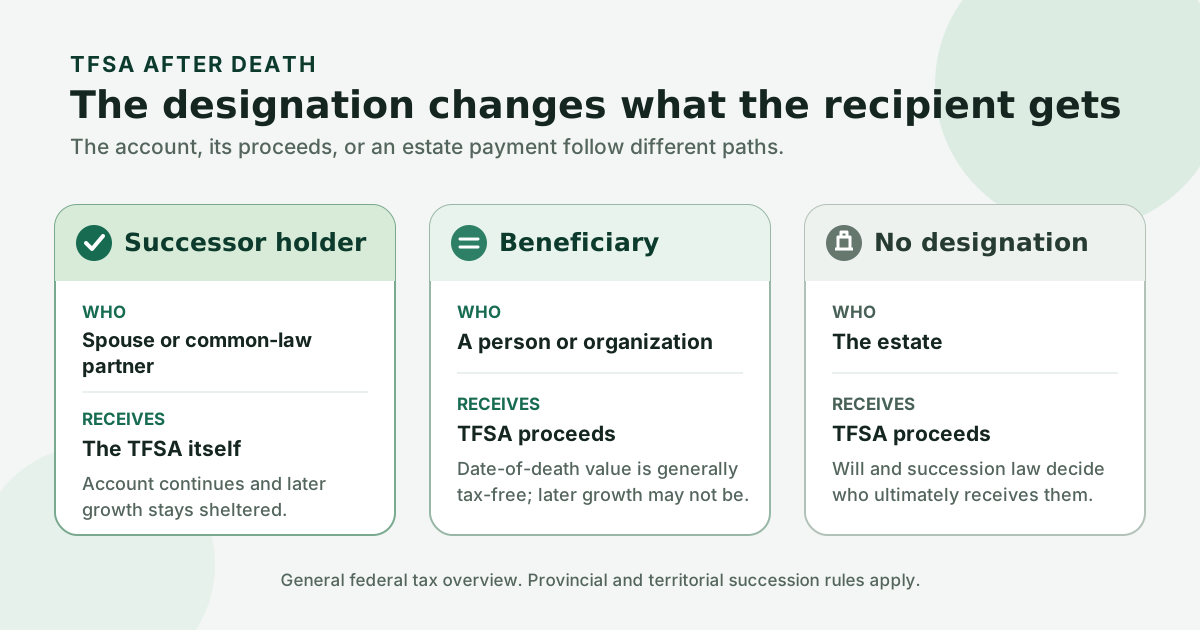
TFSA successor holder vs beneficiary at a glance
Rules checked October 20, 2026. The comparison assumes the deceased holder had no excess TFSA amount. An excess can create additional tax and can affect the survivor's result.
| Question | Successor holder | Designated beneficiary |
|---|---|---|
| Who can qualify? | Only the spouse or common-law partner who was the survivor immediately before death | A spouse, child, other person, organization or qualified donee |
| What do they receive? | The TFSA and all the holder's rights under it | A payment or distribution from the TFSA |
| Does the TFSA continue? | Yes, under the new holder | Not as the beneficiary's TFSA; treatment depends on whether it is a trust, deposit or annuity contract |
| Date-of-death value | Remains inside the continuing TFSA | Generally received tax-free up to fair market value immediately before death |
| Post-death growth | Remains sheltered | May be taxable; a surviving spouse may obtain exempt-contribution relief |
| Survivor's contribution room | Not reduced merely by becoming holder, provided the deceased had no excess | A non-spouse needs room to recontribute; a qualifying spouse can use the exempt-contribution route |
| Extra CRA form | No RC240 for the takeover | A spouse making an exempt contribution generally sends Form RC240 within 30 days of contributing |
| Quebec | Not recognized for non-insurance TFSAs | Contract designations are not recognized for non-insurance TFSAs; use the will and applicable rollover process |
A successor holder receives the account, not just its balance
The Income Tax Act defines the successor as the deceased holder's survivor who acquires all the holder's rights, including the unconditional right to revoke a beneficiary designation. CRA says the new holder takes ownership immediately on death. The issuer reports the ownership change to CRA, and the TFSA does not collapse merely because the original holder died.
This continuity produces the cleanest tax result. The account's value at death and all later income or gains remain sheltered. The successor can keep the account separate, make tax-free withdrawals, contribute if they have available room, or ask the issuer to complete a direct qualifying transfer into another TFSA they already hold. Taking over the deceased's TFSA does not consume the survivor's contribution room, but it also does not transfer the deceased's unused room.
That last distinction matters. A successor holder may end up with two TFSA accounts, but still has one contribution-room total across them. New deposits after the takeover use the survivor's own available room. If the deceased had an excess TFSA amount, special rules can deem the successor to have made a contribution equal to that excess at the start of the following month. This is a reason to obtain account records rather than assume every inherited TFSA is clean.
A successor designation must be valid under the TFSA contract, will and applicable provincial or territorial law. The label alone is not enough. CRA says a will can create a successor holder only if it gives the survivor all the same rights as the original holder, including the right to change beneficiaries.
A beneficiary receives value from the TFSA
A beneficiary does not step into the holder's place. The beneficiary instead receives a distribution, and the tax result splits at the date of death. Up to the TFSA's fair market value immediately before death can generally be paid without tax to the recipient. Earnings and appreciation after death require a second analysis.
For a deposit or annuity contract, the arrangement ceases to be a TFSA when the last holder dies. Later interest, income or gains are taxable under the normal rules. For a trusteed TFSA, which is the common structure for brokerage accounts, the trust can retain limited exempt status until the earlier of when it ceases to exist and the end of the first calendar year that begins after death. This window is called the exempt period.
The exempt period does not make every payment tax-free. For a non-spouse beneficiary, the part of a trust distribution above the remaining date-of-death value generally represents post-death income or appreciation and is taxable. CRA says this taxable portion is reported in box 134 of a T4A. If the trust still exists after the exempt period, it becomes a taxable inter-vivos trust and can face T3 filing requirements.
A beneficiary who is not the spouse or common-law partner cannot turn inherited proceeds into extra TFSA room. They may contribute the cash to their own TFSA only to the extent they already have room. The usual 1% monthly excess-contribution tax can apply if they deposit more than that. The TFSA contribution-room guide explains how room and prior withdrawals are tracked.
The spouse-beneficiary route and the 2026 change
A surviving spouse or common-law partner who receives a survivor payment can contribute it to their own TFSA during the rollover period and designate the deposit as an exempt contribution. It does not use their available room. The rollover period begins at death and ends on December 31 of the following calendar year. CRA generally requires Form RC240 within 30 days after the contribution, unless it permits a later filing.
Federal rules improved on January 1, 2026. Department of Finance explanatory notes say the exempt contribution is no longer limited to the TFSA's fair market value immediately before death. Qualifying income and appreciation earned during the exempt period can also be covered when paid to the surviving spouse and contributed. The amended Income Tax Act now subtracts the exempt contribution when calculating the spouse's income from a trusteed TFSA distribution.
Relief is not automatic. CRA says an exempt contribution is generally unavailable if the deceased had an excess TFSA amount or payments are made to more than one survivor. The payment and contribution must occur within the rollover period. A successor-holder designation remains administratively simpler because the account continues without a distribution, recontribution or RC240 filing.
The exempt-contribution route is especially important in Quebec, where non-insurance TFSA contracts cannot recognize a successor holder or beneficiary designation. A surviving spouse may still qualify based on a payment received because of the death, but the will and estate administration must be coordinated carefully.
Three examples show the practical difference
Assume a TFSA is worth $100,000 immediately before death and rises to $106,000 before it is distributed. These figures are hypothetical and ignore any excess contribution.
- Spouse is validly named successor holder. The spouse becomes holder at death. The original $100,000 and later $6,000 gain remain inside the TFSA and sheltered. No contribution room is used merely because ownership changed, and Form RC240 is not needed for the takeover.
- Spouse is beneficiary, not successor. The spouse receives a survivor payment. If the distribution and contribution occur within the rollover period and the conditions are met, the spouse can contribute the qualifying amount to their own TFSA as an exempt contribution and file RC240. The 2026 amendment is intended to let qualifying post-death appreciation be included, subject to the official-guidance caution above.
- Adult child is beneficiary. The child can generally receive the $100,000 date-of-death value tax-free. The $6,000 of later growth may be taxable depending on the arrangement and distribution. The child cannot make an exempt contribution and needs $106,000 of existing TFSA room to put the full payment into their own TFSA.
If no valid successor or beneficiary is in place, the TFSA value is paid to the estate and the will or provincial succession law determines who ultimately receives it. This can change administration, timing and potential estate costs, but those effects are province-specific. It does not make the date-of-death TFSA value taxable by itself.
A practical designation checklist
- Check every TFSA separately. A designation attached to one bank or brokerage account may not cover another institution's TFSA.
- Use the exact role. If the intended recipient is a spouse or common-law partner, ask the issuer whether its form records that person as successor holder or only as beneficiary.
- Name eligible alternatives. Children and other non-spouses can be beneficiaries, not successor holders. Ask how contingent beneficiaries work if the first recipient dies before the holder.
- Coordinate the form and will. Provincial law determines whether and how contract or will designations operate. Quebec residents need particular care for non-insurance TFSAs.
- Review after life changes. Marriage, separation, divorce, a new common-law relationship, a death or a move between provinces can make an old designation inconsistent with the estate plan.
- Keep values and dates after death. The legal representative or survivor should obtain the date-of-death fair market value, account type, distribution amount and payment date from the issuer.
- Protect the rollover deadline. A spouse using the beneficiary route should confirm the final date, make the contribution within the rollover period and send the current RC240 within 30 days of contributing.
The designation answers who receives the account or its proceeds. It does not decide whether the investments inside are suitable for the survivor. Before consolidating inherited holdings, review concentration, risk and account fit separately. The site's TFSA vs RRSP vs non-registered framework and TFSA transfer-in-kind guide explain those next steps.
Related reading
- TFSA transfer in kind: tax and contribution room
- Unused TFSA and RRSP contribution room by year
- Canadian stock account location: TFSA vs RRSP vs non-registered
- Foreign withholding tax by Canadian account type
Review what the TFSA holds
Use the free screener to check a stock or ETF's sector, dividend and Canadian account-location context before consolidating inherited investments.
Open the free stock screenerFrequently asked questions
Should a spouse be a TFSA successor holder or beneficiary?
A successor-holder designation is normally the simpler path where provincial law permits it. The spouse or common-law partner becomes holder immediately, the TFSA continues, post-death growth stays sheltered, and taking over the account does not use the survivor's contribution room if the deceased had no excess amount.
Can a child be a successor holder of a TFSA?
No. Under the Income Tax Act, a successor holder must be the deceased holder's spouse or common-law partner immediately before death. A child may be named as a beneficiary, subject to the applicable provincial or territorial rules.
Does inheriting a TFSA use the beneficiary's contribution room?
Receiving TFSA proceeds does not itself use room. A non-spouse who contributes the proceeds to their own TFSA needs available room. A surviving spouse may be able to make an exempt contribution during the rollover period without using room and must generally file Form RC240.
What happens to TFSA growth after the holder dies?
Growth remains sheltered when a valid successor holder takes over. Without one, the date-of-death value can generally be distributed tax-free, while later growth may be taxable depending on the TFSA type and recipient. Since January 1, 2026, qualifying post-death growth paid to a surviving spouse may be covered by an exempt contribution.
Can Quebec residents name a TFSA successor holder?
Quebec does not recognize successor-holder or beneficiary designations for non-insurance TFSAs. A surviving spouse may still use the exempt-contribution process, but Quebec residents should coordinate the TFSA with a properly drafted will and obtain legal advice.
Sources
- Canada Revenue Agency, If you are a successor holder of a TFSA, checked October 20, 2026; eligibility, account continuity, contribution room, consolidation and excess amounts.
- Canada Revenue Agency, If you are a designated beneficiary of a TFSA, checked October 20, 2026; beneficiaries, exempt contributions, post-death income, Quebec and the January 1, 2026 change.
- Canada Revenue Agency, Death of a Tax-Free Savings Account holder, checked October 20, 2026; deposit, annuity and trust treatment, exempt period and reporting.
- Canada Revenue Agency, Form RC240: Designation of an Exempt Contribution, 2026 form page; prescribed survivor-payment designation.
- Department of Finance Canada, Explanatory Notes to Legislative Proposals, clauses 23 and 33, August 15, 2025; post-death appreciation and January 1, 2026 effective date.
- Justice Laws Website, Income Tax Act, section 146.2, current to September 21, 2026 and last amended June 18, 2026; holder and survivor definitions, TFSA continuity and trust rules after death.
- CIBC, What happens when a TFSA holder dies?, June 2026; practical successor, beneficiary, exempt-contribution and Quebec summary.