
Canada's capital gains inclusion rate in 2026: what changed
Answer first: Canada's general capital gains inclusion rate is 50% in 2026. The government cancelled the proposed increase to two-thirds on March 21, 2025, and Budget 2025 later confirmed that decision. The previously discussed $250,000 annual threshold for individuals was part of that cancelled regime, so it is not a second capital gains bracket that investors need to apply in 2026.
A 50% inclusion rate is not a 50% tax rate. It means one-half of a net capital gain is included in income. Federal and provincial or territorial income tax rates then apply to that taxable amount. The result depends on the investor's other income, deductions, province or territory, and any available capital losses.
This is the law and policy position checked September 18, 2026. The consolidated Income Tax Act, section 38, current to July 21, 2026, states the one-half rule. The federal Spring Economic Update 2026 also describes the proposed increase as cancelled.
The 2026 rule at a glance
As of September 18, 2026: the general inclusion rate is one-half. Special rules and exemptions can produce a different result for particular dispositions.
| Question | 2026 answer | Practical meaning |
|---|---|---|
| General inclusion rate | 50%, or one-half | Half of a net capital gain is generally included in income |
| Proposed two-thirds rate | Cancelled | Do not use the old proposal for a 2026 estimate |
| $250,000 individual threshold | Not part of the current general rule | It belonged to the cancelled proposal |
| Capital losses | One-half is generally allowable | Losses generally offset taxable capital gains, not salary or interest |
| TFSA gains | Generally tax-free | No Schedule 3 capital gain for ordinary investing inside the plan |
| RRSP gains | Not taxed while funds remain in the plan | Withdrawals are generally taxed as RRSP income, not reported as capital gains |
What's in this guide
| What happened to the increase | The proposal, deferral, and cancellation |
| How the 50% rule works | A worked taxable-account example |
| Capital losses | Offsets, carryovers, and superficial losses |
| Account treatment | Taxable accounts, TFSAs, and RRSPs |
| Rules the headline misses | Homes, business income, and the LCGE |
| Investor checklist | Records to assemble before filing |
Why investors heard three different answers
The confusion came from a proposal that changed twice before being abandoned. Budget 2024 proposed a two-thirds inclusion rate for corporations and most trusts, and for the portion of an individual's annual capital gains above $250,000. It was initially meant to apply to dispositions on or after June 25, 2024.
On January 31, 2025, the Department of Finance deferred the proposed effective date to January 1, 2026. That announcement explains why older tax articles and planning notes say the higher rate would begin in 2026.
On March 21, 2025, the government announced that it would cancel the proposed increase. Budget 2025 later confirmed that decision in its fiscal projections, and the Spring Economic Update 2026 reiterated it. The enacted text now matters more than the abandoned proposal: section 38 says a taxable capital gain is one-half of the capital gain, subject to specific exceptions.
The clean reading is therefore simple. There was no higher general rate for June 25, 2024 onward, and there is no two-thirds general rate starting January 1, 2026. The $250,000 threshold has no role in calculating an ordinary 2026 public-market capital gain.
How the 50% inclusion rate works
CRA Guide T4037 says a capital gain is generally the proceeds of disposition minus the property's adjusted cost base and the outlays and expenses incurred to sell it. Investors then net relevant capital gains and losses and apply the inclusion rate.
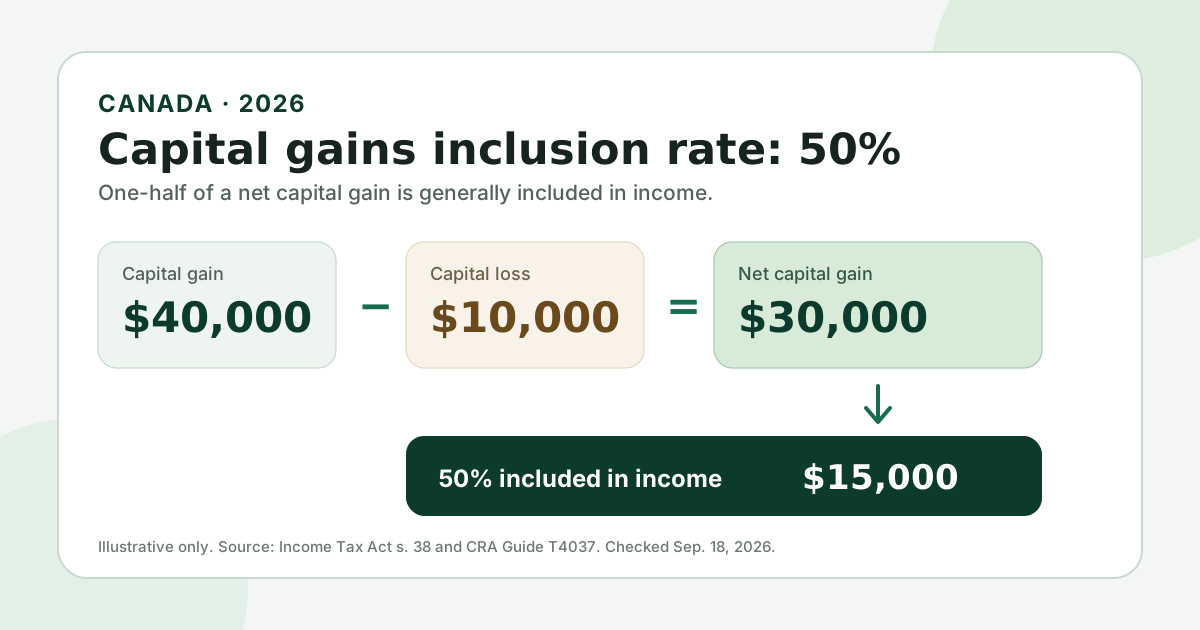
Consider an investor who sells shares in a non-registered account for $100,000. The shares have a $59,000 adjusted cost base, and selling costs are $1,000. The capital gain is $40,000. If the investor also realizes a $10,000 capital loss on another capital property in the same year, the illustrative net capital gain is $30,000. At a 50% inclusion rate, $15,000 is the taxable capital gain included in income.
The tax is not $15,000. That amount is added to the investor's income, where the applicable federal and provincial or territorial rates determine the incremental tax. A quick estimate that multiplies the taxable gain by one marginal rate can still miss bracket changes, credits, deductions, benefits, minimum tax, and other interactions.
Adjusted cost base is not always the number beside “book value” on a brokerage screen. CRA says investors in identical shares bought at different prices generally need an average cost. Commissions can adjust cost, return-of-capital distributions reduce ACB, and reinvested taxable distributions can increase it. For foreign securities, CRA instructs taxpayers to translate the purchase cost and sale proceeds into Canadian dollars using the exchange rates applicable when each transaction occurred.
Capital losses can offset gains, but timing rules matter
Section 38 generally makes one-half of a capital loss an allowable capital loss. CRA's capital-loss guidance says a net capital loss can be carried back three years or forward indefinitely. It is generally limited to taxable capital gains, so it does not ordinarily erase employment income, interest, or dividends.
A sale at a loss does not guarantee an immediate deduction. Canada's superficial loss rule can deny the loss when the investor or an affiliated person acquires the same or identical property during the period from 30 days before through 30 days after the sale and still owns it 30 days after the sale. The denied amount is usually added to the replacement property's ACB, but a repurchase inside a registered account can make the loss unusable. The 61-day superficial loss guide explains the test and common spouse, TFSA, RRSP, and dividend-reinvestment traps.
Harvesting a tax loss solely to reduce a tax bill can also change the portfolio, incur trading costs, and create time out of the market. Start with the investment decision, then verify whether the tax result survives the identical-property and affiliated-person rules.
The inclusion rate mainly matters in taxable accounts
Non-registered account: sales of stocks and ETFs held on capital account are generally reported on Schedule 3. Keep trade confirmations, acquisition dates, commissions, Canadian-dollar exchange rates, reinvested distributions, return-of-capital adjustments, and reorganizations. CRA's T5008 guide warns that the cost or book value shown on a slip may not reflect the investor's ACB and may require adjustments. The ETF distributions and ACB guide covers cash distributions, DRIPs, and non-cash reinvested distributions.
TFSA: CRA says interest, dividends, and capital gains earned in a TFSA are generally tax-free, including when withdrawn. An investment loss does not produce a deductible taxable-account capital loss, and CRA says the loss does not create contribution room. Active trading that amounts to carrying on a business is a separate issue, covered in the TFSA business-income risk guide.
RRSP: CRA says income earned in an RRSP is usually exempt while the funds remain in the plan, and withdrawals are generally taxable. The plan does not preserve capital-gains character for a later withdrawal. A $1 RRSP withdrawal is generally RRSP income whether the underlying growth came from interest, dividends, or gains.
The inclusion rate is therefore not a reason to prefer one eligible stock or ETF over another inside a TFSA or RRSP. Account choice still affects contribution room, withdrawal treatment, foreign withholding tax, and flexibility. The site's Canadian account-location framework puts those factors together.
Important rules the 50% headline does not answer
Principal residence: a qualifying principal residence can be fully or partly exempt, but the sale still must be reported and designated. CRA says the exemption is allowed only when the disposition and designation are reported. Rental use, business use, multiple properties, or a change in use can require a more detailed calculation.
Business income versus capital gains: the inclusion rate applies only when the profit is a capital gain. If the facts show a business of trading or dealing in securities, net profit can be business income instead. CRA's securities-transactions bulletin says no single factor is decisive. Frequency, knowledge, time spent, holding periods, financing, and the taxpayer's course of conduct can all matter, so a high-activity case deserves professional review.
Lifetime Capital Gains Exemption: cancellation of the inclusion-rate increase did not cancel the separate LCGE increase. Budget 2025 Implementation Act, No. 1, which received royal assent March 26, 2026, increased the base exemption to apply to up to $1.25 million of eligible gains for qualifying dispositions on or after June 25, 2024, with indexation resuming in 2026. This narrowly applies to qualifying small-business shares and qualified farm or fishing property. It does not exempt ordinary sales of publicly traded shares or ETFs.
Other special rules can apply to gifts of listed securities to qualified donees, employee stock options, depreciable property, trusts, estates, non-residents, and partnerships. The general rate is a starting point, not a complete return for every disposition.
A practical 2026 investor checklist
- Identify the account. Do not mix taxable-account ACB records with TFSA or RRSP transactions.
- Confirm there was a disposition. A sale, deemed sale, transfer, redemption, or change of use can count even when cash was not the main consideration.
- Rebuild ACB in Canadian dollars. Include every purchase of identical property and relevant commissions and distribution adjustments.
- Subtract selling costs. Brokerage commissions and other eligible disposition costs reduce the gain.
- Review losses before repurchasing. Check the full superficial-loss window across the investor, spouse or partner, corporations, and registered plans.
- Use Schedule 3 and the current tax package. CRA's Schedule 3 page provides the applicable form and prior-year versions.
- Escalate unusual facts. Large one-time gains, business sales, real estate, estates, emigration, and active trading can involve rules beyond the basic calculation.
The useful conclusion is not that capital gains are “taxed at 50%.” It is that the general 2026 calculation includes one-half of the net gain in income. Good records determine the gain; the taxpayer's broader return determines the tax.
Related reading
- Canadian stock account location: TFSA vs RRSP vs taxable
- Canada's superficial loss rule and the 61-day test
- ETF distributions and adjusted cost base in Canada
- TFSA transfers in kind, deemed dispositions, and contribution room
- Official Canadian investor tax and account resources
Screen the investment, then place it in context
Use the free screener for an educational TFSA, RRSP, FHSA, and taxable-account overview. Keep the tax calculation separate from the investment case.
Open the free stock screenerFrequently asked questions
What is the capital gains inclusion rate in Canada for 2026?
As of September 18, 2026, the general inclusion rate is one-half, or 50%. Section 38 of the Income Tax Act states that one-half of a capital gain is a taxable capital gain, subject to specific exceptions.
Does Canada have a $250,000 capital gains threshold in 2026?
No. The $250,000 annual threshold for individuals belonged to a proposed two-thirds inclusion-rate regime. The government cancelled the proposed increase in March 2025, so that threshold is not part of the general 2026 rule.
Does a 50% inclusion rate mean a 50% tax on a capital gain?
No. It means 50% of the net capital gain is included in taxable income. Federal and provincial or territorial tax rates then apply based on the taxpayer's circumstances.
Can a capital loss reduce salary or interest income?
Generally, a net capital loss is limited to taxable capital gains. CRA says it can be carried back three years or carried forward indefinitely, subject to the applicable rules.
Are capital gains in a TFSA subject to the inclusion rate?
CRA says capital gains earned in a TFSA are generally tax-free, including on withdrawal. A loss inside the TFSA is not a taxable-account capital loss and does not restore contribution room.
Sources
- Justice Laws Website, Income Tax Act, section 38, one-half taxable-capital-gain and allowable-capital-loss rules; Act current to July 21, 2026 and checked September 18, 2026.
- Prime Minister of Canada, cancellation announcement, cancellation of the proposed capital gains inclusion-rate increase; March 21, 2025.
- Department of Finance Canada, Budget 2025, Annex 1, fiscal projections confirming cancellation of the proposed increase; November 4, 2025.
- Department of Finance Canada, Spring Economic Update 2026, Annex 1, fiscal projections reflecting cancellation of the proposed increase; checked September 18, 2026.
- Department of Finance Canada, January 31, 2025 deferral announcement, history of the proposed two-thirds rate and $250,000 individual threshold.
- Canada Revenue Agency, Guide T4037, Capital Gains 2025, latest published individual guide when checked, including the gain formula, ACB, foreign-currency conversion, and Schedule 3 reporting.
- Canada Revenue Agency, Capital losses, loss use, carryback and carryforward periods, and superficial-loss treatment; checked September 18, 2026.
- Canada Revenue Agency, Principal residence, exemption, designation, and reporting rules; checked September 18, 2026.
- Canada Revenue Agency, What is a TFSA, tax treatment of investment income and withdrawals; checked September 18, 2026.
- Canada Revenue Agency, How to contribute to a TFSA, investment losses and contribution room; checked September 18, 2026.
- Canada Revenue Agency, Registered Retirement Savings Plan, tax deferral while funds remain in the plan and general withdrawal taxation; checked September 18, 2026.
- Canada Revenue Agency, T5008 Guide, cost or book value and possible investor ACB adjustments; checked September 18, 2026.
- Canada Revenue Agency, archived Interpretation Bulletin IT-479R, Transactions in Securities, factors used to distinguish capital gains from business income; checked September 18, 2026.
- Parliament of Canada, Budget 2025 Implementation Act, No. 1, royal assent March 26, 2026 and the enacted $1.25-million base LCGE increase for qualifying property.
- Canada Revenue Agency, Schedule 3, Capital Gains or Losses, tax form access; checked September 18, 2026.