
HXT vs XIU: a taxable-account question first
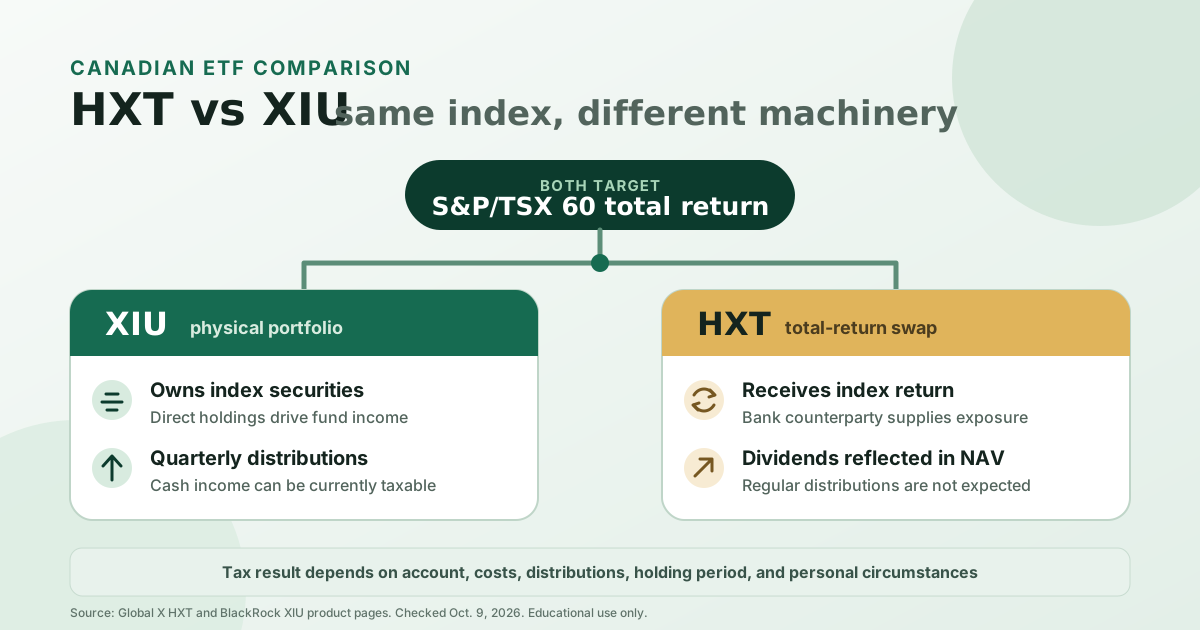
HXT's main argument applies in a taxable account. HXT and XIU target the same S&P/TSX 60 total return, but XIU owns the stocks and pays quarterly distributions, while HXT uses a corporate-class total-return swap, builds the index's dividend return into its share value, and is not designed to make regular distributions. That can defer tax in a non-registered account. Inside a TFSA or RRSP, where investment income is already sheltered while it stays in the account, the advantage largely disappears.
Deferral is not the same as a better investment. HXT's structure adds swap costs, counterparty exposure and tax-policy risk. XIU is simpler and pays cash, but its distributions can create taxable income every year.
In a taxable account: deferral versus cash flow and simplicity
In a non-registered account, XIU distributions can be taxed each year even when reinvested. CRA explains that mutual fund distributions may include dividends, capital gains, foreign income, interest, other income, or return of capital, and the tax slip, not the cash label, determines what is reported.
Eligible dividends from taxable Canadian corporations may support federal and provincial or territorial dividend tax credits for an individual who meets the reporting conditions. XIU's distribution yield was 2.20% at October 7, 2026, but a yield is not a tax rate, and no future distribution is guaranteed to have a particular tax character. Read the annual tax breakdown and keep adjusted-cost-base records.
HXT's intended advantage is timing. Global X says investors are not expected to receive taxable distributions because the index's dividend return is reflected in the fund price. If the structure works as intended, tax is generally deferred until shares are sold and a capital gain is realized. CRA says a gain on the sale or redemption of mutual fund shares is usually a capital gain when the investment is capital property.
Deferral keeps more money invested for longer, but it does not eliminate the tax. A sale can trigger it, the fund could still make a taxable distribution, and legislation or fund operations could change. How much deferral is worth depends on province, marginal rate, holding period, other income, available losses, and whether eligible-dividend credits already make XIU's income fairly efficient.
HXT still needs records. Track purchases, commissions, corporate actions, any distributions and sale proceeds in Canadian dollars; the ETF distribution and adjusted cost base guide explains the mechanics, and the eligible dividends guide covers the credit that works in XIU's favour.
In a TFSA, RRSP, FHSA or RESP, the deferral case mostly disappears
TFSA: CRA says interest, dividends, and capital gains earned in a TFSA are generally tax-free, including on withdrawal. There is usually no annual personal tax bill on XIU's distributions to avoid. HXT may spare you reinvesting cash, but its swap complexity and costs come along regardless.
RRSP: CRA says income earned in an RRSP is usually exempt from tax while the funds remain in the plan, and payments from the plan are generally taxable. HXT offers no extra tax-timing benefit here, so cash-flow preference, all-in costs, trading and comfort with the structure carry more weight.
FHSA and RESP: both funds are Canadian equity investments that can lose value. When a home purchase or tuition bill has a fixed date, the equity allocation matters more than the wrapper. The FHSA investment guide and RESP guide deal with that timeline.
Both issuers flag their funds as eligible for registered plans. That means the accounts may hold them, not that either fund suits a particular goal, time horizon or risk capacity.
HXT and XIU side by side
Changing figures have explicit dates. HXT fee ratios are at June 30, 2026, counterparty exposure is at July 31, 2026, and net assets are at October 8, 2026. XIU net assets are at October 8, 2026, and its distribution yield is at October 7, 2026. Official pages were checked October 9, 2026.
| Factor | HXT | XIU | Practical read |
|---|---|---|---|
| Benchmark | S&P/TSX 60 Index, total return | S&P/TSX 60 Index, total return | Same underlying large-cap exposure |
| Implementation | Corporate-class ETF using a total-return swap | Physical ETF holding index securities | Structure is the decisive difference |
| Management fee / MER | 0.07% / 0.08% | 0.15% / 0.17% | MER alone is not a complete HXT cost comparison |
| Other disclosed cost | 0.19% TER; swap fee up to 0.20% | No comparable swap fee | Do not count HXT's swap fee twice; read the current reports |
| Distributions | At manager's discretion; regular payments are not expected | Quarterly | HXT favours internal total return; XIU supplies cash flow |
| Net assets | $5.53 billion at October 8 | $22.67 billion at October 8 | Both are established funds |
| Inception | September 14, 2010 | September 28, 1999 | XIU has the longer live history |
| Account eligibility | All registered and non-registered accounts | Registered plans: yes | Eligibility does not establish suitability |
The current figures come from the Global X HXT and BlackRock XIU product pages. HXT's trading expense ratio, or TER, reflects commissions and other portfolio transaction costs for the reporting period. Its stated maximum swap fee is not an extra amount to add mechanically to the reported TER.
How HXT's swap works, and the risk it adds
XIU is the conventional route. BlackRock holds the index securities in the fund and says its distributions consist primarily of amounts received from those securities, less expenses, plus realized capital gains. The fund distributes its net taxable income at least annually and currently schedules cash distributions quarterly.
HXT is synthetic. Global X says its total-return index ETFs generally hold cash and enter agreements with one or more large financial-institution counterparties, which provide the index's total return in exchange for the interest earned on that cash. Dividends paid by index companies show up in HXT's net asset value instead of arriving as cash.
The swap brings a risk that a fund owning every index stock does not carry in the same form. Global X defines counterparty exposure as the net amount owed to or from the bank counterparties as a share of fund assets, and HXT's product page reported 56.36% at July 31, 2026. That number is not an expected loss, but it is a reason to read the current prospectus, collateral terms, counterparties and risk disclosure before treating HXT as a cheaper XIU.
None of this is permanent. Swap terms, tax law, the corporate-class arrangement and manager decisions can all change, and Global X says distributions are at the manager's discretion. “Not expected” is different from “cannot happen.”
Is HXT really cheaper than XIU?
On the headline, yes: HXT's current MER is 0.08% against 0.17% for XIU, roughly $8 and $17 a year on $10,000 if the balance and rates stayed unchanged. That arithmetic leaves out HXT's swap-related transaction costs.
Global X separately reported a 0.19% TER for HXT at June 30, 2026 and a swap fee of up to 0.20%. Its MER definition excludes commissions and other portfolio transaction costs, which the TER captures for the stated period. Global X announced the increase in HXT's maximum swap cost from nil to 0.20% effective January 1, 2025.
So compare HXT's MER and TER together, without counting the disclosed maximum swap fee a second time, then look at tracking difference over matching periods, current bid-ask spreads, commissions and tax. HXT can still come out ahead after tax for some taxable investors, but the lowest MER does not prove it.
The same 60 companies either way
Both funds seek the total return of the S&P/TSX 60, net of expenses. S&P Dow Jones Indices defines the index as a 60-security subset of the S&P/TSX Composite representing Canadian large caps, with selection also considering liquidity and sector balance.
Return charts can differ slightly because of fees, tracking, cash flows or valuation timing, but HXT is not a different bet on which Canadian companies will lead. Both concentrate in the same large banks, energy producers, miners and industrial companies; HXT reported financials at 40.80% of exposure on September 30, 2026.
Neither is a broad Canadian-market fund. If more mid-cap exposure is the goal, the index choice comes first, and the XIU vs XIC guide compares the S&P/TSX 60 with the broader S&P/TSX Capped Composite. HXT versus XIU only starts once the 60-company index has been chosen deliberately.
Before choosing or switching
- Benchmark: are 60 Canadian large caps the exposure you actually want?
- Account: HXT's distribution deferral matters in a taxable account, not an already sheltered one.
- All costs: HXT's MER, TER, swap fee and tracking difference against XIU's MER, plus each live bid-ask spread.
- Cash flow: XIU pays quarterly; HXT generally keeps the index's dividend return in NAV.
- Swap risk: read the current prospectus and counterparty disclosure rather than relying on the MER.
- Personal tax: if the amounts are material, province, income, holding period and eligible-dividend credits can change the after-tax result.
Switching needs its own arithmetic. Selling either fund in a taxable account can realize a gain or loss, cost a spread and interrupt exposure. Because both target the same index, do not assume that selling one at a loss and immediately buying the other avoids Canada's superficial-loss rule. CRA's archived interpretation bulletin says whether two properties are identical depends on their material qualities and the facts; the bulletin does not have the force of law and is no longer updated. The superficial-loss guide explains the 61-day test and when professional advice may be appropriate.
For comparisons where index scope, listing currency or foreign withholding drive the choice, see the ETF account-location comparison hub. HXT versus XIU is the rare pairing with identical market exposure and different machinery.
Related guides
- ETF account-location comparison hub
- XIU vs XIC: large caps or the broad Canadian market?
- Eligible dividends and the Canadian dividend tax credit
- ETF distributions and adjusted cost base
- Canada's superficial-loss rule
Look up HXT or XIU
The screener gives an educational account-location read for each ticker. Fund terms change, so confirm them with Global X and BlackRock.
Open HXT in the screenerFrequently asked questions
Does HXT pay dividends?
Not as a rule. HXT uses a total-return swap, so dividends paid by index companies are reflected in its net asset value rather than passed on as cash. Global X says distributions are at the manager's discretion and regular payments are not expected. XIU pays quarterly.
Is HXT cheaper than XIU?
HXT has the lower published MER, at 0.08% versus 0.17% for XIU, but that comparison is incomplete. Global X also reported a 0.19% TER for HXT and a swap fee of up to 0.20%. Compare all disclosed cost measures and avoid counting the swap cost twice.
Is HXT more tax-efficient than XIU in a taxable account?
HXT may defer annual taxable income because the index's dividend return is reflected in its NAV and taxable distributions are not expected. XIU normally distributes income. The result depends on personal tax circumstances, future distributions, costs, and the tax triggered when shares are sold.
Does HXT have an advantage over XIU in a TFSA or RRSP?
The distribution-deferral benefit is generally not useful inside a TFSA or RRSP because investment income is already sheltered while it remains in the plan. Structure, costs, cash-flow preference, and risk become the more relevant differences.
Can I sell XIU at a loss and buy HXT straight away?
Be careful. Both track the same index, and CRA's archived bulletin says whether two properties are identical depends on their material qualities and the facts. Do not assume the swap avoids the superficial-loss rule's 61-day test; get professional advice if the loss is material.
Sources
- Global X Investments Canada, HXT product page, objective, structure, management fee, MER, TER, swap fee, counterparty exposure, assets, distribution policy, performance, and exposure; varying dates through October 8, 2026, checked October 9, 2026.
- Global X Investments Canada, increased swap costs announcement, HXT maximum swap fee change effective January 1, 2025; checked October 9, 2026.
- BlackRock iShares Canada, XIU product page, objective, physical holdings, fees, assets, distributions, yield, listing, and registered-plan flag; data through October 8, 2026, checked October 9, 2026.
- S&P Dow Jones Indices, S&P/TSX Canadian Indices Methodology, S&P/TSX 60 composition, eligibility, liquidity, and sector-balance framework; September 2026 edition, checked October 9, 2026.
- Canada Revenue Agency, Tax treatment of mutual funds, distribution types, tax slips, dispositions, and adjusted cost base; checked October 9, 2026.
- Canada Revenue Agency, Federal dividend tax credit, qualifying dividends and reporting conditions; updated August 14, 2026, checked October 9, 2026.
- Canada Revenue Agency, What is a TFSA, general treatment of investment income and withdrawals; checked October 9, 2026.
- Canada Revenue Agency, Registered Retirement Savings Plan, general treatment of income within an RRSP and payments from the plan; updated May 7, 2026, checked October 9, 2026.
- Canada Revenue Agency, IT-387R2, Meaning of Identical Properties (archived), the fact-specific interpretive approach to identical property and the bulletin's limitations; checked October 9, 2026.