
VBAL vs XBAL Canada: fees, holdings and account fit
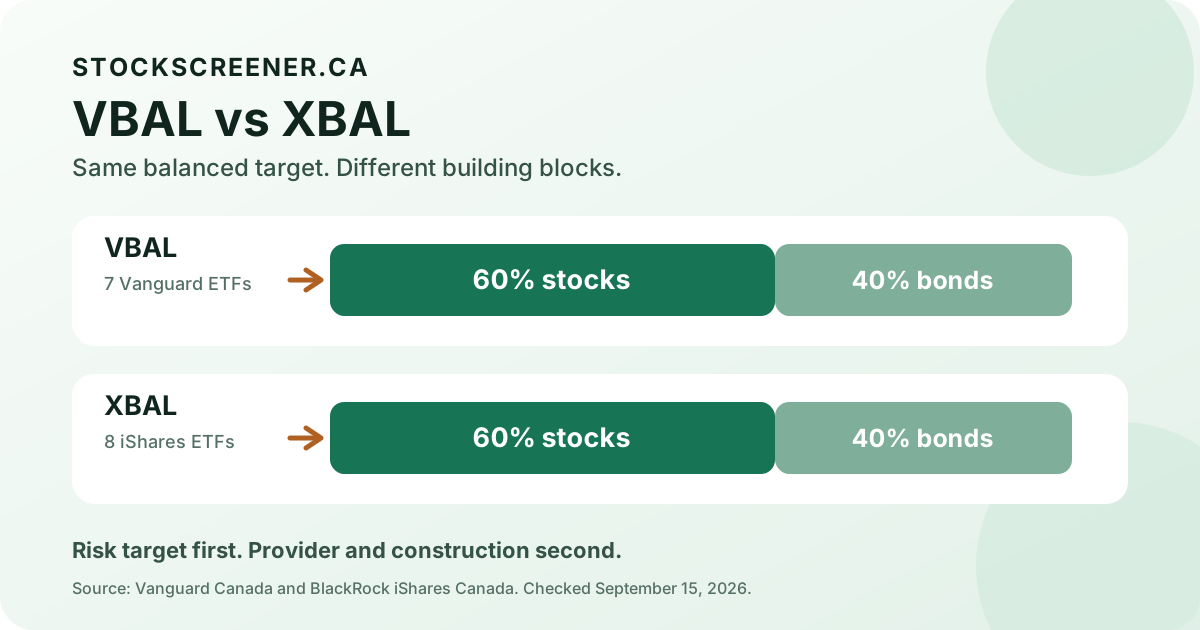
Answer first: VBAL and XBAL solve almost the same portfolio problem. Each is a Canadian-listed, automatically rebalanced fund-of-funds that targets about 60% stocks and 40% fixed income. Both now publish a 0.17% management fee. The practical choice is between two providers, modestly different regional equity weights, and different bond building blocks, not between different headline stock-and-bond targets.
VBAL currently gives a little more weight to Canadian and emerging-market stocks. XBAL gives more to developed markets outside North America and uses a larger Canadian bond allocation plus dedicated short-term corporate, US Treasury, and US-dollar investment-grade corporate bond sleeves. Those differences can change relative returns at the margin. They do not turn either fund into a fundamentally different portfolio.
For most comparisons, the 60/40 allocation deserves more attention than a small fee or holdings-count difference. A balanced ETF can still lose money, and 60% in stocks may be too volatile for a near-term home purchase, education payment, or withdrawal that cannot wait for a recovery.
VBAL versus XBAL at a glance
Portfolio weights are at August 31, 2026. Other changing fund details were checked on September 15, 2026. Holdings drift and may be rebalanced.
| Factor | VBAL | XBAL | Practical read |
|---|---|---|---|
| Provider | Vanguard Canada | BlackRock iShares Canada | Different managers, similar all-in-one mandate |
| Strategic target | Approximately 60% stocks, 40% fixed income | 60% stocks, 40% fixed income | Same headline risk budget |
| Underlying ETFs | Seven | Eight | Different construction, not automatically better diversification |
| Management fee | 0.17%, effective November 18, 2025 | 0.17%, effective December 18, 2025 | Current published fee is a tie |
| Reported MER | 0.22% | 0.18% | Backward-looking figures; VBAL says its MER does not yet reflect the full fee cut |
| Trading and distributions | TSX in CAD; quarterly | TSX in CAD; quarterly | No need to convert CAD to USD to trade either fund |
| Automatic rebalancing | Yes, around its strategic allocation | Yes, as needed around target weights | Both handle the core maintenance job internally |
The current figures come from the issuers' VBAL product page, XBAL product page, and BlackRock's August 2026 XBAL factsheet. Management fee and MER are not synonyms. The management fee pays the manager, while MER also captures applicable operating expenses and taxes and is reported for an elapsed period.
What's in this guide
| Portfolio construction | Where the underlying allocations differ |
| Bond design | Why three sleeves versus four can matter |
| Fees and trading | How to read the current 0.04-point MER gap |
| Account location | TFSA, RRSP, FHSA, RESP, and taxable accounts |
| Switching or holding both | Tax and implementation consequences |
| Decision framework | What deserves priority |
Same destination, different underlying routes
Vanguard reported that VBAL held seven Vanguard ETFs on August 31, 2026. Its four equity sleeves were 27.37% US total market, 18.54% Canadian all-cap, 11.05% developed markets outside North America, and 4.65% emerging markets. Together they represented 61.61% before rounding. The three bond sleeves totalled 38.36%, with the remaining 0.03% explained by rounding.
BlackRock's August 2026 factsheet listed eight underlying iShares ETFs. Its equity sleeves were 26.90% US total market, 15.22% Canadian stocks, 15.04% developed markets, and 2.97% emerging markets, or 60.13% in total. Its four fixed-income sleeves totalled 39.56%, plus small cash and currency positions.
The clearest equity differences are geographic. VBAL held 3.32 percentage points more Canadian equity and 1.68 points more emerging markets. XBAL held 3.99 points more developed-market equity outside Canada and the United States. Their US equity weights differed by less than half a percentage point. These are snapshots, not permanent promises.
That means neither fund provides a market that the other broadly omits. Each covers Canada, the United States, developed international markets, and emerging markets. Holding counts are a weak shortcut here because funds count securities using different methods and bonds can greatly expand the total. Exposure, cost, and risk are more useful than simply choosing the larger number.
The bond sleeves are the most meaningful construction difference
Vanguard's August 31 holdings show that VBAL's fixed-income side held 22.93% in Canadian aggregate bonds, 7.59% in currency-hedged US aggregate bonds, and 7.84% in currency-hedged global bonds outside the United States. It spreads the foreign bond allocation across broad US and global markets.
BlackRock's August factsheet shows that XBAL held 25.89% in a Canadian universe bond ETF, 5.68% in Canadian short-term corporate bonds, 4.00% in a US Treasury bond ETF, and 3.99% in a broad US-dollar investment-grade corporate bond ETF. This gives XBAL more explicit short corporate, US government, and US-dollar corporate sleeves.
Those designs create modest differences in duration, credit exposure, and geographic exposure. They can make one fund lead for a period when interest rates, credit spreads, or currencies move. A recent return gap is therefore not proof of superior management. It is often the expected result of holding slightly different building blocks.
Both issuers describe their products as automatically rebalanced around the target allocation. That convenience is central. The fund can sell part of an outperforming sleeve and add to an underweight sleeve without requiring the investor to calculate and trade each component. In a taxable account, internal fund activity can still contribute to taxable distributions.
The management fee is tied, while the reported MERs are not
The issuers' product pages report that Vanguard cut VBAL's management fee from 0.22% to 0.17% effective November 18, 2025, and BlackRock cut XBAL's management fee from 0.18% to 0.17% effective December 18, 2025. At the current published rates, each management fee is equivalent to $17 a year per $10,000 invested, before returns and ignoring other expenses.
XBAL reports a 0.18% MER, while VBAL reports 0.22%. Applied mechanically, that is $18 versus $22 per $10,000. Yet Vanguard explicitly says its MER does not yet reflect the management-fee reduction because MER is calculated at the fund's fiscal year-end. The four-dollar historical difference should not be projected indefinitely as though it were a guaranteed future spread.
Both trade in Canadian dollars on the TSX and distribute quarterly. CAD trading avoids a currency conversion just to place the trade, but it does not remove the economic currency exposure of foreign holdings. Investors may also pay brokerage commissions and cross the bid-ask spread.
Distribution yield is not a reliable tie-breaker. A distribution can contain interest, Canadian dividends, foreign income, capital gains, or return of capital. A higher cash payout is not automatically a higher total return, and the tax character matters in a non-registered account.
VBAL vs XBAL in a TFSA, RRSP, FHSA, RESP, or taxable account
Eligibility: both ETFs trade on the Toronto Stock Exchange. CRA's qualified-investment folio says ETF units listed on a designated stock exchange are generally qualified investments for registered plans, and Finance Canada lists the TSX as designated. This supports general TFSA, RRSP, FHSA, RESP, RRIF, and RDSP eligibility. It does not establish suitability.
TFSA: CRA says interest, dividends, and capital gains earned in a TFSA are generally tax-free. It also says investment losses do not create new contribution room. The two ETFs have nearly identical headline risk, so the account label offers no good reason to prefer one ticker. The loss a TFSA goal can withstand and the date of the planned withdrawal are more important.
RRSP: investment income is generally exempt while it remains in an RRSP, and withdrawals are generally taxable. Both are Canadian-listed fund-of-funds with foreign equity holdings. Foreign withholding can occur before income reaches the Canadian fund, so putting either Canadian wrapper in an RRSP does not create the treaty treatment available when certain US securities are held directly. The foreign withholding tax guide explains these layers.
FHSA and RESP: a 60/40 fund is not cash. A home purchase or education payment can arrive on a fixed date, while both stocks and bonds can fall. As the spending date approaches, test whether a loss would delay the goal. The site's FHSA investment guide and RESP account-location guide cover the account mechanics and timelines.
Taxable account: CRA says fund distributions can include interest, dividends, foreign income, capital gains, and return of capital. Reinvested taxable distributions still need to be reported, and return of capital reduces adjusted cost base. The issuer's annual tax breakdown and the T3 slip, not the cash amount alone, determine reporting. See the ETF distributions and ACB guide for record-keeping.
Switching or holding both adds more work than diversification
Selling one fund to buy the other does not materially change the 60/40 risk target. In a taxable account, however, the sale can realize a capital gain or loss. CRA generally calculates that result from proceeds minus adjusted cost base and selling expenses. A switch should clear a meaningful implementation hurdle, not merely respond to a small recent performance gap.
Holding both is possible, but a 50/50 combination still targets approximately 60% stocks and 40% fixed income. It blends providers and underlying approaches while duplicating broad exposure to many of the same markets. The investor must also decide whether to maintain an equal split. Neither issuer rebalances the relationship between the two separate holdings.
If the actual question is whether 60/40 is conservative enough, changing providers does not answer it. The sibling VBAL vs VGRO comparison examines 60/40 versus 80/20 within Vanguard, while XBAL vs XGRO makes the same risk comparison within iShares.
Choose the allocation first, then use practical tie-breakers
CIRO's investor education says a portfolio should account for the goal's time horizon and the investor's willingness and financial ability to withstand loss. If 60/40 fits that work, VBAL and XBAL are both close implementations. A short decision checklist can keep small differences in proportion:
- Confirm the 60/40 risk budget. Neither product guarantees principal, and both can decline.
- Check brokerage mechanics. Commission-free eligibility, recurring-purchase support, fractional trading, and a dividend reinvestment plan can matter more than a few basis points.
- Choose a construction preference only if it is deliberate. VBAL has somewhat more Canadian and emerging-market equity; XBAL has more developed-market equity and a different bond structure.
- Read the newest issuer pages before acting. Management fees, MERs, holdings, and programs can change.
- Avoid performance chasing. Small return gaps can reflect the known allocation differences and can reverse.
The broader ETF account-location comparison hub connects wrapper, withholding-tax, and account questions. The key conclusion here is narrower: VBAL versus XBAL is a close provider and construction comparison after the investor has already decided that a 60/40 portfolio fits the goal.
Related reading
- ETF account-location comparison hub
- VBAL vs VGRO: 60/40 or 80/20?
- XBAL vs XGRO: 60/40 or 80/20?
- VGRO vs XGRO: same 80/20 target, different providers
- Canadian stock and ETF account-location framework
Check each ticker in context
Use the free screener for an educational account-location overview, then confirm the latest allocation and documents with each issuer.
Open VBAL in the screenerFrequently asked questions
What is the main difference between VBAL and XBAL?
Both target about 60% stocks and 40% fixed income and automatically rebalance. VBAL uses seven Vanguard ETFs, while XBAL uses eight iShares ETFs. Their regional equity weights and bond sleeves differ modestly.
Is XBAL cheaper than VBAL?
Both currently publish a 0.17% management fee. XBAL reports a 0.18% MER and VBAL reports a 0.22% MER, but VBAL says its MER does not yet reflect the full effect of its November 2025 management-fee reduction. MERs are backward-looking and can change.
Can VBAL and XBAL be held in a TFSA or RRSP?
Both trade on the Toronto Stock Exchange. CRA guidance says units of ETFs listed on a designated exchange are generally qualified investments for registered plans, and Finance Canada lists the TSX as designated. Eligibility does not establish that a 60/40 allocation suits a particular goal.
Should I hold both VBAL and XBAL?
Holding both is possible, but it does not create a new stock-and-bond target because each aims for 60% stocks and 40% fixed income. It mainly blends two providers and creates an extra position to monitor. It also duplicates broad exposure to many of the same markets.
Sources
- Vanguard Canada, VBAL product page, objective, strategic target, fee and MER, August 31, 2026 underlying allocations, listing, and distributions; checked September 15, 2026.
- BlackRock iShares Canada, XBAL product page, objective, target, automatic rebalancing, fee and MER, listing, registered-plan eligibility, and distributions; checked September 15, 2026.
- BlackRock iShares Canada, XBAL factsheet, August 2026, underlying holdings and portfolio data as at August 31, 2026.
- BlackRock iShares Canada, About Asset Allocation ETFs, diversification, automatic rebalancing, and target-allocation range; checked September 15, 2026.
- Vanguard Canada, Frequently asked questions, foreign withholding inside Canadian-listed ETFs and T3 reporting; checked September 15, 2026.
- BlackRock Canada, Distributions and Tax, distribution types, foreign income, return of capital, and T3 information; checked September 15, 2026.
- Canadian Investment Regulatory Organization, Understanding Risk, risk tolerance and capacity; checked September 15, 2026.
- Canadian Investment Regulatory Organization, Understanding Investment Performance and Returns, time horizon, risk, diversification, and rebalancing; checked September 15, 2026.
- Canada Revenue Agency, What is a TFSA, qualified ETF holdings and tax treatment; checked September 15, 2026.
- Canada Revenue Agency, Making withdrawals from an RRSP, tax deferral while funds remain in the plan and general withdrawal taxation; checked September 15, 2026.
- Canada Revenue Agency, Income Tax Folio S3-F10-C1, listed ETF units as qualified investments for registered plans.
- Department of Finance Canada, Designated Stock Exchanges, TSX designation confirmed September 15, 2026.
- Canada Revenue Agency, Tax treatment of mutual funds, distribution types, reinvested distributions, adjusted cost base, and dispositions; checked September 15, 2026.