
XBAL vs XGRO: two rungs on the same iShares ladder
XBAL and XGRO hold the same eight underlying iShares ETFs with almost the same regional mix inside their stock and bond sleeves. The only real decision is how much goes to each sleeve: XBAL targets approximately 60% equities and 40% fixed income, and XGRO approximately 80% equities and 20% fixed income.
XBAL's double bond weight should usually soften an equity decline, at the cost of less money in long-run stock growth; XGRO is the more aggressive of the two. Neither is short-term savings and neither avoids losses. The right one is the allocation you can finance, tolerate and hold through a bad market, not whichever returned more lately.
Everything else is close. On September 8, 2026, BlackRock showed a 0.17% management fee for both and reported MERs of 0.18% for XBAL and 0.19% for XGRO. Both trade in Canadian dollars on the TSX, distribute quarterly, and are eligible for BlackRock's recurring purchase and distribution-reinvestment programs.
Where each fund sits on the risk ladder
Because the underlying funds are shared, iShares' all-in-one range works like a ladder of equity weights: XBAL at about 60/40, XGRO at about 80/20, and XEQT at roughly 100% equity, compared in XGRO vs XEQT. A 50/50 mix of XBAL and XGRO lands in between, at roughly 70% equity and 30% fixed income: half of XBAL's 60/40 target plus half of XGRO's 80/20 target.
That makes the comparison cleaner than most ETF matchups. Choosing XGRO is not a bet on a different country or index provider; it moves about 20 percentage points from bonds into the same diversified stock markets, and XBAL does the reverse.
The same eight funds in both
Portfolio holdings are at July 31, 2026. The latest issuer product-page fees and other changing details were checked September 8, 2026. Allocations move with markets and rebalancing.
| Factor | XBAL | XGRO | Practical read |
|---|---|---|---|
| Strategic target | Approximately 60% equity, 40% fixed income | Approximately 80% equity, 20% fixed income | The 20-point equity gap is the main decision |
| Actual equity / bonds | About 62.80% / 36.78%, plus cash | About 80.19% / 19.58%, plus cash and an FX item | Normal market drift around the targets |
| Underlying sleeves | Eight iShares ETFs | The same eight iShares ETFs | Broadly the same markets, differently weighted |
| Management fee | 0.17% | 0.17% | No difference in the published management fee |
| Reported MER | 0.18% | 0.19% | A $1 annual difference per $10,000, using current reported figures |
| Trading and distributions | TSX in CAD; quarterly | TSX in CAD; quarterly | Neither requires CAD-to-USD conversion to trade |
| Issuer risk rating | Low to medium | Low to medium | The shared label does not make their equity exposure equal |
Actual equity and bond totals above are sums of the underlying sleeves in BlackRock's July 2026 XBAL factsheet and XGRO factsheet. Rounding prevents each set of holdings from adding to exactly 100%.
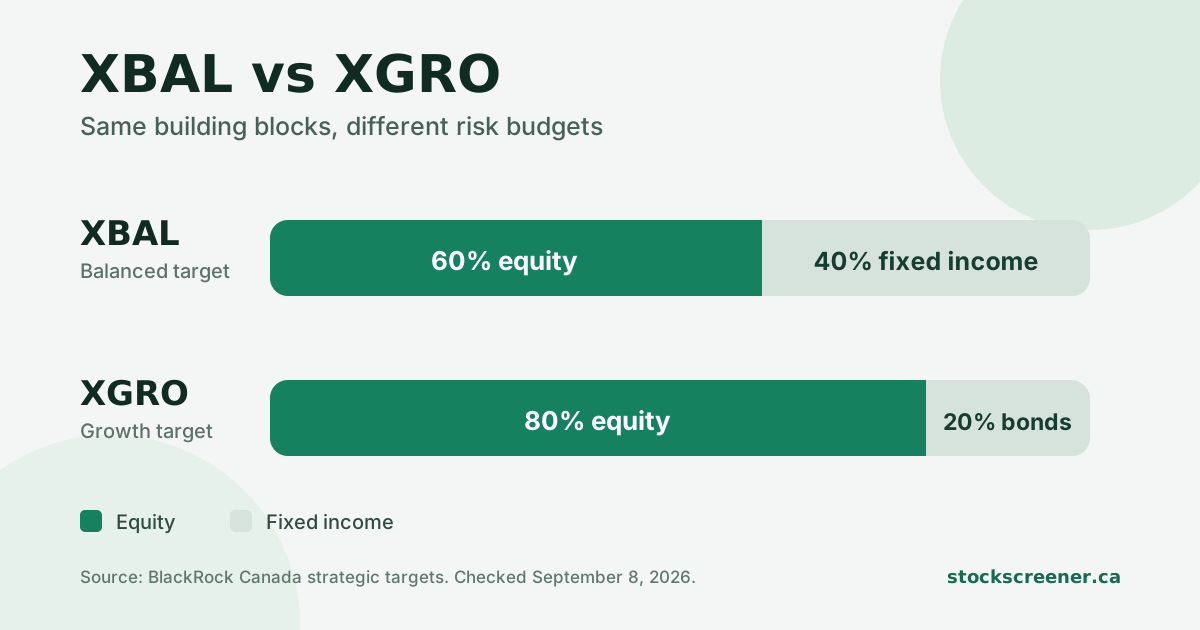
Each portfolio holds broad-market sleeves for Canadian, US, developed international, and emerging-market equities. Each also holds Canadian universe bonds, short-term Canadian corporate bonds, US Treasuries, and US investment-grade corporate bonds. BlackRock says the portfolios are monitored continuously and automatically rebalanced as needed to maintain their asset-class targets.
The July 31 holdings show how closely the regional recipes align. XBAL held 28.14% in US equity, 15.73% in Canadian equity, 16.05% in developed EAFE equity, and 2.88% in emerging markets. XGRO held 36.22%, 19.75%, 20.08%, and 4.14% in the same four sleeves. Relative to each fund's total equity, the regional proportions are very similar.
The bond side follows the same pattern. XBAL held 23.68% in Canadian universe bonds, 5.76% in short-term Canadian corporate bonds, 3.68% in US Treasuries, and 3.66% in US investment-grade corporate bonds. XGRO's corresponding weights were 12.76%, 3.00%, 1.91%, and 1.91%. Both seek to hedge foreign-currency exposure within the non-Canadian fixed-income allocation, according to their June 2026 ETF Facts.
How much more can 80/20 fall?
Stocks and bonds can both lose value, sometimes together. Bonds still have a different economic role: they provide contractual income and generally respond differently from equities to growth, inflation, and interest-rate changes. A larger bond sleeve can reduce portfolio volatility and provide assets to sell during rebalancing after stocks fall. It also reduces participation when equities rise strongly.
BlackRock's June 19, 2026 XBAL ETF Facts and XGRO ETF Facts rate both funds “low to medium” under the prescribed volatility scale. That category is broad. For the 10 years ending April 30, 2026, the documents report worst three-month returns of -10.01% for XBAL and -13.16% for XGRO, both ending March 31, 2020. Those figures are historical, are not loss limits, and include periods before the funds adopted their current fundamental objectives on December 11, 2018.
Whether that three-point historical gap repeats matters less than whether you could keep contributing, and avoid selling, if an 80% equity portfolio fell materially further than a 60% one. A plan that looks efficient in a spreadsheet fails if its owner abandons it mid-decline.
Ontario Securities Commission investor education says asset mix should reflect goals, risk tolerance, and time horizon. It also warns that a horizon can shorten unexpectedly because of job loss or an urgent expense. Emergency savings outside the portfolio can protect a long-term allocation from being liquidated at the wrong time.
A one-basis-point MER gap
BlackRock reduced each management fee from 0.18% to 0.17% effective December 18, 2025. On September 8, 2026, the issuer's XBAL product page displayed a 0.18% MER and its XGRO product page displayed 0.19%. The July factsheets still show prior reported MERs of 0.19% and 0.20%, and each retains a stale 0.18% management-fee sentence even though its fee table shows 0.17%. This article uses the later live-page figures. The current one-basis-point MER difference equals $1 per year for every $10,000 invested and is too small to justify taking an unsuitable risk level.
MER is deducted inside a fund and already reflected in reported returns, but it is not the only cost. Commissions, bid-ask spreads, recurring-purchase support, fractional shares and taxes triggered by switching can matter more. Both funds trade in Canadian dollars on the TSX, so neither trade needs a currency conversion.
Both distribute quarterly, and a bigger distribution is not extra return, because it generally lowers the fund's net asset value by the same amount. XBAL's larger bond sleeve may produce more interest income than XGRO's, but the mix of interest, Canadian dividends, foreign income, capital gains and return of capital changes each tax year, so yield is a poor tiebreaker.
The account matters less than when you need the money
TFSA and RRSP: both ETFs are listed on the Toronto Stock Exchange. CRA's qualified-investment folio says units of ETFs listed on a designated stock exchange are generally qualified investments for registered plans, and the Department of Finance lists the TSX as designated. That establishes eligibility, not suitability. A TFSA used for next year's purchase and an RRSP intended for retirement decades away may need very different allocations.
Both are Canadian-listed fund-of-funds with foreign stocks. BlackRock's December 2025 withholding-tax guide says US withholding applies inside a Canadian-listed ETF holding US stocks whether the investor's account is taxable or non-taxable, so an RRSP holding XBAL or XGRO does not get the investor-level treaty exemption available when a US-listed ETF or US stock is held directly. The foreign withholding tax guide covers the mechanism.
For an FHSA or RESP, the spending date should dominate: a home closing or education withdrawal may not be able to wait for markets to recover, and 60% equity can still be too much for a near-term, inflexible expense. The FHSA investment guide and RESP account-location guide explain how the timeline changes the decision.
In a taxable account, a larger bond allocation can mean more fully taxable interest, while Canadian eligible dividends and capital gains are treated differently; foreign taxes shown on a T3 may support a foreign tax credit, and reinvested distributions and return of capital can change adjusted cost base (see the ETF distributions and ACB guide). Weigh tax across all accounts rather than forcing a goal into the wrong risk level. Switching funds in a taxable account can also realize a capital gain or loss; registered-account trades do not trigger capital gains tax, though spreads, commissions and timing still apply.
Holding both for a 70/30 mix
Because the eight underlying ETFs are the same, a blend adds no market diversification; it simply sets a point between the two risk targets. That can be useful when 70/30 is the written policy, but it needs a maintenance rule: each ETF rebalances internally, while BlackRock does not rebalance an investor's split between XBAL and XGRO, so contributions or occasional trades must restore the weights. Holding both because the decision feels hard adds complexity without settling the plan.
Questions that settle the choice
Write down when withdrawals could begin, how flexible that date is, the loss the plan can absorb and the loss that would tempt a sale, then compare the two targets. Recent performance comes last, if at all.
- Would a 60/40 portfolio still have enough expected growth to meet the goal?
- Could the plan remain intact through a severe decline in an 80% equity portfolio?
- Is there enough emergency cash to avoid an unplanned sale?
- Does the choice fit the household's other accounts, pension assets, and debts?
- Would switching create tax and trading costs larger than the likely benefit?
A 60/40 policy maps directly onto XBAL and an 80/20 policy onto XGRO. To compare brands at the same 80/20 target, see VGRO vs XGRO.
Related reading
- ETF account-location comparison hub
- XGRO vs XEQT: 80/20 or all equity?
- VGRO vs XGRO: two 80/20 portfolios compared
- Canadian stock and ETF account-location framework
Look up XBAL or XGRO
The screener gives an educational account-location read for each fund. Confirm the latest holdings with BlackRock.
Open XBAL in the screenerFrequently asked questions
Is XBAL safer than XGRO?
XBAL has a lower strategic equity target, 60% versus XGRO's 80%, and twice the target bond weight. That should usually mean less sensitivity to stock-market declines, but it does not make XBAL safe from losses. Bonds can also fall, and BlackRock says neither ETF is guaranteed.
Do XBAL and XGRO hold different funds?
No. Both hold the same eight iShares ETFs: Canadian, US, developed international and emerging-market equity sleeves, plus Canadian universe bonds, short-term Canadian corporate bonds, US Treasuries and US investment-grade corporate bonds. Only the weights differ.
Can I get a 70/30 mix with XBAL and XGRO?
Yes. A portfolio split equally between the two would target roughly 70% equity and 30% fixed income before market movement. That can be intentional, but it adds a second position and requires the investor to maintain the chosen split.
Why does XGRO's factsheet show a different MER from its product page?
Reporting dates. The July factsheets showed prior reported MERs of 0.19% for XBAL and 0.20% for XGRO, while the live product pages on September 8, 2026 showed 0.18% and 0.19%. The factsheets also kept a stale 0.18% management-fee sentence even though their fee tables show 0.17%.
Sources
- BlackRock Canada, XBAL product page, target, rebalancing, current fees, holdings count, listing, distributions, and registered-plan eligibility checked September 8, 2026.
- BlackRock Canada, XGRO product page, target, rebalancing, current fees, holdings count, listing, distributions, and registered-plan eligibility checked September 8, 2026.
- BlackRock Canada, XBAL factsheet, portfolio holdings at July 31, 2026, and the fee-text discrepancy noted above.
- BlackRock Canada, XGRO factsheet, portfolio holdings at July 31, 2026, and the fee-text discrepancy noted above.
- BlackRock Canada, XBAL ETF Facts, June 19, 2026, objective, currency-hedging policy, risk rating, historical loss context, and fee-change warning.
- BlackRock Canada, XGRO ETF Facts, June 19, 2026, objective, currency-hedging policy, risk rating, historical loss context, and fee-change warning.
- GetSmarterAboutMoney.ca, Choosing your asset mix as an investor, Ontario Securities Commission investor education on goals, risk tolerance, time horizon, and diversification, checked September 8, 2026.
- GetSmarterAboutMoney.ca, What is an investment time horizon?, Ontario Securities Commission investor education on horizon risk and emergency savings, checked September 8, 2026.
- Canada Revenue Agency, Income Tax Folio S3-F10-C1, listed ETF units as qualified investments for registered plans.
- Department of Finance Canada, Designated Stock Exchanges, TSX designation confirmed September 8, 2026.
- BlackRock Canada, Understanding Foreign Withholding Tax, December 2025, Canadian-listed ETF treatment by exposure and account type.
- Canada Revenue Agency, Tax treatment of mutual funds, T3 income categories, foreign tax credit reporting, sale proceeds, and adjusted cost base, checked September 8, 2026.