
VCN vs XIC: fees, indexes and account fit
Answer first: VCN and XIC are close substitutes for a broad Canadian equity allocation. Both trade in Canadian dollars on the Toronto Stock Exchange, charge a 0.05% management fee, distribute quarterly, and own roughly 200 Canadian stocks. VCN reports a 0.05% management expense ratio, or MER, while XIC reports 0.06%. That one-basis-point gap is about $1 a year per $10,000 invested, assuming the rates do not change.
The real distinction is the benchmark. VCN tracks the FTSE Canada All Cap Domestic Index, which covers Canadian large-, mid- and small-cap stocks. XIC tracks the S&P/TSX Capped Composite Index, which applies a 10% limit to each constituent and covers about 95% of the Canadian equity market. Current portfolios overlap heavily, so neither ticker creates a clear TFSA-versus-RRSP advantage.
For a new contribution, brokerage features, recurring-purchase support, the live bid-ask spread, and which fund already fits the portfolio can be more useful tie-breakers than a one-basis-point MER difference. For an existing taxable holding, switching solely to save that basis point can create a capital gain or loss and more record-keeping.
VCN versus XIC at a glance
Changing figures have explicit dates. VCN portfolio data are at August 31, 2026. XIC holdings and asset data are at September 21, 2026. Fees and issuer pages were checked September 22, 2026.
| Factor | VCN | XIC | Practical read |
|---|---|---|---|
| Provider | Vanguard Canada | BlackRock iShares Canada | Different managers, similar core role |
| Benchmark | FTSE Canada All Cap Domestic Index | S&P/TSX Capped Composite Index | Broad Canadian equity through different index rules |
| Constituent rule | Large-, mid- and small-cap Canadian stocks | 10% maximum weight per constituent | The clearest structural difference |
| Management fee / MER | 0.05% / 0.05% | 0.05% / 0.06% | About $1 per $10,000 separates the reported MERs |
| Portfolio count | 212 stocks at August 31 | 217 holdings at September 21 | The count changes and is not a meaningful winner by itself |
| Fund assets | $17.75 billion, checked September 22 | $34.16 billion at September 21 | Both are large; fund size does not determine future return |
| Launch | August 2, 2013 | February 16, 2001 | XIC has the longer live history |
| Trading / distributions | TSX in CAD / quarterly | TSX in CAD / quarterly | No currency conversion is needed just to trade either fund |
The figures come from the issuers' VCN product page and XIC product page. Management fee and MER are different measures. The management fee pays the manager. MER also includes applicable operating costs and taxes and is calculated for a reporting period.
What's in this guide
| Index methodology | What the two benchmarks actually change |
| Holdings and concentration | How much overlap sits beneath the tickers |
| Fees, yield and trading | Which differences deserve weight |
| Account location | TFSA, RRSP, FHSA, RESP, and taxable accounts |
| Switching or holding both | Tax and duplication consequences |
| Decision framework | A short, evidence-based checklist |
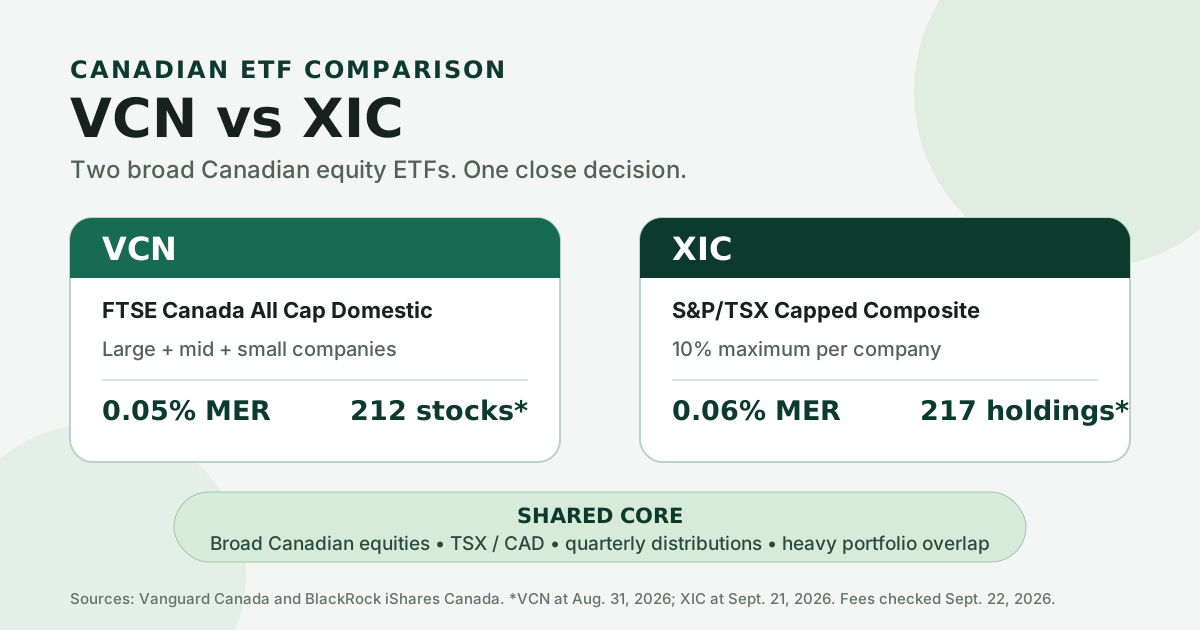
The benchmark rules are different, but the destination is close
Vanguard says VCN seeks to track the FTSE Canada All Cap Domestic Index and uses full replication where possible. Its stated universe includes large-, mid- and small-capitalization Canadian companies. FTSE Russell's global equity series defines “all cap” as those three size bands, rather than micro-cap stocks.
The FTSE benchmark also changed materially in September 2025. FTSE Russell reported that its Canada All Cap membership would expand by roughly 50 securities when Canada became a separate review region, with much of the increase coming from stocks previously classified as micro caps. This history matters because an index name is not a promise that its membership will stay fixed.
BlackRock says XIC seeks to replicate the S&P/TSX Capped Composite Index. S&P Dow Jones Indices says the parent S&P/TSX Composite covers about 95% of the Canadian equity market, while the capped version limits each constituent to 10%. The cap becomes most relevant if one company grows past that threshold. Current top weights are below it, so the rule is a guardrail rather than a large active bet today.
Different index providers also set their own eligibility, liquidity, size, rebalancing, and corporate-action rules. Those details can produce small differences in additions, deletions, and weights. They do not change the larger fact that both ETFs are concentrated in one national market. A broad Canadian ETF is diversified across many companies, but it is not a complete global equity portfolio.
The current portfolios overlap where it matters most
Vanguard reported 212 stocks for VCN at August 31, 2026. BlackRock reported 217 holdings for XIC at September 21. A five-position difference across different as-of dates does not establish that one fund is materially more diversified. Small positions contribute little to portfolio behaviour, and the counts can change after index reviews or corporate events.
The top holdings show the overlap. At August 31, VCN's ten largest positions were Royal Bank, TD Bank, Shopify, Bank of Montreal, Scotiabank, Enbridge, CIBC, Agnico Eagle, Canadian Natural Resources, and Brookfield. BlackRock's July 31 factsheet listed nine of those same names in XIC's top ten, with Suncor replacing Agnico Eagle. The respective snapshots placed about 38% of each fund in its ten largest holdings.
That concentration is mostly a feature of the Canadian market, not a special flaw in either product. Financials, energy, and materials occupy large roles, while sectors such as health care have much smaller representation than in a global portfolio. Splitting a Canadian equity allocation between VCN and XIC does not diversify away that country and sector structure because the same large companies drive both.
Recent performance is a poor tie-breaker. A difference over one month or one year can come from small weight changes around the same holdings. Choosing the recent leader assumes those relative moves will persist, which the benchmark documents do not promise.
The fee gap is real, but small
Both issuers publish a 0.05% management fee. VCN also reports a 0.05% MER, while XIC reports 0.06%. Applied mechanically, that is $5 versus $6 a year per $10,000 invested. The difference compounds, but fees can change and a one-time commission, spread, or tax cost can outweigh several years of a one-dollar annual gap.
XIC is older and larger. BlackRock reported $34.16 billion of net assets on September 21, while Vanguard showed $17.75 billion for VCN when checked September 22. Those figures can support confidence that both products are established. They do not prove that XIC will earn more or that every trade will receive a better price. The relevant trading cost is the live bid-ask spread and order execution at the time of a transaction.
Both funds distribute quarterly, and each issuer reported a 1.96% 12-month trailing yield on its latest available date. That coincidence should not drive the decision. Yield changes with distributions and price, and it is not total return. A distribution can also contain more than Canadian dividends.
In a taxable account, CRA says mutual fund trust distributions can include Canadian dividends, capital gains, other income, foreign income, and return of capital. The annual T3 slip and the issuer's tax breakdown determine the character. Return of capital reduces adjusted cost base, while reinvested taxable distributions can increase it. The cash amount alone does not settle the tax calculation.
VCN vs XIC in a TFSA, RRSP, FHSA, RESP, or taxable account
Eligibility: both ETFs trade on the TSX. CRA's qualified-investment folio says ETF units listed on a designated stock exchange are generally qualified investments for registered plans, and Finance Canada lists the TSX as designated. This supports general eligibility for TFSAs, RRSPs, FHSAs, RESPs, RRIFs, and RDSPs. Eligibility is not the same as suitability.
TFSA: CRA says interest, dividends, and capital gains earned in a TFSA are generally tax-free. That treatment does not make one of these two Canadian-listed funds the clear winner. The better question is whether a 100% Canadian equity holding fits the investor's time horizon and total country allocation.
RRSP: investment income is generally exempt from tax while it remains in an RRSP, and withdrawals are generally taxable. Again, the account does not make one benchmark superior. A choice between VCN and XIC is mainly a choice of provider and index rules.
FHSA and RESP: both are equities and can fall sharply. A down payment or education bill can arrive on a fixed date. Account eligibility does not make either fund appropriate for money that cannot withstand a market decline before withdrawal. The site's FHSA investment guide and RESP account-location guide cover the timeline problem.
Taxable account: Canadian dividends distributed and designated by the fund may qualify for the dividend tax credit. CRA says foreign dividends do not. Capital-gain distributions, return of capital, and a gain or loss on sale follow different rules. Use the T3 slip, issuer tax factors, and an adjusted-cost-base ledger. The ETF distributions and ACB guide explains the record-keeping.
Switching or holding both rarely changes the portfolio much
Moving from XIC to VCN to save one basis point, or the reverse because of a recent return difference, needs a realistic hurdle. In a taxable account, selling can realize a capital gain or loss. In any account, the trade can involve a spread, commission, time out of the market, or loss of an established automated purchase plan.
Holding both is possible, but it mostly blends two methods of owning the same Canadian market. It does not add meaningful geographic diversification. It also creates another position to monitor and a decision about how to direct new contributions.
If the actual objective is broader diversification, compare Canadian equity with the rest of the portfolio. The sibling VUN vs VFV comparison examines total US market versus US large caps, while XEQT vs VFV contrasts a global equity portfolio with the S&P 500. Those are larger exposure decisions than choosing between VCN and XIC.
A practical VCN vs XIC decision framework
Start with the portfolio role. If a broad Canadian equity sleeve is intentional, both funds are credible implementations. Then use a short checklist:
- Choose the benchmark rule deliberately. VCN follows FTSE's all-cap domestic construction. XIC follows the S&P/TSX Composite with a 10% constituent cap.
- Keep the fee difference in proportion. The current reported MER gap is about $1 per $10,000 each year.
- Check the brokerage workflow. Recurring buys, fractional units, dividend reinvestment, commission policy, and the live spread can affect implementation.
- Respect taxes before switching. A taxable disposition can matter far more than the annual fee gap.
- Review the total allocation. Neither fund supplies material exposure outside Canada.
The broader ETF account-location comparison hub connects listings, wrappers, withholding tax, and account choice. For VCN versus XIC, the restrained conclusion is the useful one: the products are similar enough that consistency and portfolio design usually matter more than declaring a universal winner.
Related reading
- ETF account-location comparison hub
- VUN vs VFV: total US market or S&P 500?
- VEQT vs XEQT: fees, allocation and account location
- Eligible dividends and the Canadian dividend tax credit
- Canadian stock and ETF account-location framework
Check each ticker in context
Use the free screener for an educational account-location overview, then verify the latest holdings and documents with each issuer.
Open VCN in the screenerFrequently asked questions
What is the main difference between VCN and XIC?
VCN tracks the FTSE Canada All Cap Domestic Index, while XIC tracks the S&P/TSX Capped Composite Index. XIC's benchmark applies a 10% cap to each constituent. Both provide broad Canadian equity exposure and currently hold similar portfolios.
Is VCN cheaper than XIC?
Both issuers publish a 0.05% management fee. Vanguard reports a 0.05% MER for VCN and BlackRock reports a 0.06% MER for XIC. A one-basis-point difference equals about $1 a year per $10,000 invested, before compounding and assuming the rates remain unchanged.
Is VCN or XIC better for a TFSA or RRSP?
The account label does not create a clear winner. Both are Canadian-listed ETFs holding Canadian equities, both trade in Canadian dollars on the TSX, and both are generally eligible for registered plans. Portfolio role, trading access, and the complete allocation are more useful tie-breakers.
Does holding both VCN and XIC improve diversification?
Usually very little. Their top holdings and broad Canadian market exposure overlap heavily. Holding both mainly splits one Canadian equity allocation between two providers and benchmark methodologies.
Sources
- Vanguard Canada, VCN product page, objective, benchmark, fees, assets, holdings, prices, yield, and distributions; portfolio data as at August 31, 2026, checked September 22, 2026.
- BlackRock iShares Canada, XIC product page, objective, benchmark, fees, assets, holdings, yield, listing, and distributions; checked September 22, 2026.
- BlackRock iShares Canada, XIC factsheet, July 2026, portfolio data as at July 31, 2026.
- S&P Dow Jones Indices, S&P/TSX Capped Composite, market coverage and 10% constituent cap; checked September 22, 2026.
- FTSE Russell, FTSE Global Equity Index Series Ground Rules, version 14.3, August 2026, size bands and methodology.
- FTSE Russell, Why we are separating Canada from the US within our global equity framework, September 2025 Canada All Cap review changes.
- Canada Revenue Agency, Tax treatment of mutual funds, distribution types, return of capital, adjusted cost base, and dispositions; checked September 22, 2026.
- Canada Revenue Agency, Federal dividend tax credit, Canadian and foreign dividend treatment; checked September 22, 2026.
- Canada Revenue Agency, What is a TFSA, ETF holdings and general tax treatment; checked September 22, 2026.
- Canada Revenue Agency, Registered Retirement Savings Plan, tax deferral while income remains in an RRSP and general withdrawal taxation; checked September 22, 2026.
- Canada Revenue Agency, Income Tax Folio S3-F10-C1, listed ETF units as qualified investments for registered plans.
- Department of Finance Canada, Designated Stock Exchanges, TSX designation; checked September 22, 2026.