
Canadian equivalent of VOO: VFV, XUS and ZSP, plus the hedged versions
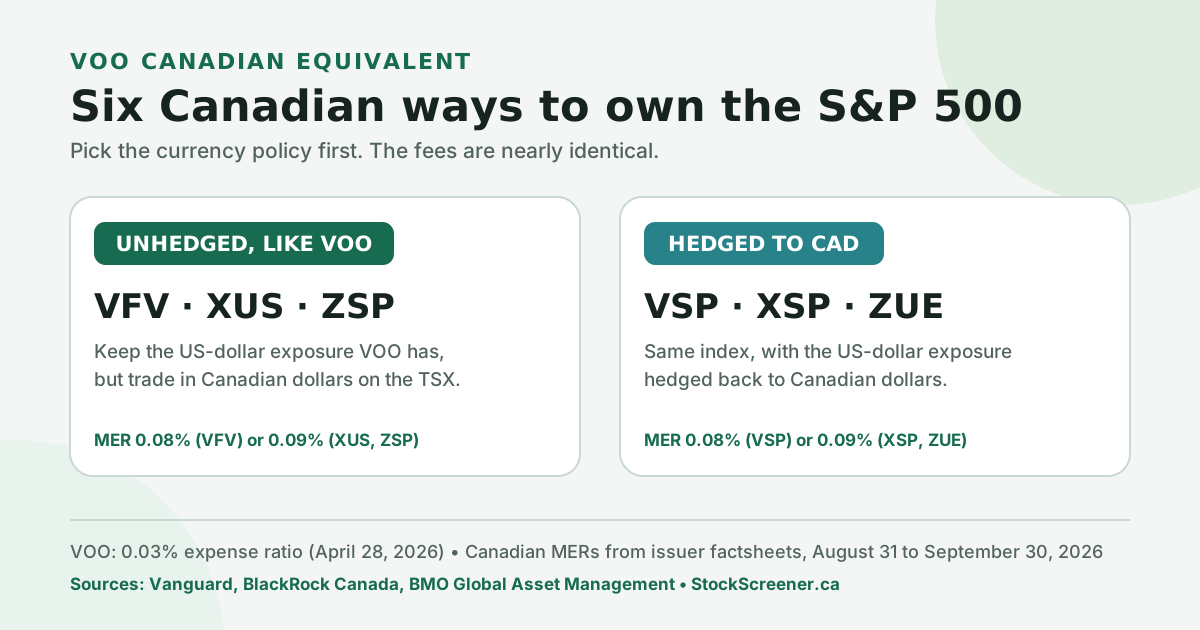
VFV, XUS and ZSP are the closest Canadian-listed equivalents of VOO. All three track the S&P 500, trade in Canadian dollars on the Toronto Stock Exchange, and leave the US-dollar exposure unhedged, just as VOO does for a Canadian investor. VSP, XSP and ZUE track the same index but hedge the US dollar back to the Canadian dollar, so they are a different currency decision rather than a closer copy.
The published costs are close. The six Canadian funds report MERs of 0.08% or 0.09%, against VOO's 0.03% expense ratio. That gap is about $5 to $6 a year on $10,000, which a single currency conversion to buy VOO can easily exceed. The account matters more than the ticker: only VOO held directly in an RRSP or RRIF avoids US withholding tax on its dividends.
Jump to: all seven funds · VFV, XUS and ZSP · the hedged versions · withholding by account · when VOO itself fits · FAQ
VOO and its six Canadian-listed counterparts
Information checked October 14, 2026. BMO and iShares figures come from factsheets dated September 30, 2026. Vanguard Canada figures come from August 31, 2026 factsheets, with MERs as of June 30, 2026. VOO's expense ratio is from its April 28, 2026 summary prospectus and its net assets from its June 30, 2026 factsheet. Net assets are rounded.
| Fund | Issuer | Currency policy | How it holds the S&P 500 | Management fee / MER | Distributions | Net assets |
|---|---|---|---|---|---|---|
| VOO | Vanguard (US) | Unhedged, trades in USD | Holds the index stocks | 0.03% expense ratio | Quarterly, in USD | US$979.0 billion (ETF share class) |
| VFV | Vanguard Canada | Unhedged | Primarily holds VOO | 0.08% / 0.08% | Quarterly | C$35.2 billion |
| XUS | iShares (BlackRock Canada) | Unhedged | Holds the US-listed iShares Core S&P 500 ETF (99.94%) | 0.08% / 0.09% | Semi-annual | C$13.7 billion |
| ZSP | BMO | Unhedged | Holds the index stocks directly | 0.08% / 0.09% | Quarterly | C$25.6 billion |
| VSP | Vanguard Canada | Hedged to CAD | Underlying Vanguard fund plus currency derivatives | 0.08% / 0.08% | Quarterly | C$6.3 billion |
| XSP | iShares (BlackRock Canada) | Hedged to CAD | One underlying fund plus currency hedging | 0.08% / 0.09% | Semi-annual | C$16.3 billion |
| ZUE | BMO | Hedged to CAD | Fund of funds plus currency hedging | 0.08% / 0.09% | Quarterly | C$4.9 billion |
BMO and BlackRock list ZSP, ZUE, XUS and XSP as eligible for registered plans such as the RRSP and TFSA. All seven funds follow the same 500-company index, so their stock holdings are effectively the same. The decisions that remain are currency policy, structure, distribution timing, and which account the fund sits in.
VFV, XUS and ZSP: the unhedged equivalents
If you want what VOO gives a Canadian investor, meaning S&P 500 exposure whose value also moves with the US dollar, these three are the match. None of them hedges currency. When the US dollar rises against the Canadian dollar, all three tend to gain from it, and when it falls they lose from it, exactly as VOO does once you measure it in Canadian dollars.
What separates them is small and mostly structural:
- VFV is Vanguard Canada's fund and primarily holds VOO itself, so it is the most literal Canadian wrapper around VOO. Its MER is 0.08%, the lowest of the three, and it pays quarterly.
- XUS holds BlackRock's US-listed iShares Core S&P 500 ETF, which made up 99.94% of the fund on September 30, 2026. Its MER is 0.09% and it distributes semi-annually rather than quarterly.
- ZSP holds the S&P 500 stocks directly instead of owning a US ETF. BMO reports a 0.09% MER and quarterly distributions.
The 0.01-point MER difference works out to about $1 a year on $10,000, so distribution schedule, personal preference and which fund a broker offers commission-free usually decide among the three. The ZSP vs VFV comparison looks at that pairing in detail, and the VFV vs VOO guide compares the Canadian wrapper with VOO itself.
One neighbour is often mistaken for an equivalent: VUN tracks the whole US market, including mid and small companies, not just the S&P 500. The VUN vs VFV guide covers that broader-market choice.
VSP, XSP and ZUE: the CAD-hedged versions
The hedged funds own the same S&P 500 companies, then use currency derivatives to offset most of the effect of the US dollar moving against the Canadian dollar. Vanguard describes VSP as using derivative instruments to seek to hedge the US-dollar exposure of the index's securities back to the Canadian dollar. BlackRock's XSP and BMO's ZUE follow the S&P 500 Hedged to Canadian Dollars Index.
So they are a different investment experience from VOO, not a more accurate copy. A hedged fund's return tracks the S&P 500's return in its local currency more closely, while an unhedged fund's Canadian-dollar return also includes the exchange-rate move, and neither wins in every period. Hedging adds implementation costs and can lag its index slightly, although the published MERs are no higher: VSP reports 0.08% and XSP and ZUE report 0.09%.
For "the Canadian version of VOO," the unhedged funds are the match. For S&P 500 stocks without the currency swing, the hedged funds are the tool. The VFV vs VSP guide walks through that currency decision with Vanguard's two funds.
Does the structure change withholding tax?
No. It is tempting to assume ZSP, which holds US stocks directly, avoids a layer of tax that VFV and XUS pay by holding a US ETF. BlackRock Canada's withholding-tax guide says otherwise: all Canadian-listed ETFs seeking US stock exposure face the same level of US withholding, whether they hold US stocks directly or through a US or Canadian ETF. The usual rate is 15% of US dividends under the Canada-US tax treaty.
| Account | Any Canadian-listed equivalent (VFV, XUS, ZSP, VSP, XSP, ZUE) | VOO held directly |
|---|---|---|
| RRSP or RRIF | Withholding applies and is a net cost | Generally exempt under the treaty |
| TFSA, FHSA or RESP | Withholding applies and is a net cost | Withholding applies and is a net cost |
| Taxable account | Withholding applies but is generally creditable | Withholding applies but is generally creditable |
In a TFSA, FHSA or RESP, then, no S&P 500 route avoids US withholding, and VOO's only edges are its lower fee and any benefit from US dollars you already hold. In a taxable account, the foreign tax credit generally offsets withholding for all of them. The RRSP and RRIF are the only accounts where structure produces a real tax difference, and it favours VOO held directly. The foreign withholding tax guide explains the mechanics.
To size it: 15% withholding on a yield of about 1.1%, close to the 1.10% 12-month trailing yield BlackRock reported for XUS on September 30, 2026, is roughly 0.17% of the position a year. That is an illustration, not a forecast, since yields change.
When VOO itself can make sense
Holding VOO directly is mainly an RRSP or RRIF question. The treaty relief is worth something there, but only after accounting for the cost of turning Canadian dollars into US dollars. Conversions usually carry a spread, and a 1% conversion cost, for example, would take several years of a roughly 0.17% annual withholding saving to recover. Investors who convert large amounts sometimes use Norbert's Gambit to reduce that cost, at the price of more steps.
Outside registered plans, VOO brings two administrative items that Canadian-listed funds avoid:
- Foreign property reporting. CRA's Form T1135 applies when the total cost of specified foreign property, which includes shares of non-resident corporations held outside registered plans, exceeds C$100,000 at any time in the year. CRA's guidance does not treat units of Canadian-resident mutual fund trusts as specified foreign property, and property held in registered plans is excluded.
- US estate tax exposure. The IRS says the estate of a non-US citizen who was not a US resident must file a US estate tax return if US-situated assets exceed US$60,000. US-listed securities can count toward that figure. The Canada-US treaty provides relief that depends on the estate's size, so larger holders may want professional advice.
The Canadian-listed versus US-listed ETF guide covers these trade-offs across more funds, and the XEQT vs VOO comparison looks at VOO against a global all-equity fund.
Related reading and ticker pages
- VFV vs VOO: which account for Canadian investors?
- ZSP vs VFV compared
- VFV vs VSP: unhedged or CAD-hedged S&P 500?
- Ticker pages: VOO, VFV, ZSP, XSP
Frequently asked questions
What is the Canadian equivalent of VOO?
VFV, XUS and ZSP are the closest. Each tracks the S&P 500, trades in Canadian dollars on the TSX, and leaves the US-dollar exposure unhedged like VOO. VFV primarily holds VOO itself.
Is VFV the same as VOO?
Not quite. VFV is a Canadian fund that primarily holds VOO, so the underlying portfolio is effectively the same, but VFV trades in Canadian dollars, reports a 0.08% MER against VOO's 0.03% expense ratio, and cannot use the treaty exemption on US dividends in an RRSP.
Is XSP a Canadian equivalent of VOO?
It tracks the same index but hedges the US dollar back to the Canadian dollar. Its returns will differ from VOO's whenever the exchange rate moves, so it is better described as the hedged alternative.
Do VFV, XUS and ZSP pay distributions on the same schedule?
No. VFV and ZSP distribute quarterly, while XUS distributes semi-annually. The amounts flow from the same S&P 500 dividends, so the schedule matters mainly for cash-flow timing and reinvestment.
Which VOO equivalent suits a TFSA?
There is no withholding-tax winner in a TFSA: US withholding is a net cost for VOO and for every Canadian-listed equivalent. The comparison comes down to fees, currency policy, and whether you want to convert to US dollars at all.
Sources
- Vanguard Canada, VFV factsheet, August 31, 2026: management fee, MER as of June 30, 2026, distributions, and net assets.
- Vanguard Canada, VSP factsheet, August 31, 2026: hedging approach, management fee, MER, distributions, and net assets.
- BMO Global Asset Management, ZSP factsheet, September 30, 2026: direct holdings, fee, MER, distributions, and net assets.
- BMO Global Asset Management, ZUE factsheet, September 30, 2026: hedged index, fund-of-funds structure, fee, MER, and net assets.
- BlackRock Canada, XUS factsheet, September 30, 2026: underlying holding, fee, MER, registered-plan eligibility, distribution frequency, trailing yield, and net assets.
- BlackRock Canada, XSP factsheet, September 30, 2026: hedged index, fee, MER, distribution frequency, and net assets.
- Vanguard, VOO factsheet, June 30, 2026: benchmark and ETF share-class net assets.
- US Securities and Exchange Commission, VOO summary prospectus, April 28, 2026: 0.03% total annual fund operating expenses.
- BlackRock Canada, Understanding Foreign Withholding Tax, December 2025: withholding treatment by fund structure and account type.
- Department of Finance Canada, Canada-US Tax Convention: dividend withholding rate, the retirement-arrangement exemption, and estate-tax relief.
- Canada Revenue Agency, Form T1135 questions and answers: the C$100,000 cost threshold and what counts as specified foreign property.
- Internal Revenue Service, estate-tax FAQ for nonresidents who are not US citizens: US-situated property and the US$60,000 filing threshold.