
VFV vs VOO: which one fits an RRSP, and which a TFSA?
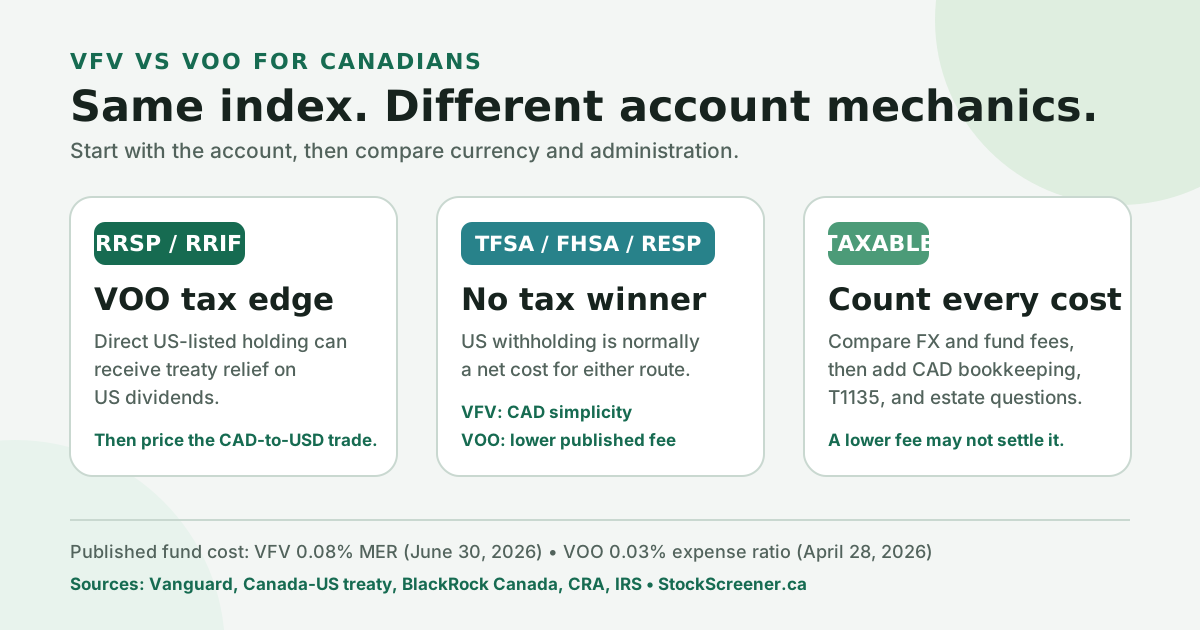
In an RRSP or RRIF, VOO held directly can avoid the US dividend withholding that VFV cannot. In a TFSA, FHSA, RESP or taxable account, VOO has no withholding advantage, and the choice comes down to VFV's Canadian-dollar convenience against VOO's lower published fee. Both lead to nearly the same unhedged S&P 500 portfolio.
Outside the RRSP, the 0.05-percentage-point fee gap has to be weighed against currency conversion, commissions, bid-ask spreads, recordkeeping, and the size and frequency of trades. A recurring 1% foreign-exchange cost would overwhelm years of a 0.05-point annual fund-cost difference.
Which account suits VFV, and which suits VOO?
| Account | VFV | VOO held directly | Useful conclusion |
|---|---|---|---|
| RRSP / RRIF | US withholding applies inside the fund and is a net cost | Generally exempt under the treaty | VOO can have a withholding advantage |
| TFSA | US withholding applies inside the fund and is a net cost | US withholding applies and is a net cost | No withholding winner |
| FHSA / RESP | US withholding applies inside the fund and is a net cost | US withholding generally applies and is a net cost | No direct retirement-plan exemption |
| Taxable | US withholding applies; foreign tax may be reported for credit | US withholding applies; foreign tax may be creditable | Compare implementation and reporting |
RRSP and RRIF, where VOO has the edge: Article XXI of the Canada-US treaty exempts qualifying dividend income earned by an arrangement operated exclusively to provide pension or retirement benefits. BlackRock's reference table treats US stocks and US-listed ETFs held directly in RRSPs and RRIFs as exempt. VFV cannot pass that benefit through, because the US payment goes from VOO to the Canadian fund, not from VOO to the investor's retirement plan.
TFSA, FHSA and RESP, where neither does: these accounts do not receive the same treaty treatment. CRA also says foreign taxes paid on TFSA or RRSP income are excluded from an individual's foreign tax credit calculation, and the same approach may apply to other registered plans. Withholding is normally a small, unrecoverable cost for either route, so VFV's CAD trading and VOO's lower fee are what remain to compare.
Taxable account: BlackRock says US withholding on both Canadian and US-listed ETFs is generally creditable, subject to Canadian rules and the actual tax slip. VOO adds foreign-currency bookkeeping, because income, adjusted cost base, proceeds and gains must be reported in Canadian dollars, and it raises the reporting and estate questions covered further down.
VFV and VOO side by side
Information checked October 14, 2026. VFV fund figures use Vanguard Canada data through September 30 and its August 31 factsheet. VFV's MER is dated June 30, 2026. VOO's expense ratio is dated April 28, 2026, and its latest available factsheet is dated June 30. Fees, holdings, prices, tax rules, and broker practices can change.
| Factor | VFV | VOO | Practical read |
|---|---|---|---|
| Listing | Toronto Stock Exchange | NYSE Arca | Canadian versus US-listed wrapper |
| Trading currency | Canadian dollars | US dollars | VOO requires USD cash or conversion |
| Underlying structure | Primarily holds VOO | Holds S&P 500 stocks through full replication | Nearly the same core exposure |
| Published fund cost | 0.08% management fee and 0.08% MER | 0.03% expense ratio | $5 annual difference per $10,000 if values and rates stayed constant |
| Currency hedge | None | None to CAD | Both retain USD economic exposure |
| Distributions | Quarterly in CAD | Quarterly in USD | Payment currency differs |
| Direct RRSP treaty relief | No, withholding can occur inside the Canadian fund | Generally available when held directly | VOO's clearest account-specific advantage |
| T1135 in taxable account | Not specified foreign property | Specified foreign property | Aggregate cost threshold and exclusions matter |
The fee labels come from different regulatory systems, so MER and expense ratio are not perfectly identical terms. They are the issuers' main published annual fund-cost measures. Neither includes the investor's currency conversion, commission, spread, or tax.
VFV owns VOO, and VOO owns the stocks
Vanguard Canada says VFV invests primarily in the US-domiciled Vanguard S&P 500 ETF. Its August 31 factsheet says the displayed portfolio information belongs to that underlying US fund. Vanguard's VOO factsheet says VOO uses a full-replication strategy, which means it holds the S&P 500 companies rather than another S&P 500 ETF.
So VFV does not currently hold each S&P 500 stock directly. A VFV investor owns units of a Canadian fund, that fund owns VOO, and VOO owns the stocks; a VOO investor owns the US ETF directly. The extra legal wrapper affects fees, withholding, reporting and estate administration, even though the market exposure is almost the same.
Both funds are unhedged for a Canadian investor. Buying VFV in Canadian dollars does not remove the Canadian-dollar value change caused by USD/CAD movements. The VFV versus VSP comparison covers the separate choice between unhedged and CAD-hedged S&P 500 exposure.
One US withholding layer, not two
Tax references talk about "level one" and "level two" withholding, which is easy to misread as two simultaneous taxes. Level one is tax between a portfolio security and an underlying fund; level two is tax between an underlying fund and the Canadian fund that owns it.
For VFV's US-stock exposure, the US companies pay dividends to VOO, another US entity, so there is no foreign withholding at that first step. When VOO pays a distribution to Canadian VFV, US withholding can apply at the second step. If a Canadian ETF held the US stocks directly, withholding would instead occur at the first step. BlackRock Canada's guide says Canadian-listed ETFs with US stock exposure bear the same single level whether they hold US stocks directly or through a US ETF.
The normal treaty rate for a Canadian resident is generally 15% of the US dividend, not 15% of the whole investment. If the portfolio yield were 1%, a 15% tax on that dividend would equal about 0.15% of the position. That is arithmetic for scale, not a current yield estimate or promised drag.
A 0.05-point fee gap against the cost of converting currency
VFV lets a Canadian investor contribute, trade, receive distributions, and withdraw in Canadian dollars. VOO trades and distributes in US dollars. A broker may charge a visible conversion fee, embed a spread in its exchange rate, or offer a USD side of the account. Those details can matter more than the published fund-fee gap, especially for small or frequent contributions.
On $10,000, the difference between 0.08% and 0.03% is about $5 for one year if the balance and ratios stayed fixed. A hypothetical 1% one-way conversion would be $100 before commission or spread. The fee saving can take many years to recover if currency is converted in and later converted back. Existing USD income or a low-cost conversion process changes the calculation.
Norbert's Gambit at Questrade is one way to convert larger amounts by buying a dual-currency security, journalling it between currency sides, and selling it. It is not free or instant. Commissions, bid-ask spreads, price movement, settlement, journalling time, and broker-specific procedures remain. The site's broader Norbert's Gambit guide explains the mechanics.
Taxable accounts: VOO brings T1135 and US estate questions
T1135: CRA says shares of non-resident corporations and interests in non-resident mutual funds are specified foreign property even when held through a Canadian broker. If the total cost amount of all specified foreign property exceeds C$100,000 at any time in the year, Form T1135 may be required. The threshold uses aggregate cost, not market value and not VOO alone. CRA says an investment in a Canadian mutual fund is not specified foreign property, so VFV does not create the same filing issue.
US estate administration: VOO is a US-domiciled ETF. The IRS says stock of US corporations is US-situated property for a nonresident who is not a US citizen, and an executor generally faces the Form 706-NA threshold when US-situated assets plus adjusted taxable gifts exceed US$60,000. That filing threshold is not an automatic tax bill.
The Canada-US treaty can provide a pro-rated unified credit linked to the credit available to a US citizen's estate. The 2026 US basic exclusion amount behind that domestic credit is US$15 million, but a Canadian estate does not simply receive a flat US$15 million exemption. Treaty calculations depend on the value of the worldwide estate, US assets, citizenship, domicile, gifts, spouse, and other facts. VFV investors own the Canadian fund rather than VOO directly, so VFV generally avoids the same direct US-situs security issue. Cross-border estates need specialist advice rather than a ticker rule.
Before you choose, or switch
- Is the S&P 500 the right exposure? If the real question is the S&P 500 against the whole US market, the VUN versus VFV comparison covers it; for US large caps against global diversification, see the XEQT versus VFV guide.
- Which account? Direct VOO has its clearest structural edge in an RRSP or RRIF. The treaty does not create the same edge in a TFSA, FHSA, RESP, or taxable account.
- What does implementation cost? Price your broker's two-way currency cost, commissions, spread, USD account fees and how often you contribute, then compare those dollars with the fee and withholding differences.
- How much administration? Taxable VOO can bring CAD bookkeeping, possible T1135 reporting and US estate questions. VFV's Canadian wrapper simplifies those points but does not hedge currency or remove withholding.
- Would switching trigger tax? Selling an existing position may realize a capital gain or loss, and a lower ongoing cost does not automatically justify an immediate taxable transaction.
In short, VFV trades convenience in Canadian dollars and simpler Canadian administration for a slightly higher fee; VOO offers the lowest published fund cost and direct-US treatment that pays off mainly inside an RRSP or RRIF. The ETF account-location comparison hub sets both beside XEQT and QQQ when the question is broader than the wrapper.
More S&P 500 and US-equity comparisons
- XEQT vs VOO, QQQ and VFV account-location hub
- VOO Canadian equivalent: VFV, XUS, ZSP and the hedged versions
- VFV vs VSP: unhedged or CAD-hedged S&P 500?
- VUN vs VFV: total US market or S&P 500?
- XEQT vs VFV: global equity or US large caps?
- Foreign withholding tax by Canadian account
- Canadian-listed vs US-listed ETFs
See VFV's account-location read
The screener gives an educational TFSA, RRSP and taxable signal for VFV or VOO. Broker currency costs and current issuer documents still need checking.
Search VFV in the screenerFrequently asked questions
Is VFV or VOO better for a Canadian RRSP?
VOO held directly in an RRSP or RRIF can receive the Canada-US treaty exemption on US dividends when the intermediary applies it. VFV is a Canadian fund that holds VOO, so withholding can remain inside VFV. The potential tax saving must be weighed against currency conversion, trading costs, contribution size, and simplicity.
Is VFV or VOO better in a TFSA?
Neither has a US dividend-withholding advantage in a TFSA. US withholding generally applies to VOO directly and inside VFV, and it is normally a net cost in the account. VFV avoids converting Canadian dollars for the trade, while VOO requires US-dollar trading.
Does VFV hold VOO or the S&P 500 stocks directly?
Vanguard Canada says VFV invests primarily in the US-domiciled Vanguard S&P 500 ETF, which is VOO. VOO uses full replication and holds the index stocks. VFV therefore provides the same core exposure through a Canadian fund wrapper.
Does holding VOO require Form T1135?
VOO in a taxable account is specified foreign property. Form T1135 may be required when the total cost amount of all specified foreign property exceeds C$100,000 at any time in the year. VFV, as an investment in a Canadian mutual fund, is not specified foreign property. Registered-plan holdings are outside this taxable-account comparison.
How much does VOO's lower fee save on $10,000?
About $5 a year: the difference between VFV's 0.08% MER and VOO's 0.03% expense ratio, if the balance and ratios stayed fixed. A hypothetical 1% one-way currency conversion on the same $10,000 would cost $100, so the saving can take many years to recover if dollars are converted in and later back.
Sources
- Vanguard Canada, VFV product page, structure, objective, fee, MER, assets, distribution schedule, benchmark, and portfolio data checked October 14, 2026.
- Vanguard Canada, VFV factsheet, August 31, 2026, including structure, fee, MER date, eligibility, exchange, currency, and benchmark withholding convention.
- Vanguard, VOO factsheet, June 30, 2026, including full replication, exchange, expense ratio, holdings, and distribution schedule.
- US Securities and Exchange Commission, VOO summary prospectus, April 28, 2026, including the 0.03% total annual fund operating expense.
- BlackRock Canada, Understanding Foreign Withholding Tax, December 2025, treatment by fund structure and account type.
- Department of Finance Canada, Canada-US Tax Convention, Article XXI pension and retirement arrangement exemption and Article XXIX B death-tax provisions.
- Canada Revenue Agency, Income Tax Folio S5-F2-C1, foreign tax credit treatment for TFSA, RRSP, and other registered-plan income.
- Canada Revenue Agency, Form T1135 questions and answers, cost threshold, non-resident shares, registered-plan exclusions, and Canadian mutual funds.
- Internal Revenue Service, estate-tax FAQ for nonresidents who are not US citizens, US-situated property and the US$60,000 filing threshold.
- Internal Revenue Service, 2026 estate and gift tax changes, US$15 million 2026 basic exclusion amount.